Salary by Education Level in the United States
In the U.S., the connection between education and income is stark, with higher education leading to higher median earnings consistently.
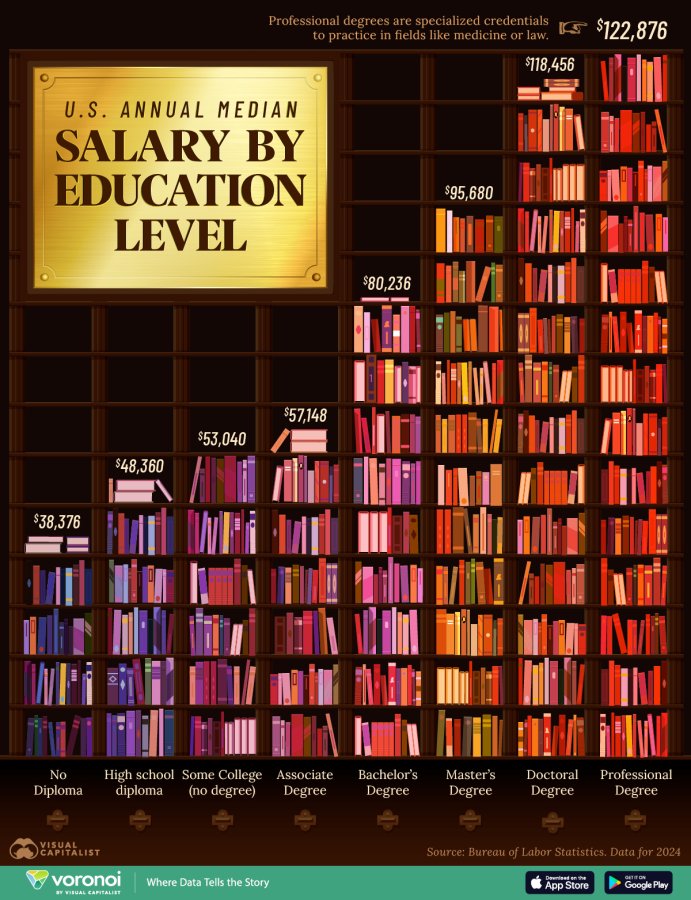
This visualization highlights how median annual salaries change at each successive level of educational attainment in the United States, using data from the Bureau of Labor Statistics for 2024.
Earnings by Education Level in the U.S. in 2024
Annual median earnings vary significantly across education levels in the U.S., ranging from a median of just $38,376 for those with no high school education to a high of $122,876 for professional degree holders.
The data table below has the annual median salary by education level in the United States for 2024:
| Education level | Annual median earnings |
|---|---|
| Professional degree | $122,876 |
| Doctoral degree | $118,456 |
| Master's degree | $95,680 |
| Bachelor's degree | $80,236 |
| Associate's degree | $57,148 |
| Some college (no degree) | $53,040 |
| High school diploma | $48,360 |
| Less than a high school diploma | $38,376 |
Doctoral degree holders in the U.S. earn an annual median of $118,456, and have one of the largest salary differences the previous level of education, earning $22,776 more than masters degree holders (who earn an annual median of $95,680).
The earnings increase of getting a master’s degree after a bachelor’s isn’t as large of a gap at $15,444, due to the relatively high median salary of $80,236 for bachelor’s degree holders.
The Bachelor’s Degree Salary Premium
The most pronounced gap appears between associate and bachelor’s degree holders. Earning a bachelor’s degree adds $23,088 to the median salary compared to an associate degree. That’s a 40% increase over associate degree holders’ annual median salary of $57,148.
This underscores the financial advantage of completing a four-year college program, even if graduate study is not pursued.
While not as large of a dollar increase, earning a high school diploma is also quite valuable, adding $9,984 to annual median earnings.
This ends up being a 26% salary increase over the $38,376 median for those with no high school diploma, and is the second-largest salary increase between education levels after that of the bachelor’s degree.
It’s worth keeping in mind that along with boosting earning power, each level of education also likely improves job stability and long-term career growth.