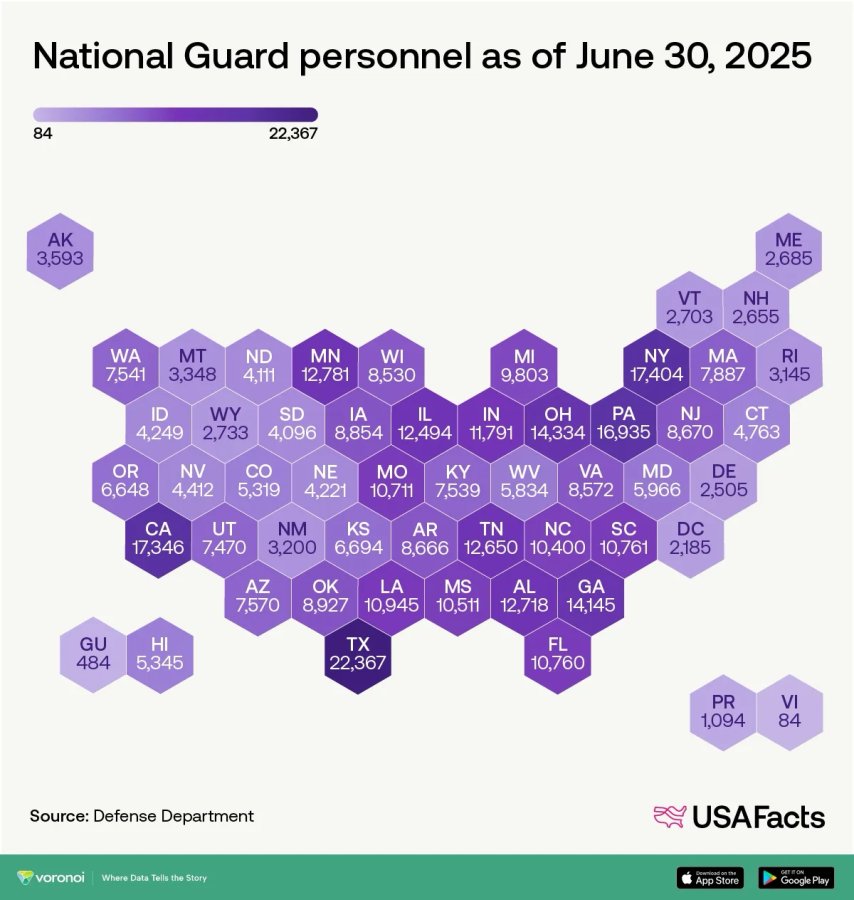
Mapped: America’s National Guard Personnel by State
America’s National Guard plays a unique dual role in the country’s defense infrastructure.
While it operates under the U.S. military umbrella, it is also deeply tied to state-level emergency response. Comprised of the Army National Guard and Air National Guard, the force can be activated by either a state governor or the president, depending on the situation. This dual control makes it one of the most versatile components of the U.S. military.
Mapped below is the distribution of National Guard personnel by state, using data from the Department of Defense and visualized by USAFacts. Here’s a look at the full dataset:
| State | Army National Guard | Air National Guard | Total National Guard |
|---|---|---|---|
| Alabama | 10330 | 2388 | 12718 |
| Alaska | 1519 | 2074 | 3593 |
| Arizona | 5064 | 2506 | 7570 |
| Arkansas | 6685 | 1981 | 8666 |
| California | 12689 | 4657 | 17346 |
| Colorado | 3619 | 1700 | 5319 |
| Connecticut | 3645 | 1118 | 4763 |
| Delaware | 1451 | 1054 | 2505 |
| District of Columbia | 1114 | 1071 | 2185 |
| Florida | 8702 | 2058 | 10760 |
| Georgia | 11349 | 2796 | 14145 |
| Guam | 75 | 409 | 484 |
| Hawaii | 3009 | 2336 | 5345 |
| Idaho | 3005 | 1244 | 4249 |
| Illinois | 9790 | 2704 | 12494 |
| Indiana | 9807 | 1984 | 11791 |
| Iowa | 6973 | 1881 | 8854 |
| Kansas | 4633 | 2061 | 6694 |
| Kentucky | 6416 | 1123 | 7539 |
| Louisiana | 9501 | 1444 | 10945 |
| Maine | 1587 | 1098 | 2685 |
| Maryland | 4165 | 1801 | 5966 |
| Massachusetts | 5794 | 2093 | 7887 |
| Michigan | 7437 | 2366 | 9803 |
| Minnesota | 10455 | 2326 | 12781 |
| Mississippi | 7970 | 2541 | 10511 |
| Missouri | 8634 | 2077 | 10711 |
| Montana | 2329 | 1019 | 3348 |
| Nebraska | 3118 | 1103 | 4221 |
| Nevada | 3274 | 1138 | 4412 |
| New Hampshire | 1567 | 1088 | 2655 |
| New Jersey | 6317 | 2353 | 8670 |
| New Mexico | 2315 | 885 | 3200 |
| New York | 11599 | 5805 | 17404 |
| North Carolina | 8952 | 1448 | 10400 |
| North Dakota | 2894 | 1217 | 4111 |
| Ohio | 9450 | 4884 | 14334 |
| Oklahoma | 6760 | 2167 | 8927 |
| Oregon | 4603 | 2045 | 6648 |
| Pennsylvania | 13104 | 3831 | 16935 |
| Puerto Rico | 2 | 1092 | 1094 |
| Rhode Island | 2098 | 1047 | 3145 |
| South Carolina | 9402 | 1359 | 10761 |
| South Dakota | 2998 | 1098 | 4096 |
| Tennessee | 9360 | 3290 | 12650 |
| Texas | 19272 | 3095 | 22367 |
| Utah | 6003 | 1467 | 7470 |
| Vermont | 1685 | 1018 | 2703 |
| U.S. Virgin Islands | 7 | 77 | 84 |
| Virginia | 7118 | 1454 | 8572 |
| Washington | 5563 | 1978 | 7541 |
| West Virginia | 3821 | 2013 | 5834 |
| Wisconsin | 6286 | 2244 | 8530 |
| Wyoming | 1511 | 1222 | 2733 |
Unsurprisingly, Texas tops the list with over 22,000 personnel, followed by New York and California. Meanwhile, smaller states and territories like the Virgin Islands (84) and Guam (484) maintain minimal forces but are still represented.
Why Are National Guard Troops Spread Across the Country?
Unlike other military branches, the National Guard is designed for both local and national duties. Whether responding to hurricanes, wildfires, or civil unrest, Guard units must be available on short notice. That’s why every state maintains its own Guard force, proportional to population, geography, and risk profile.
The decentralized distribution also reflects the Guard’s constitutional role as a state militia, which dates back to the founding of the country. For example, in times of crisis, governors can deploy Guard units independently of federal command, offering a rapid and localized response mechanism.
Recent Political Context and National Guard Use
The National Guard’s role has moved into the political spotlight in recent years, largely due to increased domestic deployments and rising tensions over federal authority. During Donald Trump’s presidency, the administration has deployed Guard troops in response to protests and civil unrest, and at times floated using them to quell urban violence or manage immigration enforcement. This stirred significant controversy, especially when governors objected to federal attempts to override their authority using statutes like the Insurrection Act, an 1807 law that allows the president to deploy U.S. military forces domestically without state consent.
Although rarely invoked in modern times, Trump has shown enthusiasm for invoking the Insurrection Act, framing it as a tool for maintaining law and order. This has reignited debate about the Guard’s intended role versus its potential use as a political instrument.
With midterm elections on the horizon in 2026, these tensions could again surface, particularly in battleground states where federal and state priorities may diverge. The visibility of the Guard, once mostly associated with natural disasters and community support, is now part of broader conversations around civil liberties and the appropriate scope of presidential power.