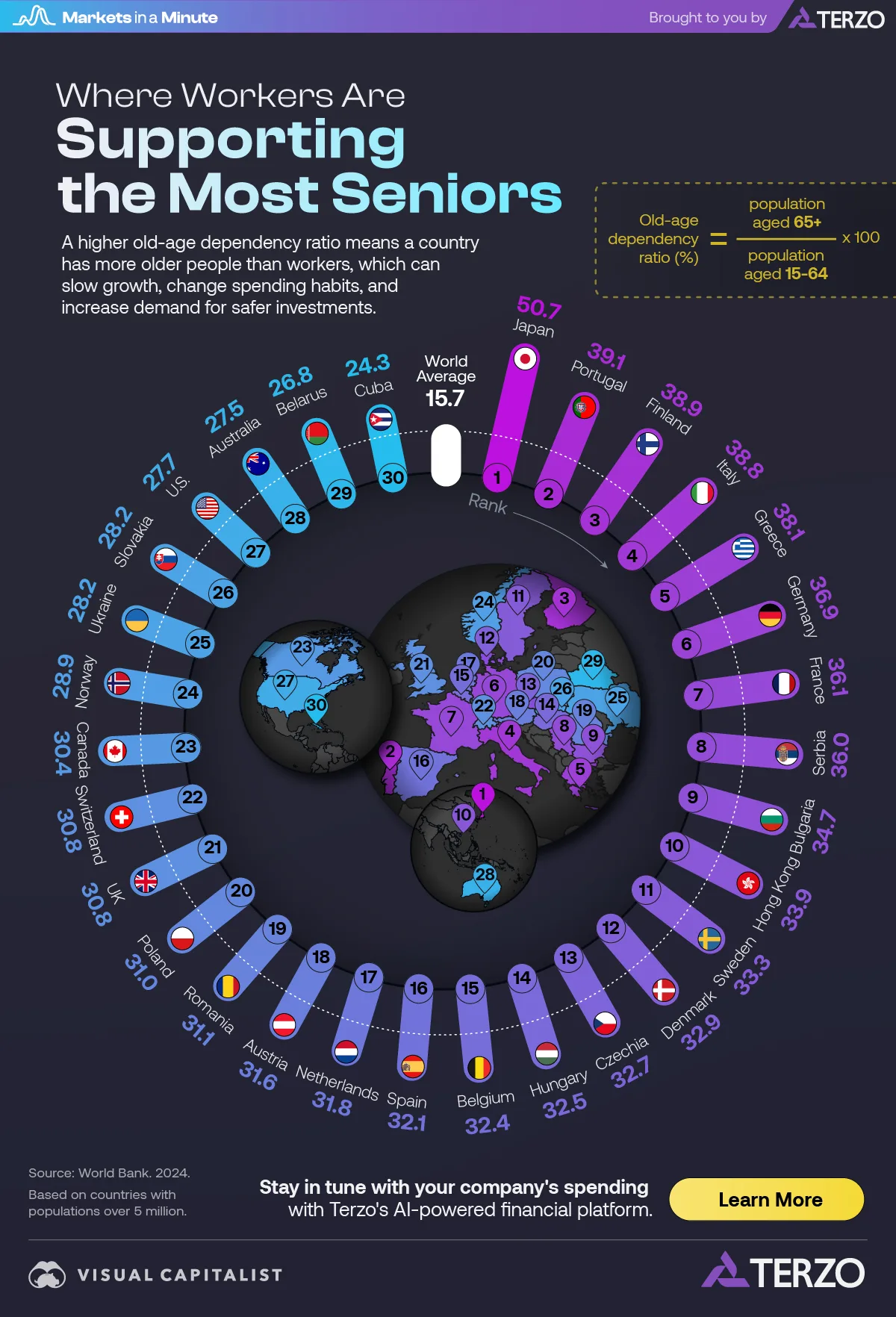
Where Workers Are Supporting the Most Seniors
Key Takeaways
- Japan remains the world’s oldest country, with over half as many seniors as working-age adults.
- Southern and Western Europe dominate the top ranks, with Portugal, Finland, and Italy close behind.
- The United States, Canada, and Australia are aging more slowly—but all now have old-age dependency ratios exceeding 25%.
The world is aging fast. In many advanced economies, the number of retirees is climbing while the working-age population shrinks, reshaping labor markets, public spending, and long-term growth prospects.
This Markets in a Minute visualization, created in partnership with Terzo, ranks countries by their old-age dependency ratio in 2024.
What Is the Old-Age Dependency Ratio?
The old-age dependency ratio is a simple measure that shows how many people aged 65 and older there are for every 100 working-age adults (15–64). In other words, it reflects the balance between those who are typically retired and those who are still in the labor force.
A higher ratio means a country has proportionally more older adults relative to workers. Over time, this shift can strain public finances, reshape consumer spending, and influence everything from housing demand to investment behavior.
Where Countries Rank on Aging
We ranked countries with populations over 5 million residents by age-dependency ratio. At the top of the list, Japan stands out as the world’s oldest society, with more than half as many seniors as working-age adults (50.7%).
Much of Southern and Western Europe follows closely. Countries like Portugal (39.1%), Finland (38.9%), Italy (38.8%), and Greece (38.1%) all have ratios above 38%, reflecting decades of low birth rates and rising life expectancy.
| Rank | Country | Old Age Dependency Ratio (%) |
|---|---|---|
| 1 | Japan | 50.7 |
| 2 | Portugal | 39.1 |
| 3 | Finland | 38.9 |
| 4 | Italy | 38.8 |
| 5 | Greece | 38.1 |
| 6 | Germany | 36.9 |
| 7 | France | 36.1 |
| 8 | Serbia | 36.0 |
| 9 | Bulgaria | 34.7 |
| 10 | Hong Kong | 33.9 |
| 11 | Sweden | 33.3 |
| 12 | Denmark | 32.9 |
| 13 | Czechia | 32.7 |
| 14 | Hungary | 32.5 |
| 15 | Belgium | 32.4 |
| 16 | Spain | 32.1 |
| 17 | Netherlands | 31.8 |
| 18 | Austria | 31.6 |
| 19 | Romania | 31.1 |
| 20 | Poland | 31.0 |
| 21 | UK | 30.8 |
| 22 | Switzerland | 30.8 |
| 23 | Canada | 30.4 |
| 24 | Norway | 28.9 |
| 25 | Ukraine | 28.2 |
| 26 | Slovakia | 28.2 |
| 27 | U.S. | 27.7 |
| 28 | Australia | 27.5 |
| 29 | Belarus | 26.8 |
| 30 | Cuba | 24.3 |
| -- | World | 15.7 |
By contrast, countries near the bottom such as Cuba (24.3%), Belarus (26.8%), and Australia (27.5%) still have relatively younger populations. The United States, at 27.7%, also ranks near the bottom of the list. However, aging trends are accelerating as large generations enter retirement and birth rates stay low.
Why it Matters for Investing
Older households tend to prioritize capital preservation over capital growth, shifting portfolios toward bonds, dividend-paying stocks, and real estate income funds rather than high-risk equities or startups. This broad move toward safer, income-generating assets can reduce overall market risk appetite and dampen venture funding and innovation.