3 Things to Know About Covered Call Options
Covered call option ETFs offer investors a unique way to generate income. But what exactly are they, and when do they tend to perform best?
In partnership with Global X, this visualization breaks down the case for covered calls. It provides clear visual context to help investors better understand their role in a portfolio.
What Are Covered Call Options?
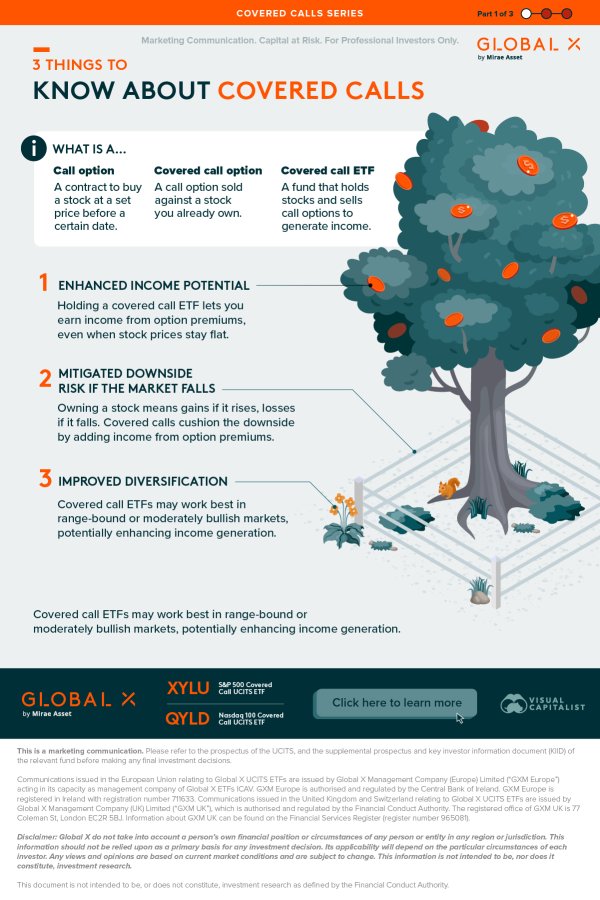
To begin, let’s break down a few key definitions. A call option is a contract that gives the buyer the right to purchase a stock at a set price before a certain date. Importantly, you don’t need to own the underlying stock in order to sell a call option.
A covered call option, on the other hand, is when you sell a call option on a stock you already own. For example, if you hold shares of Apple and choose to sell a call option on those shares, that position is considered a covered call.
Finally, a covered call ETF is a fund that holds a portfolio of stocks. The fund provider then sells call options on those holdings to generate additional income.
With these definitions in mind, what are three reasons to consider investing in covered calls in today’s market environment?
Reason 1: Enhanced Income Potential
One of the primary appeals of covered call ETFs is their ability to generate additional income through option premiums. Even when stock prices remain flat and capital gains are limited, investors can still earn consistent cash flow from the premiums collected.
This makes covered call strategies especially attractive in environments where traditional income sources, like bonds or dividends, may be less reliable.
Reason 2: Mitigated Downside Risk if the Market Falls
While owning stocks outright exposes investors to both the upside and downside of the market, covered call strategies provide a built-in cushion. By selling calls, investors receive premium income that can help offset some of the losses if stock prices fall.
Covered calls don’t eliminate downside risk entirely. However, the added layer of income can soften the blow during periods of market loss.
Reason 3: Improved Diversification
Covered call ETFs can also enhance portfolio diversification. Instead of relying solely on stock appreciation or dividends, investors benefit from an additional income stream through option premiums. This creates a more balanced return profile that combines both equity exposure and options-based income.
By blending these elements, covered call strategies can play a complementary role alongside traditional holdings, helping investors navigate different market conditions with greater flexibility.
The Opportunity
The market’s exponential growth may be running out of steam—but covered calls offer a way to keep generating income, even as stocks lose momentum. By balancing equity exposure with option premiums, they provide investors with a strategy that could thrive in a slower, more uncertain market environment.