
See more visuals like this on the Voronoi app.
Use This Visualization
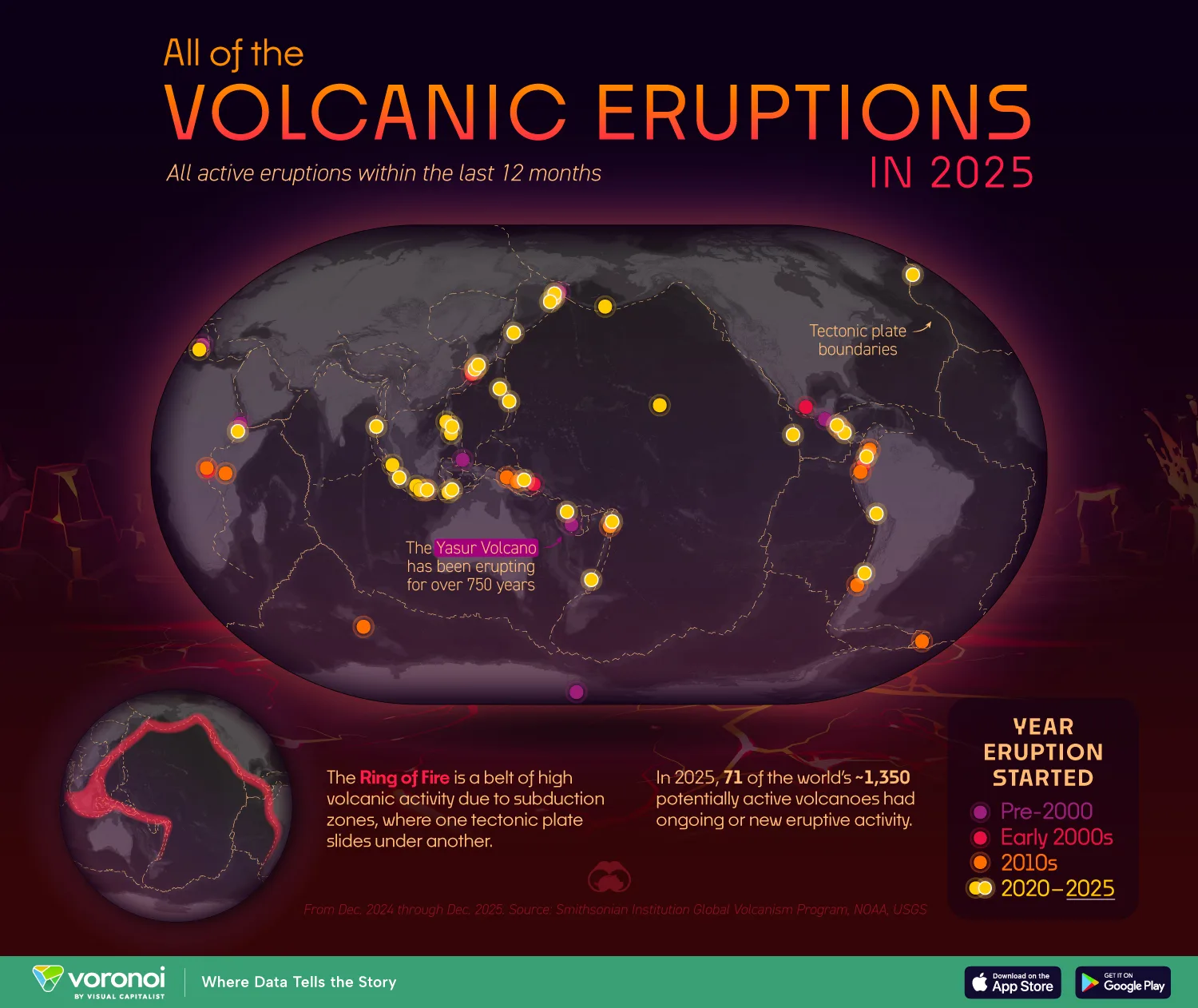
Mapped: All of the World’s Volcanic Eruptions in 2025
This was originally posted on our Voronoi app. Download the app for free on iOS or Android and discover incredible data-driven charts from a variety of trusted sources.
Key Takeaways
- More than 70 volcanoes worldwide experienced eruptive activity in 2025, spanning every inhabited continent.
- Many eruptions are long-running events, with several volcanoes active continuously for years or even decades.
In 2025, volcanic eruptions occurred across a wide range of tectonic settings, from explosive island arcs to submarine volcanoes hidden beneath the ocean surface.
Some events lasted just days, while others continued multi-year or even multi-decade eruptive phases. This map visualizes every volcanic eruption recorded globally during last year.
The data for this visualization comes from the Smithsonian Global Volcanism Program (GVP). It catalogs confirmed eruptive activity by volcano, location, eruption type, and duration, including eruptions that began before 2025 but remained active throughout the year.
The Pacific Ring of Fire Remains the Most Active
As expected, most eruptions in 2025 occurred along the Pacific Ring of Fire. This geologically active zone includes countries such as Indonesia, Japan, the Philippines, Papua New Guinea, New Zealand, Chile, Peru, Mexico, the United States, Russia, and several Pacific island nations.
| Volcano Name | Country | Eruption Start Date | Eruption Stop Date |
|---|---|---|---|
| Kikai | Japan | 2025 Dec 29 | 2025 Dec 29 |
| Home Reef | Tonga | 2025 Dec 17 | 2025 Dec 30 (continuing) |
| Ambae | Vanuatu | 2025 Nov 24 | 2025 Dec 17 (continuing) |
| Hayli Gubbi | Ethiopia | 2025 Nov 23 | 2025 Nov 23 |
| Purace | Colombia | 2025 Nov 23 | 2025 Dec 17 (continuing) |
| Planchon-Peteroa | Chile | 2025 Oct 25 | 2025 Dec 17 (continuing) |
| Ahyi | United States | 2025 Oct 20 | 2025 Dec 17 (continuing) |
| Akan | Japan | 2025 Sep 15 | Sep 2025 |
| Sabancaya | Peru | 2025 Sep 13 | 2025 Dec 17 (continuing) |
| Ioto | Japan | 2025 Sep 1 | September 2025 |
| Whakaari / White Island | New Zealand | 2025 Aug 28 | Aug 2025 |
| Dempo | Indonesia | 2025 Aug 7 | Aug 2025 |
| Krasheninnikov | Russia | 2025 Aug 2 | 2025 Dec 17 (continuing) |
| Barren Island | India | 2025 Jul 30 | 2025 Dec 30 (continuing) |
| Reykjanes | Iceland | 2025 Jul 16 | 2025 Aug 5 |
| Telica | Nicaragua | 2025 Jul 14 | Aug 2025 |
| Kirishimayama | Japan | 2025 Jun 22 | Sep 2025 |
| Karymsky | Russia | 2025 Apr 30 | 2025 Sep 19 |
| Northern EPR at 9.8°N | Undersea Features | 2025 Apr 28 | 2025 Apr 29 |
| Bulusan | Philippines | 2025 Apr 28 | 2025 Apr 29 |
| Klyuchevskoy | Russia | 2025 Apr 8 | 2025 Aug 16 |
| Reykjanes | Iceland | 2025 Apr 1 | 2025 Apr 1 |
| Ulawun | Papua New Guinea | 2025 Mar 27 | 2025 Apr 7 |
| Raung | Indonesia | 2025 Mar 13 | 2025 Jul 11 |
| Atka Volcanic Complex | United States | 2025 Feb 20 | 2025 May 2 |
| Purace | Colombia | 2025 Jan 19 | 2025 Feb 21 |
| Lewotolok | Indonesia | 2025 Jan 16 | 2025 Dec 17 (continuing) |
| Telica | Nicaragua | 2025 Jan 11 | 2025 Feb 25 |
| Poas | Costa Rica | 2025 Jan 5 | 2025 Dec 17 (continuing) |
| Bezymianny | Russia | 2024 Dec 24 | 2025 Dec 17 (continuing) |
| Kilauea | United States | 2024 Dec 23 | 2025 Dec 17 (continuing) |
| Dieng Volcanic Complex | Indonesia | 2024 Dec 18 | 2025 Jan 6 |
| Home Reef | Tonga | 2024 Dec 4 | 2025 Jun 29 ± 1 days |
| Dempo | Indonesia | 2024 Nov 23 | 2025 Feb 2 |
| Kanlaon | Philippines | 2024 Oct 19 | 2025 Dec 17 (continuing) |
| Ahyi | United States | 2024 Aug 5 | 2025 May 28 |
| Whakaari / White Island | New Zealand | 2024 May 24 | 2025 May 13 |
| Taal | Philippines | 2024 Apr 12 | 2025 Dec 17 (continuing) |
| Lewotobi | Indonesia | 2023 Dec 23 | 2025 Dec 17 (continuing) |
| Marapi | Indonesia | 2023 Dec 3 | 2025 Dec 17 (continuing) |
| Etna | Italy | 2022 Nov 27 | 2025 Dec 30 (continuing) |
| Great Sitkin | United States | 2021 May 25 | 2025 Dec 17 (continuing) |
| Merapi | Indonesia | 2020 Dec 31 | 2025 Dec 17 (continuing) |
| Sangay | Ecuador | 2019 Mar 26 | 2025 Dec 17 (continuing) |
| Semeru | Indonesia | 2019 Feb 24 | 2025 Dec 17 (continuing) |
| Manam | Papua New Guinea | 2018 Jun 10 | 2025 Dec 17 (continuing) |
| Nyamulagira | DR Congo | 2018 Apr 14 | 2025 Dec 17 (continuing) |
| Ol Doinyo Lengai | Tanzania | 2017 Apr 9 | 2025 Dec 25 (continuing) |
| Aira | Japan | 2017 Mar 25 | 2025 Dec 17 (continuing) |
| Sabancaya | Peru | 2016 Nov 6 | 2025 Apr 6 |
| Langila | Papua New Guinea | 2015 Oct 22 | 2025 Dec 28 (continuing) |
| Masaya | Nicaragua | 2015 Oct 3 | 2025 Dec 28 (continuing) |
| Tofua | Tonga | 2015 Oct 2 | 2025 Dec 30 (continuing) |
| Villarrica | Chile | 2014 Dec 2 ± 7 days | 2025 Apr 19 |
| Nevado del Ruiz | Colombia | 2014 Nov 18 | 2025 Dec 17 (continuing) |
| Saunders | United Kingdom | 2014 Nov 12 | 2025 Nov 20 (continuing) |
| Heard | Australia | 2012 Sep 5 ± 4 days | 2025 Dec 26 (continuing) |
| Reventador | Ecuador | 2008 Jul 27 | 2025 Dec 17 (continuing) |
| Ibu | Indonesia | 2008 Apr 5 | 2025 Dec 17 (continuing) |
| Popocatepetl | Mexico | 2005 Jan 9 | 2025 Dec 17 (continuing) |
| Suwanosejima | Japan | 2004 Oct 23 | 2025 Dec 17 (continuing) |
| Nyiragongo | DR Congo | 2002 May 17 (?) | 2025 Sep 19 (continuing) |
| Fuego | Guatemala | 2002 Jan 4 | 2025 Dec 17 (continuing) |
| Bagana | Papua New Guinea | 2000 Feb 28 (in or before) | 2025 Dec 17 (continuing) |
| Sheveluch | Russia | 1999 Aug 15 | 2025 Dec 17 (continuing) |
| Erebus | Antarctica | 1972 Dec 16 (on or before) ± 15 days | 2025 Dec 29 (continuing) |
| Erta Ale | Ethiopia | 1967 Jul 2 (in or before) ± 182 days | 2025 Dec 17 (continuing) |
| Stromboli | Italy | 1934 Feb 2 | 2025 Dec 17 (continuing) |
| Dukono | Indonesia | 1933 Aug 13 | 2025 Dec 17 (continuing) |
| Santa Maria | Guatemala | 1922 Jun 22 | 2025 Dec 17 (continuing) |
| Yasur | Vanuatu | 1270 ± 110 years | 2025 Dec 17 (continuing) |
Countries such as Indonesia, Japan, the Philippines, and Russia recorded numerous active volcanoes. Indonesia alone hosted several long-running eruptions, including Merapi, Semeru, and Ibu. These regions sit atop converging tectonic plates, where magma generation and seismic activity are especially common.
Long-Running Eruptions Dominate Global Activity
Many of the volcanoes active in 2025 were not new eruptions but part of ongoing events that began years or even decades earlier.
Stromboli in Italy has been erupting continuously since 1934, while Yasur in Vanuatu has remained active for centuries. Persistent lava lakes were also observed at volcanoes like Nyiragongo in the DR Congo and Masaya in Nicaragua.
Not all eruptions occur near populated areas. Several submarine eruptions were recorded in 2025, including activity at Ahyi near the Northern Mariana Islands and along the East Pacific Rise.
Remote volcanoes such as Erebus in Antarctica and Heard Island in the southern Indian Ocean also remained active. While these eruptions rarely threaten human settlements directly, they are crucial for understanding Earth’s internal processes and long-term volcanic behavior.
Learn More on the Voronoi App
If you enjoyed today’s post, check out All of the World’s Gold, in One Visual on Voronoi, the new app from Visual Capitalist.