
See more visualizations like this on the Voronoi app.
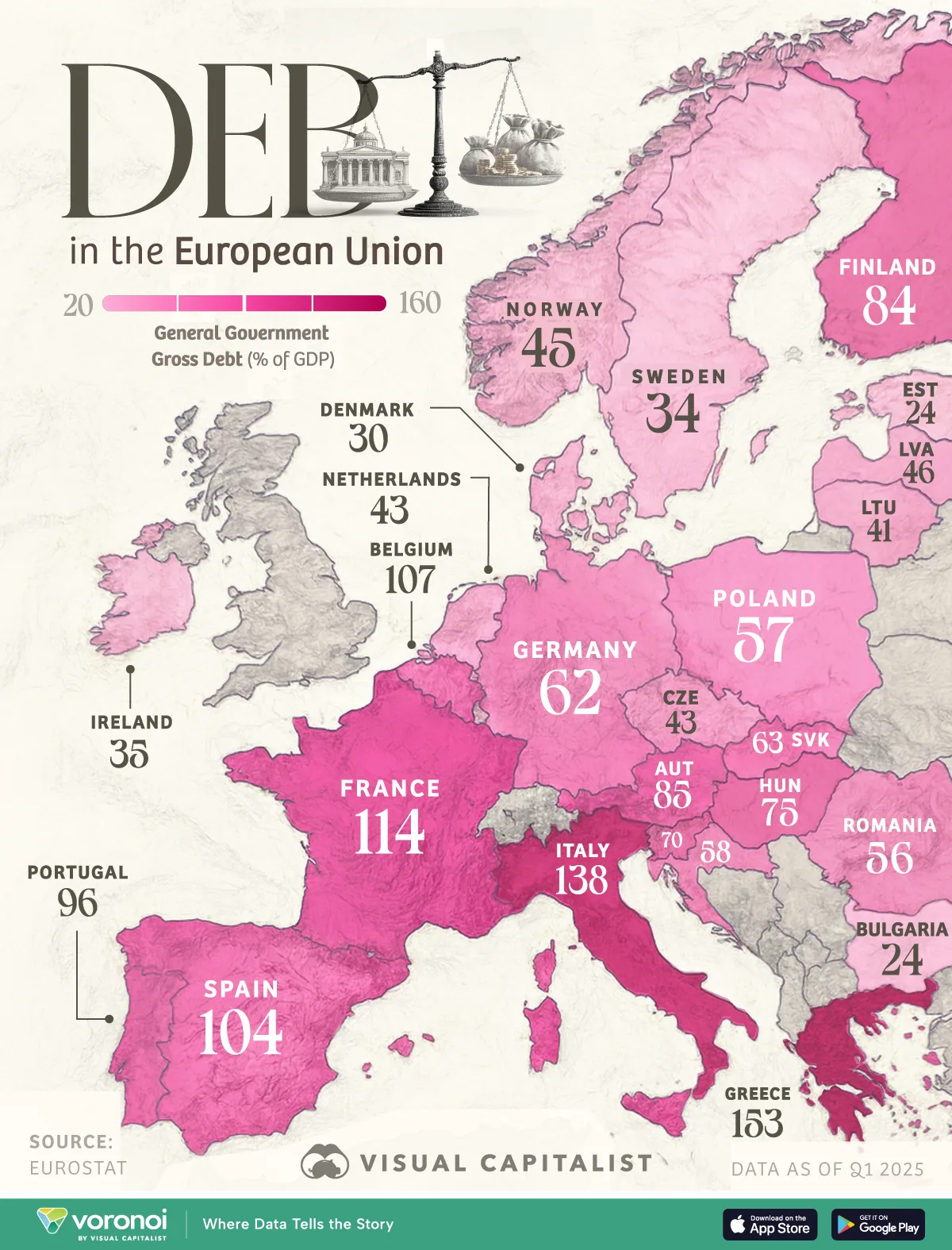
Mapped: European Union Debt-to-GDP by Country
See visuals like this from many other data creators on our Voronoi app. Download it for free on iOS or Android and discover incredible data-driven charts from a variety of trusted sources.
Key Takeaways
- The European Union’s debt ratio stood at 82% in Q1 2025, down from 92% in Q1 2021.
- While debt is falling in Greece and Italy, France’s debt rose to a record $4 trillion in September, with the country facing the widest deficit across the bloc.
As European countries pour billions into defense spending, their debt piles are expanding—raising questions of national fiscal stability.
In France, a rising debt ratio led Fitch to downgrade its credit rating in September. The country has faced ongoing political turmoil as the country’s debt supply recently hit a record $4 trillion.
This graphic shows European Union debt-to-GDP by country, based on data from Eurostat.
The State of European Union Debt-to-GDP in 2025
Below, we show general government gross debt as a percentage of GDP as of Q1 2025 in the EU:
| Country | General Government Gross Debt (% of GDP) |
|---|---|
| Greece | 153 |
| Italy | 138 |
| France | 114 |
| Belgium | 107 |
| Spain | 104 |
| Portugal | 96 |
| Austria | 85 |
| Finland | 84 |
| Hungary | 75 |
| Slovenia | 70 |
| Cyprus | 64 |
| Slovakia | 63 |
| Germany | 62 |
| Croatia | 58 |
| Poland | 57 |
| Romania | 56 |
| Malta | 48 |
| Latvia | 46 |
| Norway | 45 |
| Czechia | 43 |
| Netherlands | 43 |
| Lithuania | 41 |
| Ireland | 35 |
| Sweden | 34 |
| Denmark | 30 |
| Luxembourg | 26 |
| Estonia | 24 |
| Bulgaria | 24 |
| European Union | 82 |
While Greece’s economy is thriving in 2025—supported by tourism, real estate, and shipping sectors—its debt situation continues to rank as the worst in the EU.
However, its debt-to-GDP ratio has steadily fallen in recent years, from 180% in 2022 to 153% today. Given its recent economic momentum, the country launched an innovation and infrastructure fund with BlackRock designed to attract $1.2 billion in foreign investment.
Italy holds the second-highest debt-to-GDP ratio in the EU, at 138%. However, the country has made notable progress in narrowing its deficit, cutting it from 7.2% of GDP in 2023 to 3.4% in 2024 on the back of strong tax revenues. Like Greece, its debt levels have been gradually trending downward.
By contrast, debt is rising in France, where it stands at 114% of GDP. In efforts to combat its deteriorating fiscal situation, the French government has raised the retirement age, and proposed cutting two national holidays—stoking public outrage.
Meanwhile, Germany’s debt ratio of 62% falls significantly below the EU average of 82%. At the same time, the country has eased its fiscal rules with massive defense spending, causing debt levels to rise.
Learn More on the Voronoi App
To learn more about this topic, check out this graphic on debt to GDP by country worldwide.