
See this visualization first on the Voronoi app.
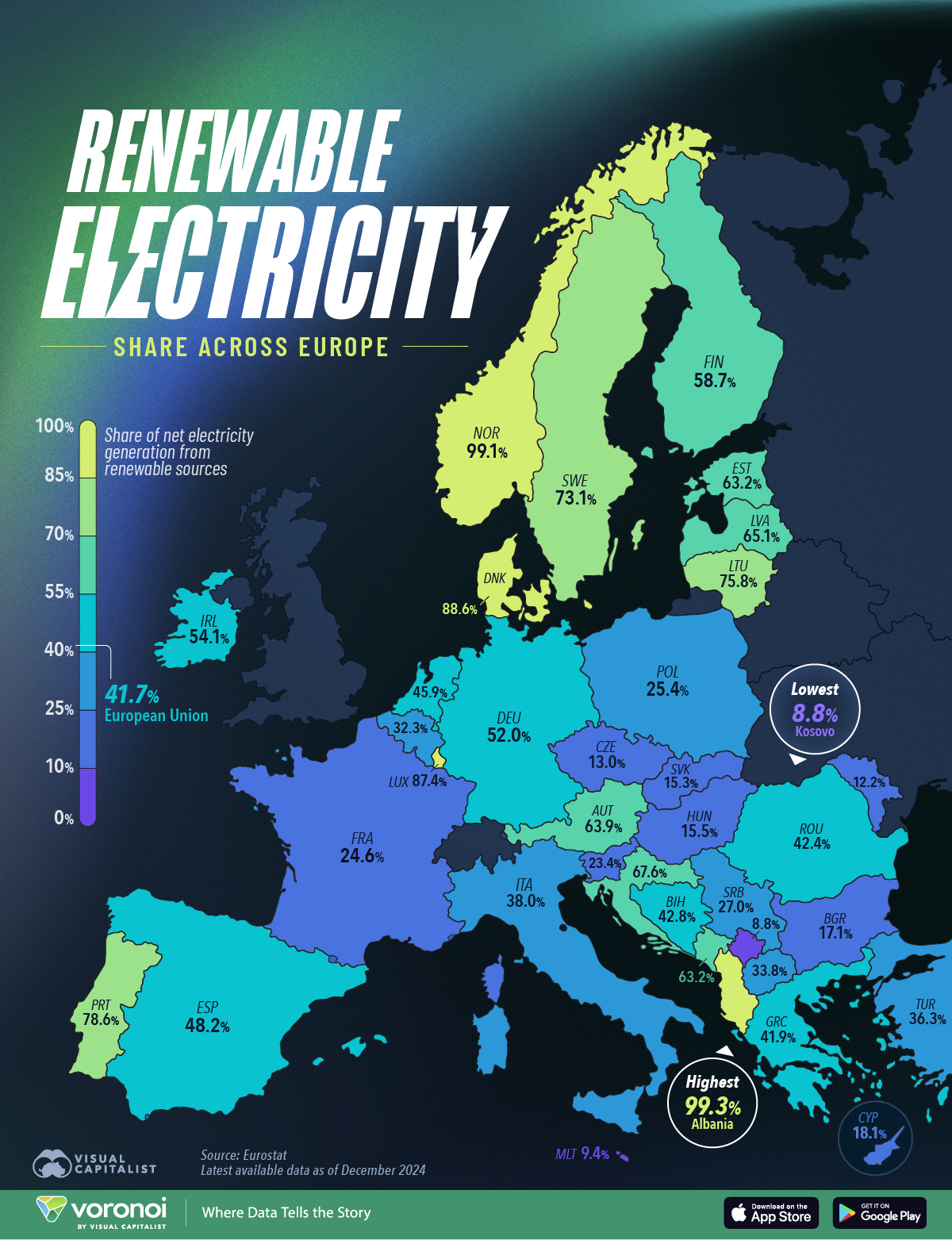
Mapped: Renewable Electricity’s Share Across Europe
This was originally posted on our Voronoi app. Download the app for free on iOS or Android and discover incredible data-driven charts from a variety of trusted sources.
Key Takeaways
- The EU generates around 42% of its electricity from renewable sources
- Albania and Norway are nearly 100% powered by renewables, followed by Denmark at 88.6%
- Kosovo, Malta, and Moldova have the lowest share of renewables in electricity generation
Europe’s transition to clean energy is well underway, with renewables making up an increasing share of electricity generation in many countries.
However, within the European continent, the share of renewables in electricity generation varies widely from country to country, ranging from as high as 99% to less than 10% in some countries.
This graphic maps European countries by the share of their net electricity generation coming from renewable sources, using data from Eurostat. The figures include electricity generated from wind, solar, hydropower, geothermal, and biofuels.
Europe’s Renewable Energy Transition
As of December 2024, the European Union (EU) derived nearly 42% of its net electricity from renewable sources, with wind and hydropower playing key roles in the overall mix.
Here’s the full breakdown of renewables’ share of electricity generation across 38 European countries:
| Country | Share of net electricity generation from renewable sources |
|---|---|
| Albania | 99.3% |
| Norway | 99.1% |
| Denmark | 88.6% |
| Luxembourg | 87.4% |
| Portugal | 78.6% |
| Lithuania | 75.8% |
| Sweden | 73.1% |
| Croatia | 67.6% |
| Latvia | 65.1% |
| Austria | 63.9% |
| Estonia | 63.2% |
| Montenegro | 63.2% |
| Finland | 58.7% |
| Georgia | 58.5% |
| Ireland | 54.1% |
| Germany | 52.0% |
| Spain | 48.2% |
| Netherlands | 45.9% |
| Bosnia and Herzegovina | 42.8% |
| Romania | 42.4% |
| Greece | 41.9% |
| European Union | 41.7% |
| Italy | 38.0% |
| Türkiye | 36.3% |
| North Macedonia | 33.8% |
| Belgium | 32.3% |
| Serbia | 27.0% |
| Poland | 25.4% |
| France | 24.6% |
| Slovenia | 23.4% |
| Cyprus | 18.1% |
| Bulgaria | 17.1% |
| Hungary | 15.5% |
| Slovakia | 15.3% |
| Czechia | 13.0% |
| Moldova | 12.2% |
| Malta | 9.4% |
| Kosovo | 8.8% |
Albania leads, generating over 99% of its electricity from renewables, predominantly hydropower. Similarly, Norway also generates almost all of its electricity from renewables, with 89% of it coming from hydropower alone.
Denmark ranks third, with wind energy playing a key role in its renewable and overall electricity generation. Overall, the leading countries for renewable electricity are geographically distributed across Eastern and Western Europe.
However, fossil fuels also remain central to the grid in parts of Central and Eastern Europe. At the lowest extreme of the spectrum, Kosovo still generates the vast majority of its power from coal, gas, or oil, with renewables making up just 8.8% of the total.
Malta (9.4%) and Moldova (12.4%) follow, along with Czechia (13%), as the top countries with the lowest share of renewables in electricity generation.
Europe’s Clean Energy Goals
The EU has set a binding target of at least a 42.5% share of renewables in its overall energy mix (including electricity, heating, cooling, and other types of energy) by 2030, while aiming for a 45% share. This is more than double the current share of 19.5%, based on the latest available data from 2023.
In support of these goals, the EU has launched various initiatives for clean energy financing, including funding for offshore renewables and billions of euros in investments under the EU Green Deal.
Learn More on the Voronoi App
If you enjoyed today’s post, check out How the EU Generates its Electricity in 2025 on Voronoi, the app from Visual Capitalist.