
See this visualization first on the Voronoi app.
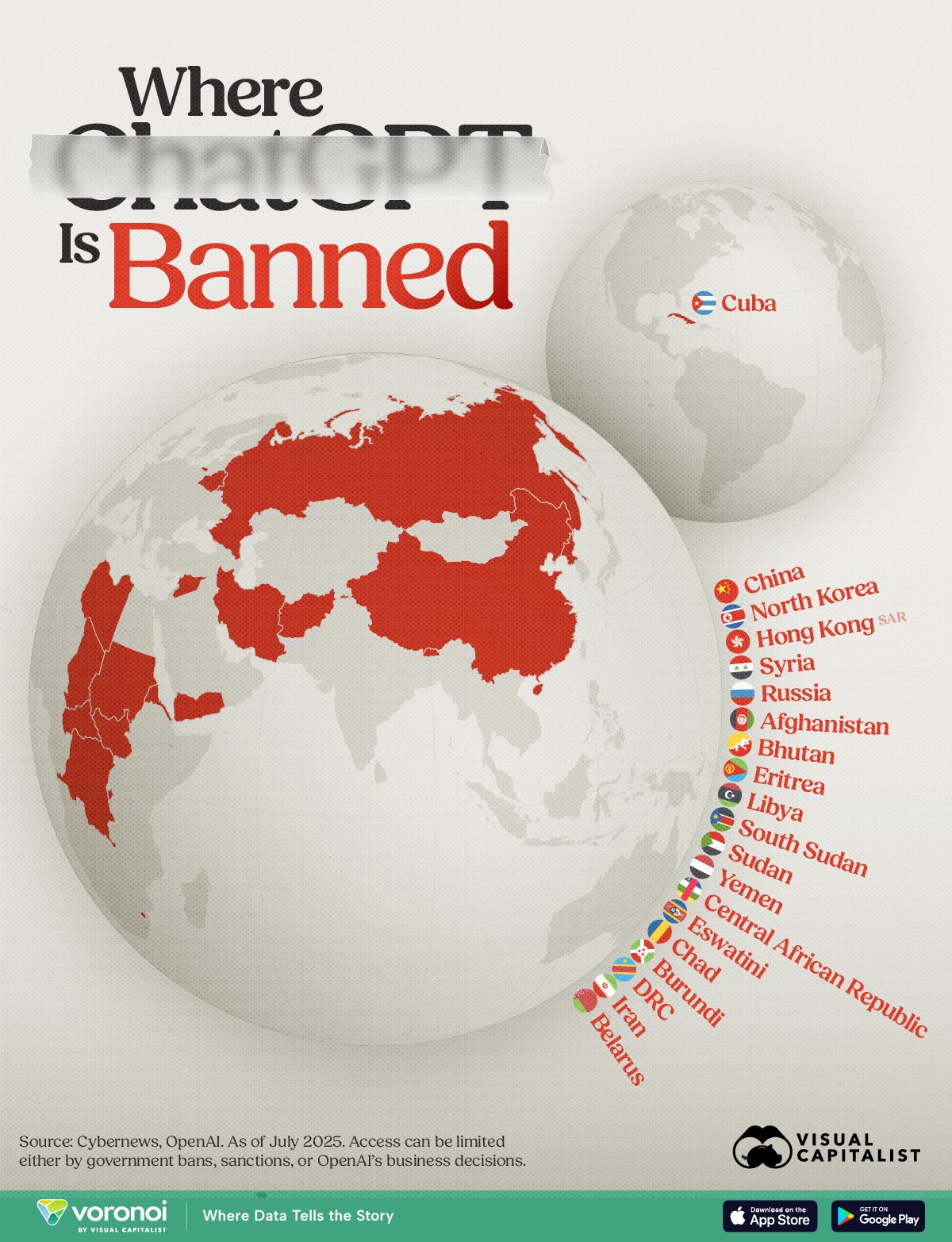
Mapped: Where ChatGPT is Banned in 2025
This was originally posted on our Voronoi app. Download the app for free on iOS or Android and discover incredible data-driven charts from a variety of trusted sources.
Key Takeaways
- ChatGPT is banned or unavailable in 20 countries due to government censorship or privacy laws.
- Some regions are excluded not by government action, but because OpenAI does not support accounts there.
Governments around the world are taking different stances on artificial intelligence tools like ChatGPT. While some embrace the technology, others have restricted or outright banned access due to political, cultural, or security concerns. In 2025, ChatGPT remains unavailable in 20 countries.
In this visualization, we highlight where ChatGPT is banned, as well as places where OpenAI does not offer service.
Data & Discussion
The data for this visualization comes from a list compiled by Cybernews, which we referenced with an official OpenAI list of supported countries.
| Country | Status |
|---|---|
| China | Blocked by government |
| North Korea | Blocked by government |
| Iran | Blocked by government |
| Cuba | Blocked by government |
| Syria | Blocked by government |
| Russia | Blocked by government |
| Afghanistan | Blocked by government |
| Central African Republic | Blocked by government |
| Eritrea | Blocked by government |
| Libya | Blocked by government |
| South Sudan | Blocked by government |
| Sudan | Blocked by government |
| Yemen | Blocked by government |
| Bhutan | Blocked by government |
| Eswatini | Blocked by government |
| Chad | Blocked by government |
| Burundi | Blocked by government |
| DRC | Blocked by government |
| Hong Kong | Not supported by OpenAI |
| Belarus | Not supported by OpenAI |
Government-Imposed Bans
Many of the bans are found in countries with strict internet control, such as China, North Korea, and Iran. These governments limit access to foreign digital platforms, often citing information control and political stability as reasons.
In China, for example, users have access to several LLMs that were developed by domestic companies, including Alibaba’s Qwen, DeepSeek, Baichuan, and Tencent-backed Hunyuan.
Meanwhile, in conflict zones like Syria, Afghanistan, and Yemen, bans are linked to both security concerns and limited infrastructure.
Unsupported Regions
Not all countries on the list have active bans. In places like Hong Kong and Belarus, the service is unavailable because OpenAI does not support accounts there. These exclusions are often due to business, regulatory, or legal complexities rather than explicit censorship.
Learn More on the Voronoi App
If you enjoyed today’s post, check out the AI “Big Bang” Study 2025 on Voronoi, the new app from Visual Capitalist.