
See more visualizations like this on the Voronoi app.
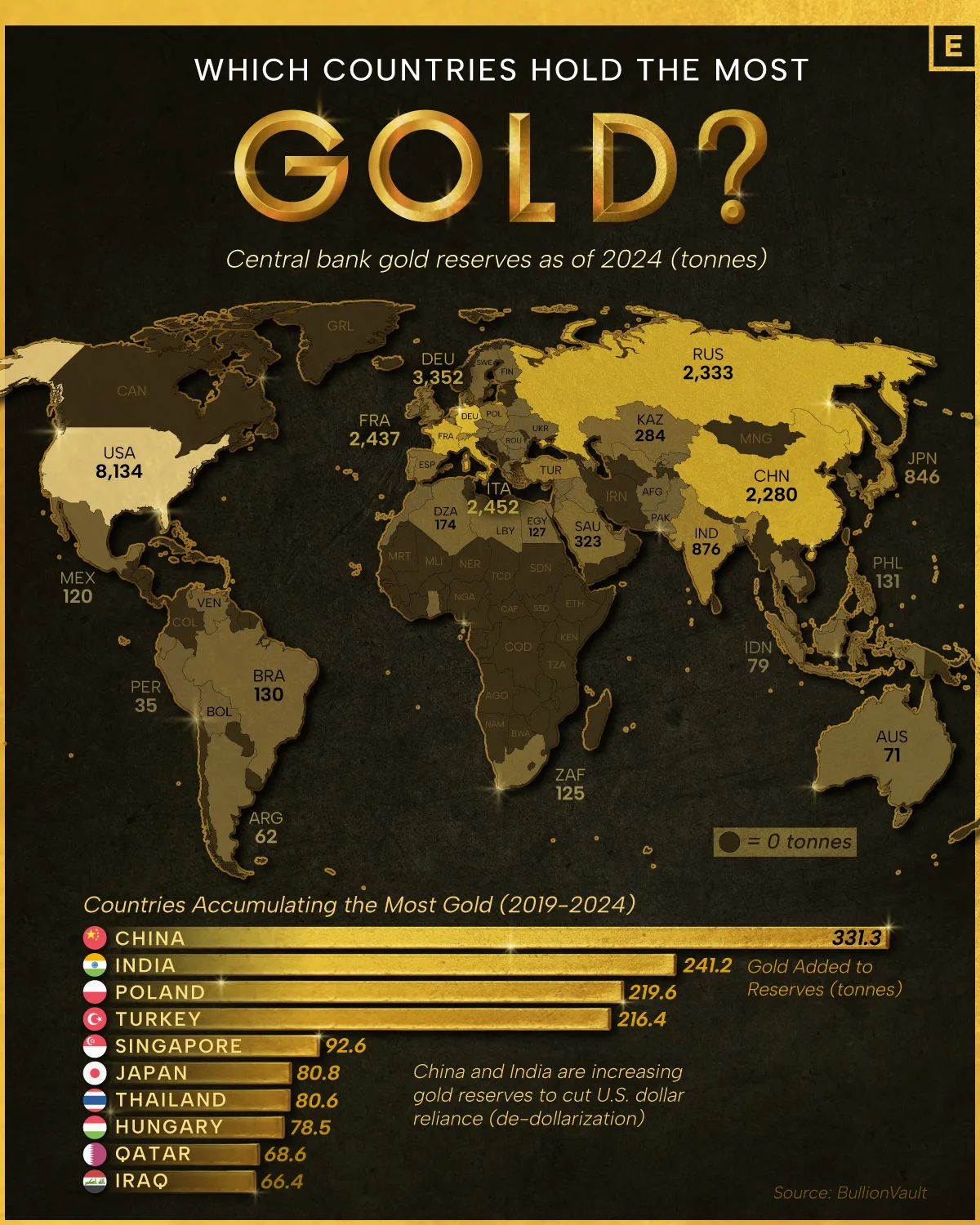
Mapped: Which Countries Hold the Most Gold Reserves?
See visuals like this from many other data creators on our Voronoi app. Download it for free on iOS or Android and discover incredible data-driven charts from a variety of trusted sources.
Key Takeaways
- The U.S. and Europe hold over 60% of global gold reserves as of 2024.
- China added 331 tonnes between 2019 and 2024, lifting its total to 2,280 tonnes.
- India, Poland, and Turkey saw major increases from 2019 to 2024.
- Poland’s holdings jumped from 2019 to 2024, reaching 448 tonnes.
Gold remains one of the world’s most enduring stores of value, and central banks continue to accumulate it at record levels. The buying also cause the metal to hit record high prices in 2025.
This map highlights which countries hold the most gold in their official reserves. The data for this visualization comes from BullionVault, which tracks global central bank gold holdings. Figures represent official gold reserves in tonnes as of 2024.
Collectively, the U.S. and Europe control more than 60% of all reported reserves.
| Rank | Country | Gold reserves (tonnes) |
|---|---|---|
| 1 | United States | 8,133.5 |
| 2 | Germany | 3,351.6 |
| 3 | Italy | 2,451.9 |
| 4 | France | 2,437.0 |
| 5 | Russia | 2,333.1 |
| 6 | China | 2,279.6 |
| 7 | Switzerland | 1,039.9 |
| 8 | India | 876.2 |
| 9 | Japan | 846.0 |
| 10 | Netherlands | 612.5 |
| 11 | Turkey | 595.4 |
| 12 | Poland | 448.2 |
| 13 | Portugal | 382.7 |
| 14 | Uzbekistan | 382.6 |
| 15 | Saudi Arabia | 323.1 |
| 16 | United Kingdom | 310.3 |
| 17 | Lebanon | 286.8 |
| 18 | Kazakhstan | 284.1 |
| 19 | Spain | 281.6 |
| 20 | Austria | 280.0 |
| 21 | Thailand | 234.5 |
| 22 | Belgium | 227.4 |
| 23 | Singapore | 220.0 |
| 24 | Algeria | 173.6 |
| 25 | Iraq | 162.6 |
| 26 | Libya | 146.7 |
| 27 | Azerbaijan | 146.6 |
| 28 | Philippines | 130.5 |
| 29 | Brazil | 129.7 |
| 30 | Egypt | 126.9 |
| 31 | Sweden | 125.7 |
| 32 | South Africa | 125.4 |
| 33 | Mexico | 120.3 |
| 34 | Greece | 114.6 |
| 35 | Qatar | 110.8 |
| 36 | Hungary | 110.0 |
| 37 | South Korea | 104.4 |
| 38 | Romania | 103.6 |
| 39 | Kuwait | 79.0 |
| 40 | Indonesia | 78.6 |
| 41 | United Arab Emirates | 74.4 |
| 42 | Jordan | 71.6 |
| 43 | Australia | 70.9 |
| 44 | Denmark | 66.5 |
| 45 | Pakistan | 64.7 |
| 46 | Argentina | 61.7 |
| 47 | Belarus | 53.9 |
| 48 | Venezuela | 52.0 |
| 49 | Czech Republic | 51.2 |
| 50 | Serbia | 48.1 |
| 51 | Cambodia | 46.5 |
| 52 | Finland | 43.8 |
| 53 | Bulgaria | 40.9 |
| 54 | Malaysia | 38.9 |
| 55 | Kyrgyzstan | 38.1 |
| 56 | Peru | 34.7 |
| 57 | Slovakia | 31.7 |
| 58 | Ghana | 30.5 |
| 59 | Ukraine | 27.4 |
| 60 | Ecuador | 26.3 |
| 61 | Syria | 25.9 |
| 62 | Bolivia | 22.5 |
| 63 | Morocco | 22.1 |
| 64 | Afghanistan | 21.9 |
| 65 | Bangladesh | 14.3 |
| 66 | Cyprus | 13.9 |
| 67 | Mauritius | 12.4 |
| 68 | Ireland | 12.0 |
| 69 | Paraguay | 8.2 |
| 70 | Mongolia | 7.3 |
| 71 | Myanmar | 7.3 |
| 72 | Georgia | 7.1 |
| 73 | Guatemala | 6.9 |
| 74 | Tunisia | 6.8 |
| 75 | Latvia | 6.7 |
| 76 | Guinea | 6.3 |
| 77 | Lithuania | 5.8 |
| 78 | Colombia | 4.7 |
| 79 | Bahrain | 4.7 |
| 80 | Mozambique | 3.9 |
| 81 | Bosnia and Herzegovina | 3.5 |
| 82 | Albania | 3.4 |
| 83 | Slovenia | 3.2 |
| 84 | Luxembourg | 2.2 |
| 85 | Hong Kong | 2.1 |
| 86 | Iceland | 2.0 |
| 87 | Trinidad and Tobago | 1.9 |
| 88 | Haiti | 1.8 |
| 89 | El Salvador | 1.4 |
| 90 | Papua New Guinea | 1.3 |
| 91 | Suriname | 1.2 |
| 92 | Honduras | 0.7 |
| 93 | Dominican Republic | 0.6 |
| 94 | Sri Lanka | 0.5 |
| 95 | Estonia | 0.2 |
| 96 | Chile | 0.2 |
| 97 | Malta | 0.2 |
| 98 | Solomon Islands | 0.2 |
| 99 | Uruguay | 0.1 |
| 100 | Bhutan | 0.1 |
| 101 | Moldova | 0.1 |
The United States Dominates Global Gold Holdings
The United States remains the world’s largest holder of gold by a wide margin, with 8,133.5 tonnes, a figure virtually unchanged for decades. Most of this gold is stored at Fort Knox and the New York Federal Reserve.
At current prices, America’s reserves are worth over $1 trillion, serving as a strategic asset that underpins confidence in the U.S. dollar.
Europe’s Long-Standing Reserves Remain Strong
Europe’s major economies—Germany (3,352 tonnes), Italy (2,452 tonnes), and France (2,437 tonnes)—collectively hold nearly 8,200 tonnes, rivaling the U.S. total.
These large holdings date back to the postwar Bretton Woods era, when gold underpinned the international monetary system.
China’s gold reserves have surged from 1,948 tonnes in 2019 to 2,280 tonnes in 2024, as Beijing diversifies away from U.S. Treasury holdings and seeks to internationalize the yuan.
India, now the world’s fifth-largest economy, holds 876 tonnes.
Other emerging markets, including Turkey (595 tonnes) and Poland (448 tonnes), have sharply increased gold holdings to hedge against inflation, currency volatility, and geopolitical uncertainty.
Beyond the Top 10: Smaller Nations Build Resilience
Countries like Uzbekistan (383 tonnes) and Saudi Arabia (323 tonnes) also feature prominently, highlighting the growing appeal of gold among energy and resource-rich economies. In addition, developing nations such as Thailand, Singapore, and Kazakhstan are quietly increasing their reserves as a safeguard against global shocks.
Learn More on the Voronoi App
If you enjoyed today’s post, check out Gold or Stocks? $10K After 25 Years on Voronoi, the new app from Visual Capitalist.