
See more visuals like this on the Voronoi app.
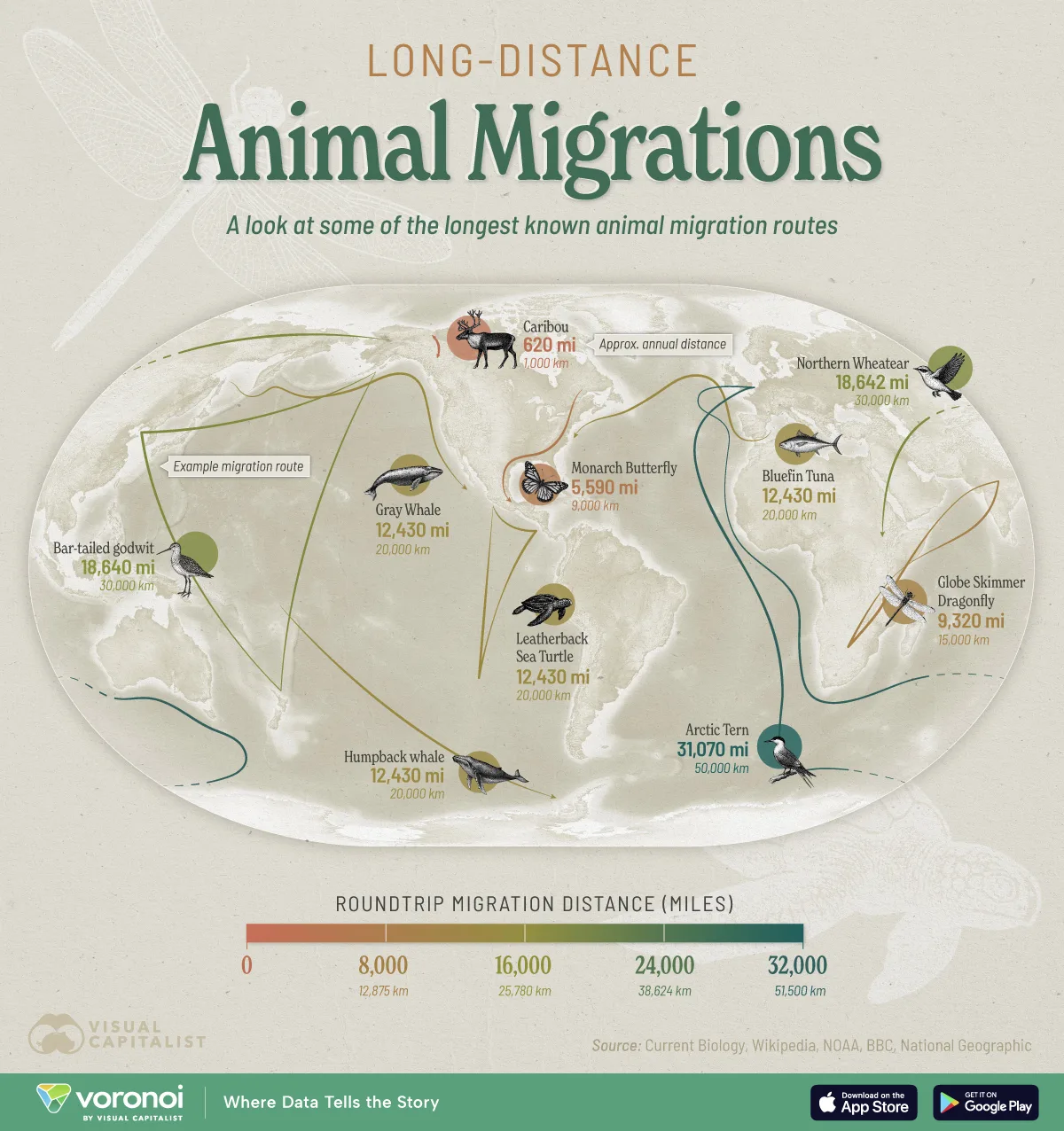
Use This Visualization
Mapped: The World’s Longest Animal Migrations
See visuals like this from many other data creators on our Voronoi app. Download it for free on iOS or Android and discover incredible data-driven charts from a variety of trusted sources.
Key Takeaways
- Traveling up to 59,652 miles (96,000 km) each year, the Arctic Tern experiences two summers annually, following continuous daylight between the Arctic and Antarctic.
- Gray and Humpback Whales depend on predictable ocean temperatures, feeding in cold, plankton-rich Arctic waters and breeding in warm tropical lagoons thousands of kilometers away.
The world’s great migrations are among nature’s most astonishing phenomena. Every year, millions of animals embark on journeys that span oceans, continents, and even hemispheres.
This visualization maps some of the longest known migration routes on Earth. From the Arctic Tern’s pole-to-pole flight to the epic oceanic travels of whales and turtles, these journeys connect ecosystems across the globe and shape entire food webs.
The data for this visualization comes from multiple sources, including Current Biology, NOAA, and National Geographic.
1. The Arctic Tern: The Ultimate Global Traveler
The Arctic Tern is the undisputed migration champion. Traveling between 31,000 and 59,000 miles (50,000–96,000 km) each year, the Arctic Tern experiences two summers. Scientists have tracked these terns following continuous daylight, timing their flights to chase the sun’s warmth and maximize feeding opportunities. Over its lifetime (up to 34 years), an Arctic Tern can fly the equivalent of three round trips to the Moon.
| Animal | Return Trip (km) | Distance (miles) | Example of Route |
|---|---|---|---|
| Arctic tern | 50,000 | 31,070 | Arctic breeding grounds → Antarctic pack-ice zone and back |
| Bar-tailed godwit | 30,000 | 18,640 | Pacific circuit: Alaska → New Zealand → China → Alaska |
| Northern wheatear | 30,000 | 18,640 | Alaska → East Africa |
| Gray whale | 20,000 | 12,430 | Sakhalin (Russia) → Mexico |
| Humpback whale | 20,000 | 12,430 | Samoa → Antarctic waters |
| Leatherback turtle | 20,000 | 12,430 | Pacific or Atlantic transoceanic routes (e.g., W. Pacific → California Current) |
| Bluefin tuna | 20,000 | 12,430 | Mediterranean spawning areas → North American feeding grounds |
| Globe skimmer dragonfly | 15,000 | 9,320 | India East Africa across the Indian Ocean (Multigenerational) |
| Monarch butterfly | 9,000 | 5,590 | Eastern North America → Mexico and back (Multigenerational) |
| Caribou | 1,000 | 620 | Annual forest tundra migration |
| Zebra | 500 | 310 | Botswana river valley → Namibia grazing areas |
Distances represent approximate annual migration distances (round trip), which may vary by population and individual.
2. Ocean Voyagers: Whales
Marine mammals such as Gray and Humpback Whales migrate thousands of miles between icy feeding grounds and tropical breeding lagoons.
Gray Whales travel up to 12,000 miles (20,000 km) annually between the Bering Sea and Baja California, while some Humpback populations cover comparable round-trip distances between tropical breeding grounds and Antarctic feeding areas. Their migrations are finely tuned to ocean productivity and temperature, making them key indicators of marine ecosystem health.
3. Feathered and Winged Flyers: Birds and Insects in Motion
Beyond the terns, species like the Bar-tailed Godwit and Northern Wheatear make record-breaking non-stop flights, crossing entire oceans without stopping to feed.
Many bird species achieve extraordinary nonstop ocean crossings by accumulating substantial fat reserves for fuel and employing energy-efficient flight techniques like dynamic soaring.
In addition, other physiological adaptations—such as the ability to temporarily reduce the size of internal organs to lighten their load—help enable these long-distance journeys. Some bird species have also been observed entering brief periods of reduced brain activity while in flight, though the role this plays in nonstop migration is still being studied.
Even smaller creatures like the Globe Skimmer Dragonfly traverse up to 11,000 miles between India and Africa.
4. Land Migrations
On land, animals like Caribou and Wildebeest follow ancient migration paths dictated by seasonal changes.
Some caribou herds can migrate over 1,000–2,500 miles (1,600–4,000 km) annually, among the longest terrestrial migrations on Earth, while the Serengeti’s Wildebeest migration—a circular movement of almost a thousand miles—is among the most visually dramatic wildlife events on Earth.
Similarly, Zebras migrate roughly 310 miles each year, traveling from Botswana’s river valleys to grazing areas across the border in Namibia.
Learn More on the Voronoi App
If you enjoyed today’s post, check out Ranked: Countries With the Largest Forests in 2025 on Voronoi, the new app from Visual Capitalist.