
See this visualization first on the Voronoi app.
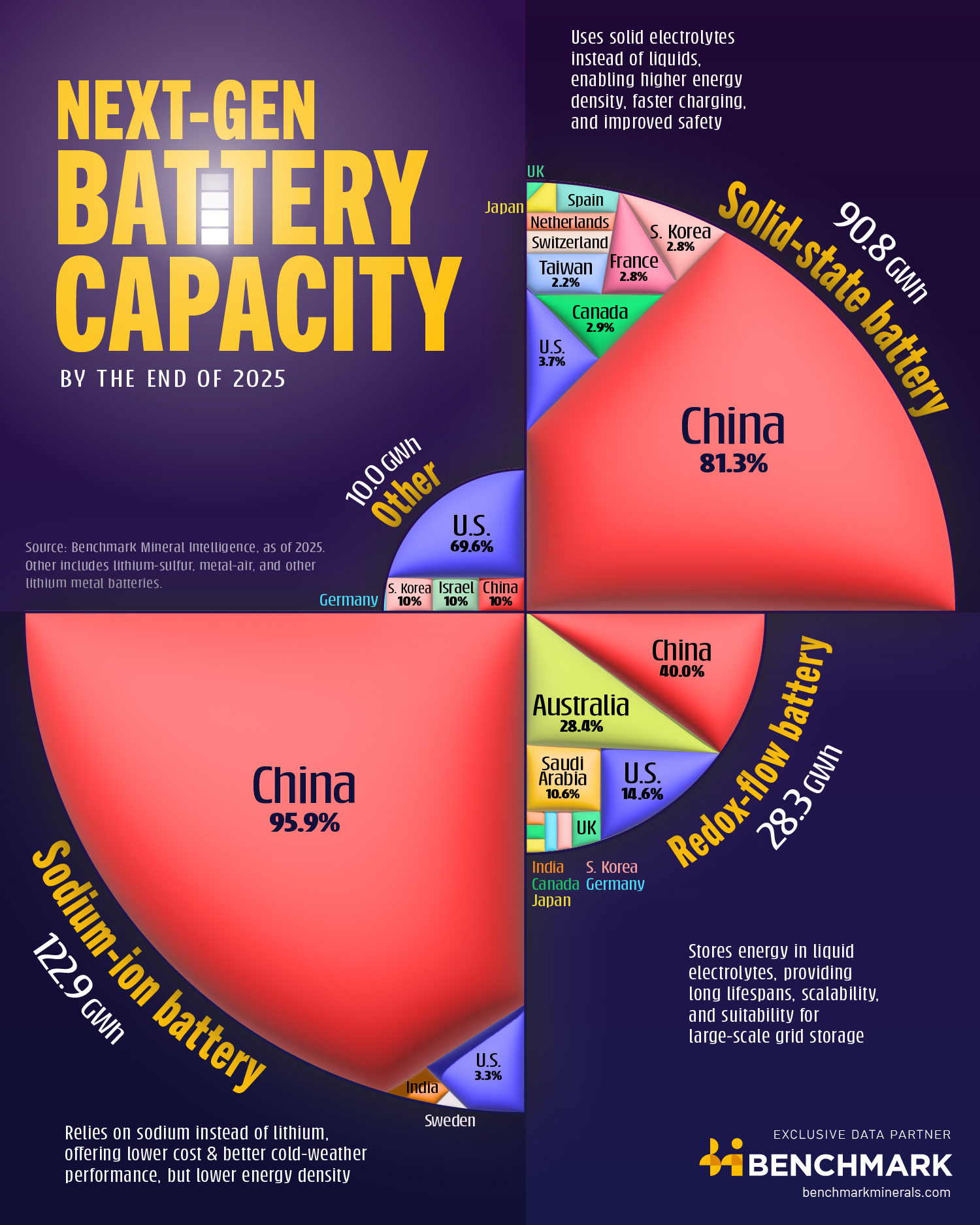
Next-Gen Battery Capacity by Country in 2025
This was originally posted on our Voronoi app. Download the app for free on iOS or Android and discover incredible data-driven charts from a variety of trusted sources.
Key Takeaways
- Besides dominating the production of more traditional batteries, China is also set to maintain dominance in emerging battery technologies over the next five years.
- The U.S. dominates the capacity pipeline for more niche next-generation technologies.
As the global energy transition accelerates, emerging battery technologies are gaining attention for their potential to outperform traditional lithium-ion solutions. These next-generation batteries could be pivotal for everything from electric vehicles to grid storage and even electric aviation.
This infographic ranks countries by their share of current production capacity for four types of next-gen batteries. These include solid-state, sodium-ion, redox-flow, other lithium-metal batteries, and metal-air chemistries.
The data for this visualization comes from Benchmark Mineral Intelligence.
Why Next-Gen Batteries Matter
Next-generation batteries are designed to overcome the limits of today’s lithium-ion technology. They offer improvements in energy density, safety, cost, and application-specific performance.
Solid-state batteries, for example, eliminate flammable liquid electrolytes. Sodium-ion batteries trade lithium for sodium, a more abundant and cheaper material, while redox-flow systems are ideal for long-duration, grid-level storage. Other chemistries like lithium-sulfur, lithium metal, and metal-air are also gaining traction for aviation, backup power, and future electric vehicles.
China’s Continued Dominance
China is set to remain the global heavyweight in next-generation battery production. In 2025, China is projected to control over 80% of solid-state capacity and an overwhelming 96% of sodium-ion capacity. Although its lead narrows slightly by 2030, it will still dominate both categories—retaining more than 59% of the solid-state and over 90% of sodium-ion capacity.
| Country | Solid-state battery | Sodium-ion (Na-ion) | Redox-flow battery | Other |
|---|---|---|---|---|
| China | 81.3% | 95.9% | 40.0% | 10.0% |
| Japan | 0.7% | 0.0% | 0.4% | 0.0% |
| South Korea | 2.8% | 0.0% | 0.7% | 10.0% |
| India | 0.0% | 0.8% | 0.4% | 0.0% |
| Taiwan | 2.2% | 0.0% | 0.0% | 0.0% |
| UAE | 0.0% | 0.0% | 0.0% | 0.0% |
| Saudi Arabia | 0.0% | 0.0% | 10.6% | 0.0% |
| Israel | 0.0% | 0.0% | 0.0% | 10.0% |
| USA | 3.7% | 3.3% | 14.6% | 69.6% |
| Canada | 2.9% | 0.0% | 0.4% | 0.0% |
| Austria | 0.0% | 0.0% | 0.0% | 0.0% |
| Belgium | 0.0% | 0.0% | 0.0% | 0.0% |
| France | 2.8% | 0.0% | 0.0% | 0.0% |
| Germany | 0.0% | 0.0% | 0.6% | 0.3% |
| Luxembourg | 0.0% | 0.0% | 0.0% | 0.0% |
| Netherlands | 1.1% | 0.0% | 0.0% | 0.0% |
| Portugal | 0.0% | 0.0% | 0.0% | 0.0% |
| Spain | 1.1% | 0.0% | 0.0% | 0.0% |
| Sweden | 0.0% | 0.1% | 0.0% | 0.0% |
| Switzerland | 1.3% | 0.0% | 0.0% | 0.0% |
| UK | 0.1% | 0.0% | 1.2% | 0.0% |
| Australia | 0.0% | 0.0% | 28.4% | 0.0% |
U.S. Betting on Redox-Flow and Innovation
The U.S. dominates the capacity pipeline for more niche next-generation technologies including lithium-sulphur, metal-air, and other lithium metal batteries. The country is set to account for 70% of the 10 GWh global market for these technologies by the end of 2025.
In addition to the two largest economies in the world, Canada, South Korea and France remain active, though with smaller shares focused mainly on solid-state chemistries.
Notably, Australia has a significant presence in redox-flow battery capacity, accounting for nearly 30% of the global total.
Learn More on the Voronoi App
If you enjoyed today’s post, check out Visualizing China’s Battery Recycling Dominance on Voronoi, the new app from Visual Capitalist.