Published
October 1, 2025 8:39 am
| 102 views
-->
By
Jenna Ross
Design
- Sabrina Fortin
Ranked: The Biggest Buyers of U.S. Debt
Key Takeaways
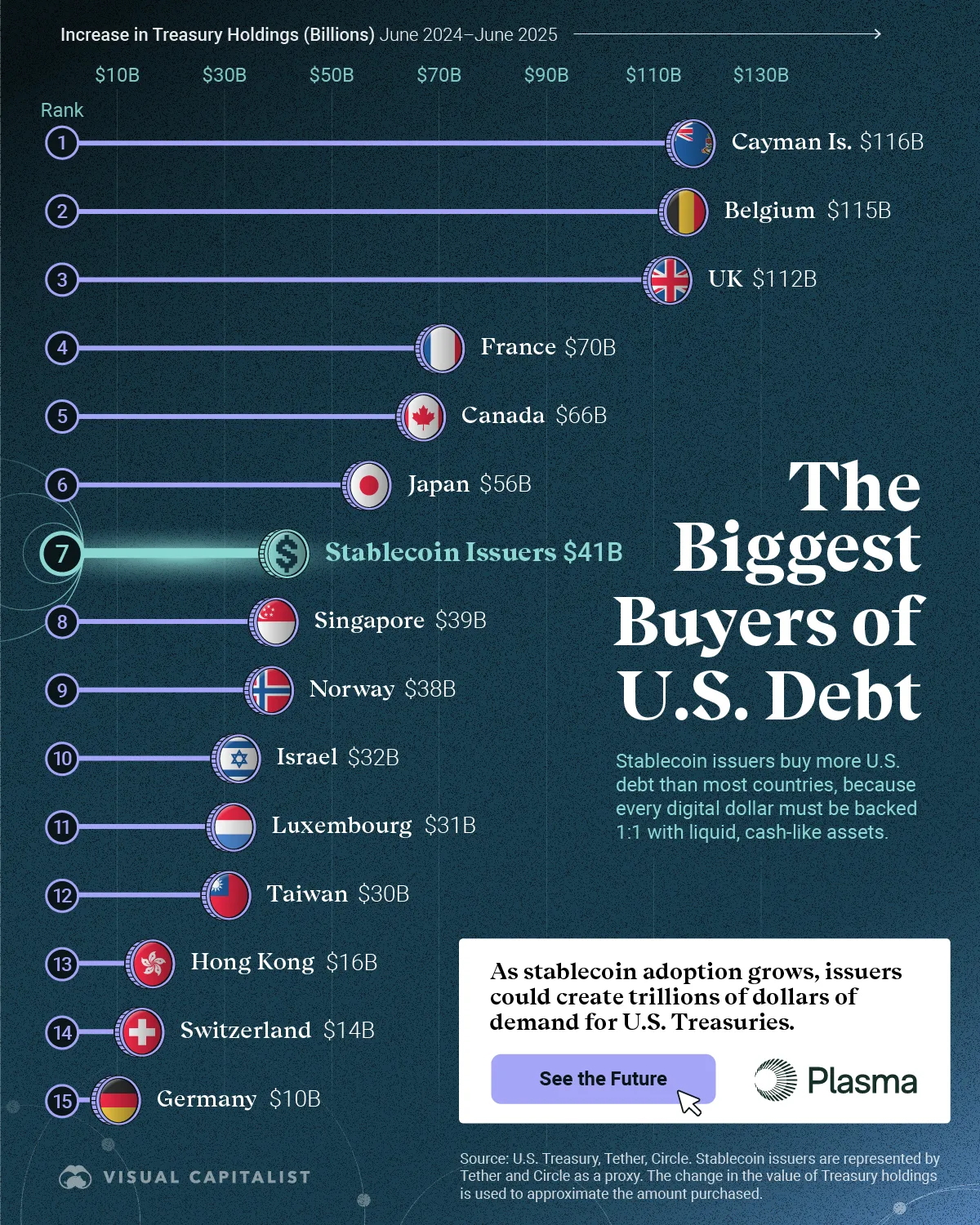
- The Cayman Islands bought the most U.S. debt in the year spanning June 2024–June 2025.
- When compared to foreign holders, stablecoin issuers rank as the seventh-largest buyer of American debt.
- Stablecoin issuers rank above countries like Singapore and Norway.
As stablecoins grow in popularity, their impact on global markets is becoming harder to ignore. This is especially true when it comes to who’s financing U.S. debt.
This visualization, created in partnership with Plasma for Stablecoin Week, compares the biggest foreign buyers of American government debt to the amount bought by stablecoin issuers.
The Role of Legal and Administrative Hubs
From June 2024–June 2025, the Cayman Islands was the biggest buyer of U.S. debt.
Why does a small Caribbean territory buy so many Treasurys? The Cayman Islands has no corporate income tax and is the legal home to many of the world’s hedge funds. When these funds buy Treasurys they count toward the Cayman Islands’ total, despite the fact that most funds are managed from elsewhere.
| Buyer | Increase in Treasury Holdings, June 2024–June 2025 |
|---|---|
| Cayman Islands | $116B |
| Belgium | $115B |
| United Kingdom | $112B |
| France | $70B |
| Canada | $66B |
| Japan | $56B |
| Stablecoin Issuers | $41B |
| Singapore | $39B |
| Norway | $38B |
| Israel | $32B |
| Luxembourg | $31B |
| Taiwan | $30B |
| Hong Kong | $16B |
| Switzerland | $14B |
| Germany | $10B |
Stablecoin issuers are represented by Tether and Circle as a proxy. The change in the value of Treasury holdings is used to approximate the amount purchased.
Belgium was the second-largest buyer of U.S. debt. This large total can be traced in part to the fact that Belgium is home to Euroclear, a custodian that holds securities on behalf of other parties.
But how do stablecoin issuers stack up against these major foreign holders?
U.S. Debt Bought by Stablecoin Issuers
When compared to these large foreign holdings, stablecoin issuers come in seventh place. Tether and Circle bought about $41 billion in U.S. Treasurys directly, more than countries like Singapore, Norway, and Israel.
The reason stablecoin issuers buy so much debt is because they must back every digital dollar 1:1 with liquid, cash-like assets. That pushes them toward ultra-safe instruments like U.S. Treasury bills, money market funds, and cash.
Both stablecoins and the U.S. Treasury market benefit from their close relationship. Stablecoin issuers rely on U.S. Treasurys to create consumer confidence and grow their user base. Treasurys also offer safe interest payments. On the other side, the U.S. Treasury market stands to gain from new, large-scale buyers to help expand demand.
However, this growing interdependence poses systemic risks. If stablecoin issuers face large redemption requests, rapid liquidations could disrupt the Treasury market.
You may also like
-

AI1 week ago
The Explosive Rise of AI App Spending (2022–2026)
Globally, AI app purchases have grown nearly 200-fold in just four years. See which regions are driving the surge in 2026.
-

Cryptocurrency2 weeks ago
Stablecoin Card Spending Has Surged to $1 Billion a Month
Stablecoin card spending has grown nearly 2,000-fold since 2023. See what’s fueling their rise and why the market may just be getting started.
-

Wealth4 weeks ago
Ranked: Where Are Ultra-Rich Populations Forecast to Grow the Fastest?
Global wealth is expanding beyond traditional hubs. Through 2031, Indonesia is forecast to see the fastest ultra-rich population growth.
-

Cryptocurrency4 months ago
Gold and U.S. Debt: Will Tether Be a Mega-Holder by 2030?
By 2030, Tether’s gold and U.S. debt holdings could rival what major countries currently own. See how the projections break down.
-

Housing4 months ago
The States Where Housing Prices Have Surged the Most (2021–2026)
Maine and Vermont lead the nation in home price growth. Explore the latest data shaping the U.S. housing market.
-

Inflation4 months ago
How Much Value $100 Loses in the World’s Highest-Inflation Countries in 2026
In Venezuela, $100 could be worth just $31 by year-end. See where inflation is eroding money’s value fastest in 2026.
-

Personal Finance8 months ago
Where $2.6T in Daily Cross-Border Currency Trades Happen
Foreign exchange markets are the backbone of global trade and finance. Where do the $2.6 trillion in daily cross-border currency trades originate?
-

Personal Finance11 months ago
Inflation Watch: Countries Losing the Most Purchasing Power in 2025
When prices rise, money’s value melts away. See how inflation could shrink the value of $100 by the end of 2025 in the hardest-hit countries.
-

Technology12 months ago
Unbanked in a Connected World: Account Ownership vs Phone Ownership
In many unbanked countries, fewer than one in three adults have a financial account, but most own a mobile phone.
-
Technology1 year ago
Mapped: Stablecoin Regulation Globally
Which countries have stablecoin regulation proposed or in place, and which have no tailored laws? Find out in this Stablecoin Week piece.
-
Technology1 year ago
Stablecoin Evolution: Milestones of the New Payment Rail
The GENIUS Act marks a turning point for stablecoin. Explore 8 key milestones in the digital dollar’s rise to mainstream finance.
-
Technology1 year ago
Is the U.S. Dollar Primed for a Digital Rebound?
U.S. dollar influence is shrinking in some spaces, but stablecoins could give the currency a new chapter of global dominance.
-
Money1 year ago
Ranked: The Biggest Currency Drops So Far in 2025
In the first half of 2025, one currency dropped over 50% against the U.S. dollar. What led to the decline?
-
Technology1 year ago
Ranked: Countries With the Highest Remittance Costs
To send money across borders, workers can be charged high remittance fees—over 50% of the amount transferred in some cases.
Subscribe
Please enable JavaScript in your browser to complete this form.Join 375,000+ email subscribers: *Sign Up