
See this visualization first on the Voronoi app.
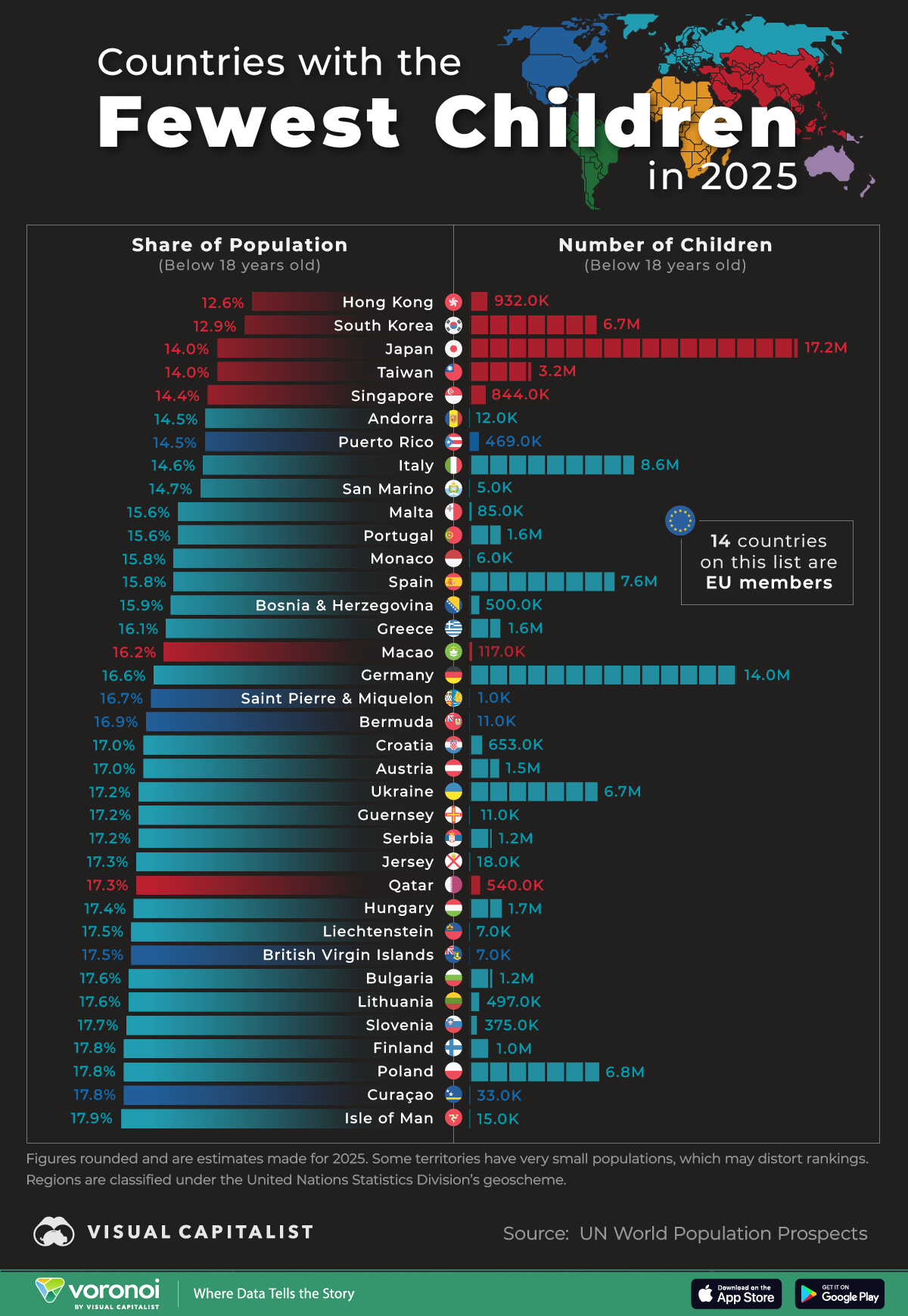
Ranked: Countries With the Fewest Children in 2025
This was originally posted on our Voronoi app. Download the app for free on iOS or Android and discover incredible data-driven charts from a variety of trusted sources.
Key Takeaways
- South Korea (12.9%) & Japan (14.0%) are the largest countries with the fewest children as a share of the population in 2025.
- No African, South Asian, or Latin American mainland countries appear on the list — a sign of younger populations.
Children are becoming rarer in many high-income economies. Fertility rates have fallen, life expectancy has risen, and migration patterns are shifting age structures.
The infographic linked above ranks 36 countries where fewer than one-fifth of residents are under 18 years old.
Data for the above visualization comes from the UN World Population Prospects, using projections for 2025.
Understanding where the fewest children live matters because it foreshadows shrinking workforces, changing consumer demand, and mounting pressures on pension systems.
Ranked: Countries With the Fewest Children by Population Share
Hong Kong (12.6%), South Korea (12.9%), and Japan (14.0%) have the fewest children as a share of the population in 2025.
Relatedly, they also have some of the highest shares of seniors.
| Rank | Country | % of Population Below 18 |
<18 Population in 2025 |
Total Population in 2025 |
|---|---|---|---|---|
| 1 | Hong Kong | 12.6% | 932.0K | 7.4M |
| 2 | South Korea | 12.9% | 6.7M | 51.7M |
| 3 | Japan | 14.0% | 17.2M | 123.1M |
| 4 | Taiwan | 14.0% | 3.2M | 23.1M |
| 5 | Singapore | 14.4% | 844.0K | 5.9M |
| 6 | Andorra | 14.5% | 12.0K | 83K |
| 7 | Puerto Rico | 14.5% | 469.0K | 3.2M |
| 8 | Italy | 14.6% | 8.6M | 59.1M |
| 9 | San Marino | 14.7% | 5.0K | 34K |
| 10 | Malta | 15.6% | 85.0K | 545K |
| 11 | Portugal | 15.6% | 1.6M | 10.4M |
| 12 | Monaco | 15.8% | 6.0K | 38K |
| 13 | Spain | 15.8% | 7.6M | 47.9M |
| 14 | Bosnia & Herzegovina | 15.9% | 500.0K | 3.1M |
| 15 | Greece | 16.1% | 1.6M | 9.9M |
| 16 | Macao | 16.2% | 117.0K | 722K |
| 17 | Germany | 16.6% | 14.0M | 84.1M |
| 18 | Saint Pierre & Miquelon | 16.7% | 1.0K | 6K |
| 19 | Bermuda | 16.9% | 11.0K | 65K |
| 20 | Croatia | 17.0% | 653.0K | 3.8M |
| 21 | Austria | 17.0% | 1.5M | 9.1M |
| 22 | Ukraine | 17.2% | 6.7M | 39.0M |
| 23 | Guernsey | 17.2% | 11.0K | 64K |
| 24 | Serbia | 17.2% | 1.2M | 6.7M |
| 25 | Jersey | 17.3% | 18.0K | 104K |
| 26 | Qatar | 17.3% | 540.0K | 3.1M |
| 27 | Hungary | 17.4% | 1.7M | 9.6M |
| 28 | Liechtenstein | 17.5% | 7.0K | 40K |
| 29 | British Virgin Islands | 17.5% | 7.0K | 40K |
| 30 | Bulgaria | 17.6% | 1.2M | 6.7M |
| 31 | Lithuania | 17.6% | 497.0K | 2.8M |
| 32 | Slovenia | 17.7% | 375.0K | 2.1M |
| 33 | Finland | 17.8% | 1.0M | 5.6M |
| 34 | Poland | 17.8% | 6.8M | 38.1M |
| 35 | Curaçao | 17.8% | 33.0K | 185K |
| 36 | Isle of Man | 17.9% | 15.0K | 84K |
Note: The source lists figures for overseas territories and special administrative regions like Puerto Rico and Hong Kong separately. They have been included as-is for full transparency.
In fact, all the top five are East Asian economies: Hong Kong, South Korea, Japan, Taiwan, and Singapore.
All share below-replacement fertility rates, high urban density, late marriage trends, and expensive housing.
South Korea stands out; its fertility rate fell to a world-low 0.72 in 2023. As a result, policymakers ramped up cash incentives and childcare subsidies to help adults bear associated costs.
As it happens, South Korea’s birth rate has rebounded to a generational high, signaling that demographics can turn on a dime.
Europe’s Demographic Squeeze
Europe dominates the remainder of the ranking, with Italy (14.6%), Portugal (15.6%), and Germany (16.6%) leading the way.
Low birth rates have persisted since the 1990s, and net migration has only partially offset population aging.
In fact, Italy’s median age is projected to hit 50 in 2030, complicating the funding of its already-strained pension system.
Meanwhile, smaller micro-states such as Andorra, San Marino, and Monaco mirror their neighbors’ demographic challenges but lack the labor market scale to import workers easily.
Missing From the List: The Global South
Noticeably, no mainland countries from Africa, South Asia, or Latin America appear in the ranking.
Nigeria, India, and Brazil all have far younger populations. More than half of Nigerians are under 18.
That youth bulge can be a demographic dividend if education and jobs keep pace.
Conversely, aging economies may lean on immigration from these regions to sustain growth.
The stark contrast underscores how development paths today are producing two distinct worlds: one scrambling to support grandparents, the other striving to educate grandchildren.
Learn More on the Voronoi App
If you enjoyed today’s post, check out When Every Continent’s Population Will Peak This Century on Voronoi, the new app from Visual Capitalist.