
See more visuals like this on the Voronoi app.
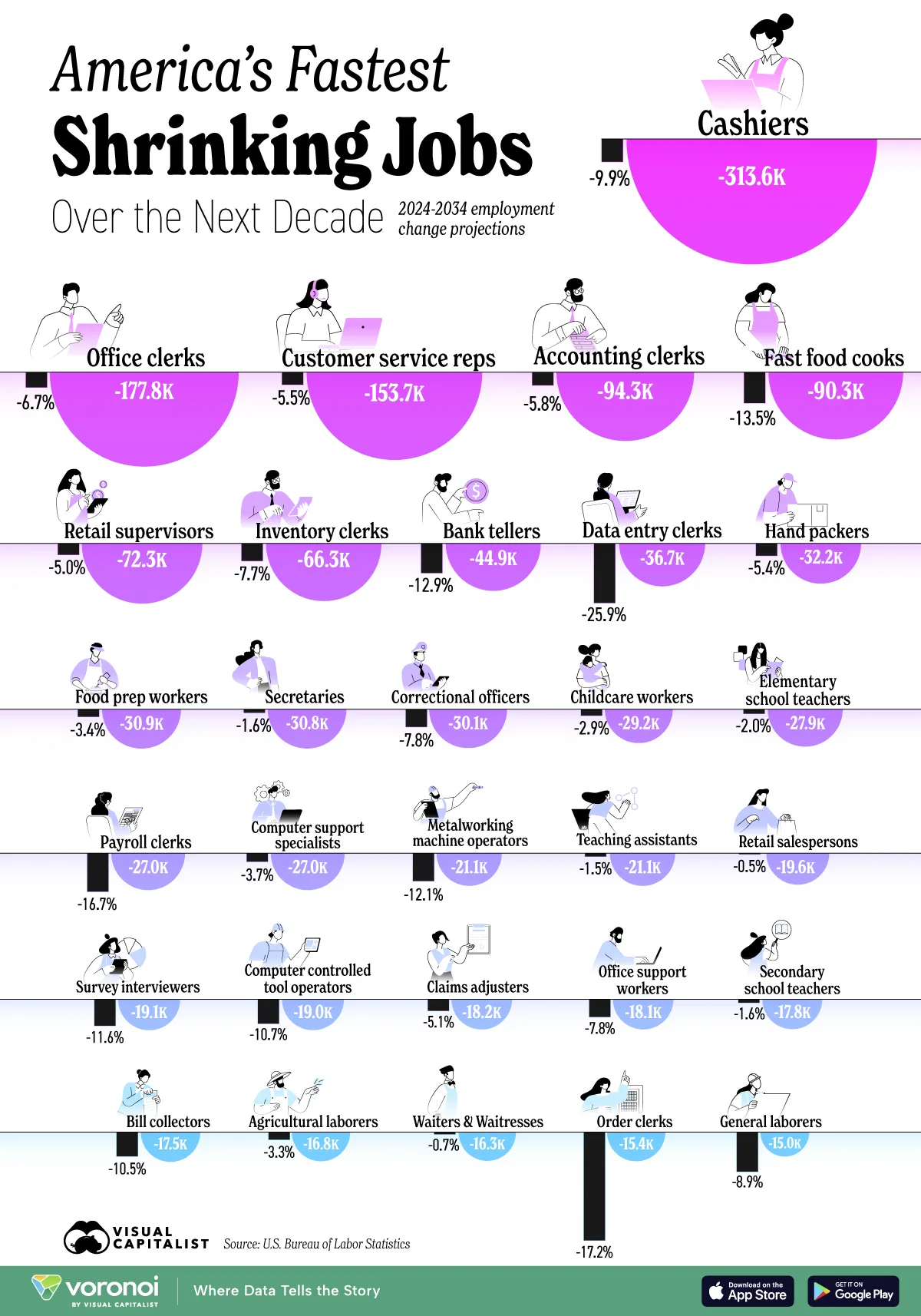
Ranked: The Fastest Shrinking Jobs in America by 2034
This was originally posted on our Voronoi app. Download the app for free on iOS or Android and discover incredible data-driven charts from a variety of trusted sources.
Key Takeaways
- Routine clerical roles like data entry clerks and payroll clerks are projected to see some of the steepest percentage declines due to automation.
- Customer-facing jobs such as cashiers and bank tellers are among the largest absolute job losses, reflecting the shift to digital self-serve technologies.
America’s labor market is undergoing a transformation as automation, artificial intelligence, and digitalization reshape the workplace.
To see where technology will have the most impact, we’ve visualized the fastest shrinking jobs in America by 2034, based on projections from the U.S. Bureau of Labor Statistics (BLS).
Data & Discussion
This data comes from the BLS Employment Projections (EP) program, which projects employment changes across hundreds of occupations from 2024 to 2034.
In our graphic, the fastest shrinking jobs are ranked by their absolute losses, with percentage declines included for context.
| Occupation | Employment change (%) | Employment change |
|---|---|---|
| Cashiers | -9.9% | -313,600 |
| Office clerks | -6.7% | -177,800 |
| Customer service reps | -5.5% | -153,700 |
| Accounting & auditing clerks | -5.8% | -94,300 |
| Fast food cooks | -13.5% | -90,300 |
| Retail supervisors | -5% | -72,300 |
| Inventory clerks | -7.7% | -66,300 |
| Bank tellers | -12.9% | -44,900 |
| Data entry clerk | -25.9% | -36,700 |
| Hand packers | -5.4% | -32,200 |
| Food prep workers | -3.4% | -30,900 |
| Secretaries (excl. legal and medical) | -1.6% | -30,800 |
| Correctional officers | -7.8% | -30,100 |
| Childcare workers | -2.9% | -29,200 |
| Elementary school teachers | -2% | -27,900 |
| Payroll clerks | -16.7% | -27,000 |
| Computer support specialists | -3.7% | -27,000 |
| Metalworking machine operators | -12.1% | -21,100 |
| Teaching assistants (excl. post-secondary) | -1.5% | -21,100 |
| Retail salespersons | -0.5% | -19,600 |
| Survey interviewers | -11.6% | -19,100 |
| Computer numerically controlled tool operators | -10.7% | -19,000 |
| Claims adjusters & investigators | -5.1% | -18,200 |
| Office & administrative support workers | -7.8% | -18,100 |
| Secondary school teachers | -1.6% | -17,800 |
| Bill & account collectors | -10.5% | -17,500 |
| Agricultural laborers | -3.3% | -16,800 |
| Waiters & waitresses | -0.7% | -16,300 |
| Order clerks | -17.2% | -15,400 |
| General laborer (manufacturing) | -8.9% | -15,000 |
Automation Hits Routine Roles Hardest
The steepest percentage losses are concentrated in office-based clerical roles. Data entry clerks, for example, are projected to decline by 25.9%, the largest percentage drop among all occupations.
Payroll clerks follow closely with a 16.7% decrease, while bank tellers also see double-digit declines. These jobs involve repetitive, rule-based tasks that can be automated by software or AI systems, reducing the need for human input.
U.S. companies driving this wave of automation include ServiceNow (ticker: NOW), UiPath (ticker: PATH), and Workday (ticker: WDAY).
Retail and Service Jobs Face Large Absolute Losses
Cashiers are expected to see the biggest total job losses as checkout systems, mobile ordering, and self-pay kiosks expand. Similarly, customer service representatives and retail supervisors are projected to shrink by over 150,000 and 70,000 positions respectively.
According to the Census Bureau, the retail industry supports over a quarter of U.S. jobs, meaning this trend could have a major impact on society.
Learn More on the Voronoi App
If you enjoyed today’s post, check out Which Jobs Are Safest From AI? on Voronoi, the new app from Visual Capitalist.