
See more visualizations like this on the Voronoi app.
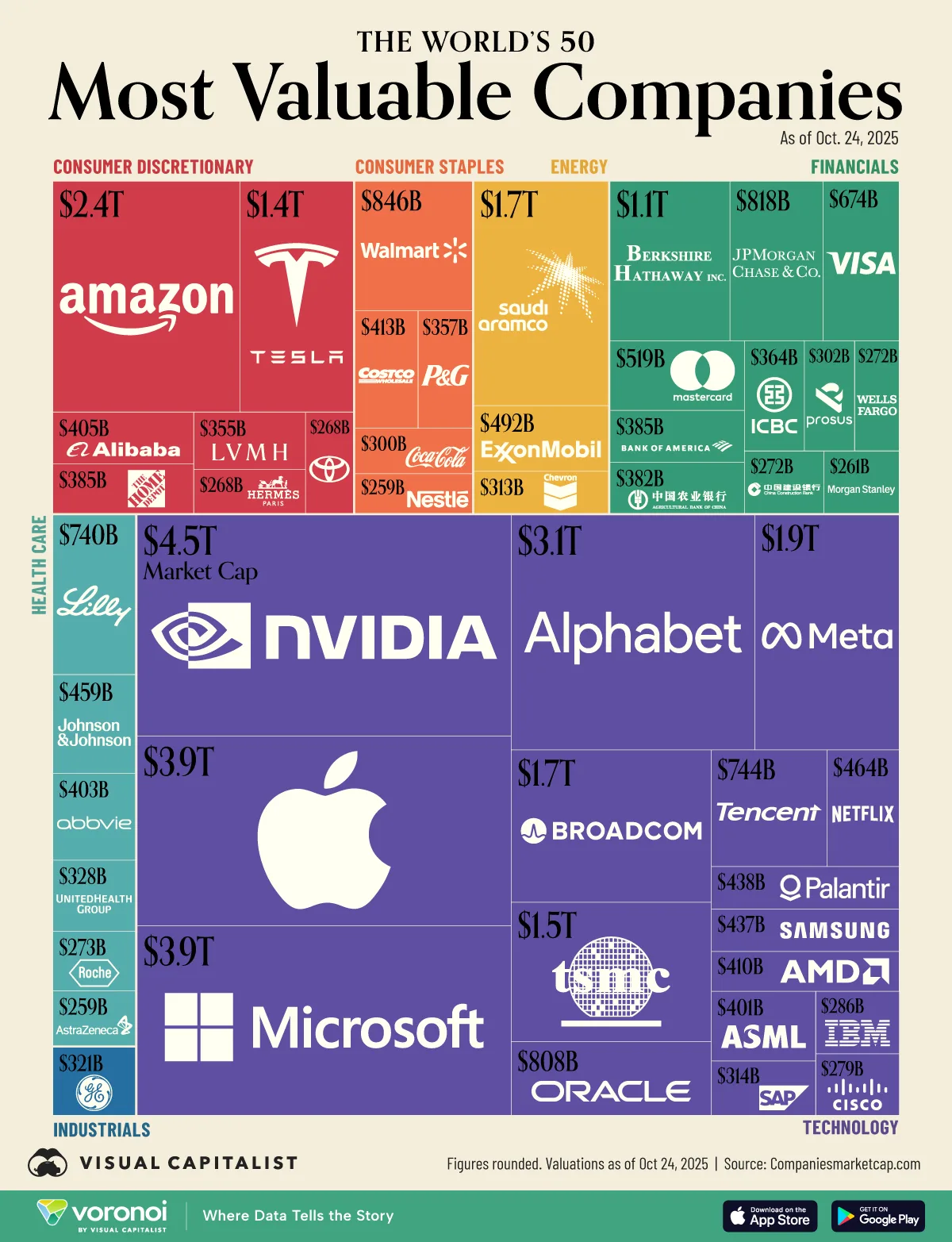
Ranked: The World’s 50 Most Valuable Companies in October 2025
See visuals like this from many other data creators on our Voronoi app. Download it for free on iOS or Android and discover incredible data-driven charts from a variety of trusted sources.
Key Takeaways
- Nvidia has pulled ahead of the rest of its Magnificent Seven peers, nearing an historic $5T valuation.
- Rival chipmaker AMD has surpassed $400B for the first time, riding off a series of catalysts including an OpenAI chip deal and a quantum computing deal with IBM.
The world’s most valuable companies have continued to grow larger in 2025, with the tech sector’s prevalence more profound than ever.
To see how things look as we approach the final two months of the year, we’ve ranked the top 50 companies by their market capitalization as of Oct. 24, sorted by industry.
Data & Discussion
The data for this visualization was sourced from CompaniesMarketCap, a simple and effective tool for tracking real-time market capitalization of publicly-traded firms.
| Name | Sector | Market Cap |
|---|---|---|
| Amazon | Consumer Discretionary | $2,391,180,000,000 |
| Tesla | Consumer Discretionary | $1,442,470,000,000 |
| Alibaba | Consumer Discretionary | $405,129,000,000 |
| Home Depot | Consumer Discretionary | $384,896,000,000 |
| LVMH | Consumer Discretionary | $355,009,000,000 |
| Hermès | Consumer Discretionary | $268,064,000,000 |
| Toyota | Consumer Discretionary | $267,678,000,000 |
| Walmart | Consumer Staples | $846,478,000,000 |
| Costco | Consumer Staples | $413,105,000,000 |
| Procter & Gamble | Consumer Staples | $356,901,000,000 |
| Coca-Cola | Consumer Staples | $299,892,000,000 |
| Nestlé | Consumer Staples | $259,050,000,000 |
| Saudi Aramco | Energy | $1,667,830,000,000 |
| Exxon Mobil | Energy | $491,936,000,000 |
| Chevron | Energy | $313,426,000,000 |
| Berkshire Hathaway | Financials | $1,061,810,000,000 |
| JPMorgan Chase | Financials | $817,858,000,000 |
| Visa | Financials | $674,244,000,000 |
| Mastercard | Financials | $518,604,000,000 |
| Bank of America | Financials | $385,308,000,000 |
| Agricultural Bank of China | Financials | $381,791,000,000 |
| ICBC | Financials | $364,370,000,000 |
| Prosus | Financials | $302,205,000,000 |
| Wells Fargo | Financials | $272,100,000,000 |
| China Construction Bank | Financials | $271,816,000,000 |
| Morgan Stanley | Financials | $260,701,000,000 |
| Eli Lilly | Health Care | $739,980,000,000 |
| Johnson & Johnson | Health Care | $458,730,000,000 |
| AbbVie | Health Care | $402,758,000,000 |
| UnitedHealth | Health Care | $328,307,000,000 |
| Roche | Health Care | $272,998,000,000 |
| AstraZeneca | Health Care | $259,460,000,000 |
| General Electric | Industrials | $320,526,000,000 |
| NVIDIA | Technology | $4,534,870,000,000 |
| Apple | Technology | $3,900,350,000,000 |
| Microsoft | Technology | $3,892,040,000,000 |
| Alphabet | Technology | $3,146,160,000,000 |
| Meta | Technology | $1,854,860,000,000 |
| Broadcom | Technology | $1,672,330,000,000 |
| TSMC | Technology | $1,529,820,000,000 |
| Oracle | Technology | $807,715,000,000 |
| Tencent | Technology | $744,318,000,000 |
| Netflix | Technology | $463,856,000,000 |
| Palantir | Technology | $438,006,000,000 |
| Samsung | Technology | $437,015,000,000 |
| AMD | Technology | $410,450,000,000 |
| ASML | Technology | $400,995,000,000 |
| SAP | Technology | $313,919,000,000 |
| IBM | Technology | $286,405,000,000 |
| Cisco | Technology | $279,214,000,000 |
Nvidia’s Rise to $4.5 Trillion
Nvidia leads the world with a staggering valuation of $4.53 trillion, surpassing both Apple ($3.9 trillion) and Microsoft ($3.89 trillion).
Nvidia GPUs remain the backbone of AI model training, with customers like OpenAI committing billions of dollars to buy its chips.
Nvidia has also committed to investing $100 billion in OpenAI to build more data centers, raising concerns about the circular nature of recent deals between major AI players.
OpenAI is currently the world’s most valuable private tech company, valued at $500 billion.
AI is Everywhere
The AI craze is creating many more winners than just Nvidia.
For example, in early October, AMD and OpenAI announced a strategic partnership to deploy 6 gigawatts of AMD GPUs. A week later, OpenAI followed up with a strategic collaboration with Broadcom to deploy 10 gigawatts of custom AI chips.
Broadcom shares are up 56% year to date, while AMD has rocketed 115% (its shares climbed 43% the week of the OpenAI announcement).
Fact: The average annual return of the S&P 500 is about 10%.
On the software side, Palantir has quickly risen to become the world’s 45th most valuable company, setting record-breaking P/E and P/S ratios along the way. The firms develops AI platforms that digest vast amounts of data to make predictive insights.
Palantir has been the best-performing S&P 500 stock since its addition to the index in September 2024, and has climbed 1,956% since its October 2020 IPO.
Learn More on the Voronoi App
If you enjoyed today’s post, check out Average S&P 500 Returns by Zodiac Year on Voronoi, the new app from Visual Capitalist.