
See this visualization first on the Voronoi app.
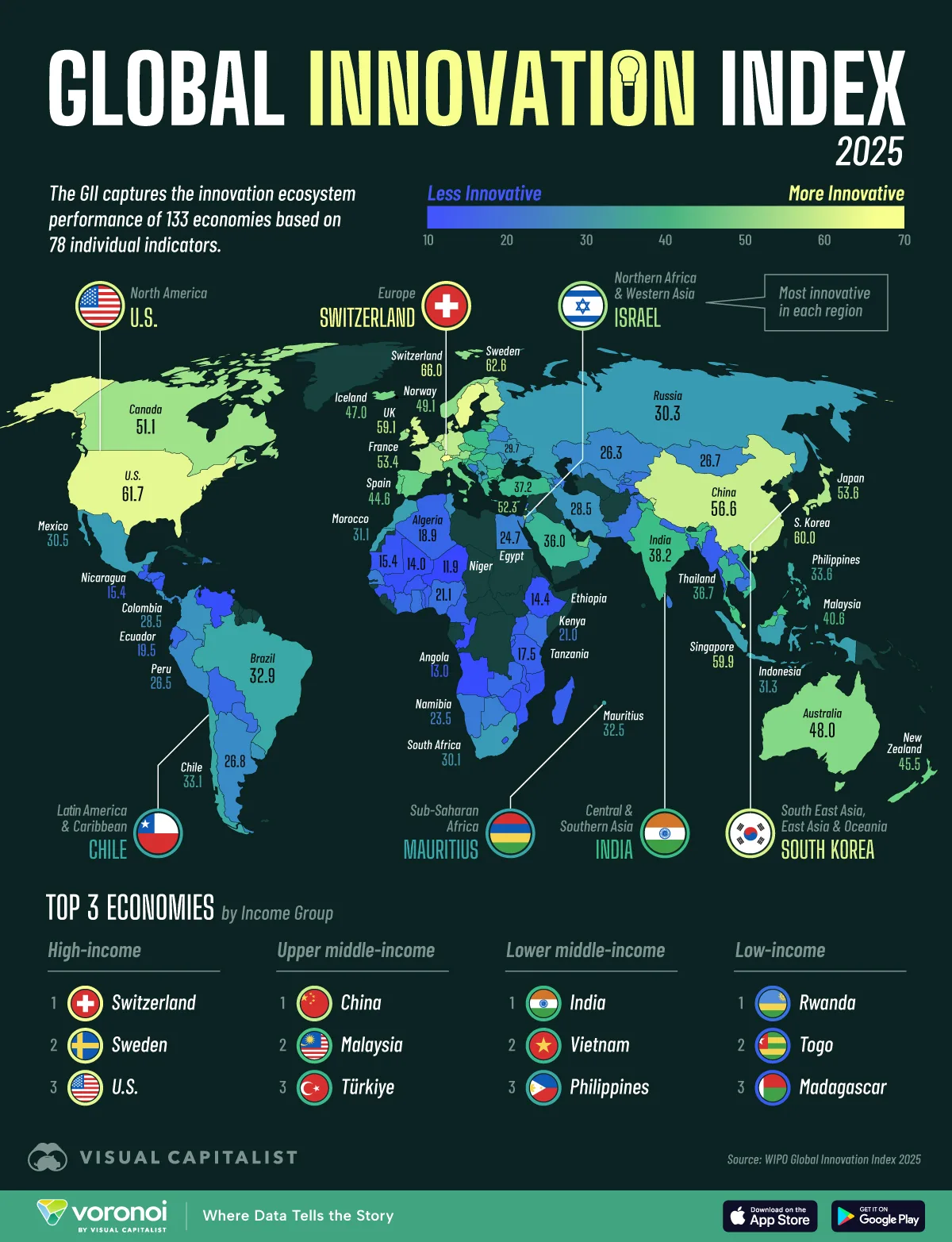
Ranked: The World’s Most Innovative Countries in 2025
This was originally posted on our Voronoi app. Download the app for free on iOS or Android and discover incredible data-driven charts from a variety of trusted sources.
Key Takeaways
- This graphic maps the main results of the Global Innovation Index (GII) 2025, which captures the innovation ecosystem performance of 139 economies.
- China has entered the GII’s top 10 for the first time, while South Korea climbed to fourth (its highest position to date).
Innovation is often viewed as the backbone of economic competitiveness.
In this graphic, we’ve visualized the results of the annual Global Innovation Index (GII), which ranks countries on their ability to foster research and entrepreneurship.
In our map, lower scores are shown as darker shades of blue, transitioning to green and then yellow as score increases.
Data & Discussion
The data for this visualization comes from the World Intellectual Property Organization (WIPO).
| GII Rank | Economy | Score |
|---|---|---|
| 1 | Switzerland | 66.0 |
| 2 | Sweden | 62.6 |
| 3 | U.S. | 61.7 |
| 4 | South Korea | 60.0 |
| 5 | Singapore | 59.9 |
| 6 | UK | 59.1 |
| 7 | Finland | 57.7 |
| 8 | Netherlands | 57.0 |
| 9 | Denmark | 56.9 |
| 10 | China | 56.6 |
| 11 | Germany | 55.5 |
| 12 | Japan | 53.6 |
| 13 | France | 53.4 |
| 14 | Israel | 52.3 |
| 15 | Hong Kong | 51.5 |
| 16 | Estonia | 51.1 |
| 17 | Canada | 51.1 |
| 18 | Ireland | 50.4 |
| 19 | Austria | 50.1 |
| 20 | Norway | 49.2 |
| 21 | Belgium | 48.5 |
| 22 | Australia | 48.0 |
| 23 | Luxembourg | 47.3 |
| 24 | Iceland | 47.0 |
| 25 | Cyprus | 45.5 |
| 26 | New Zealand | 45.5 |
| 27 | Malta | 45.4 |
| 28 | Italy | 44.9 |
| 29 | Spain | 44.6 |
| 30 | UAE | 44.2 |
| 31 | Portugal | 43.9 |
| 32 | Czech Republic | 42.0 |
| 33 | Lithuania | 40.8 |
| 34 | Malaysia | 40.6 |
| 35 | Slovenia | 40.1 |
| 36 | Hungary | 40.0 |
| 37 | Bulgaria | 39.1 |
| 38 | India | 38.2 |
| 39 | Poland | 37.7 |
| 40 | Croatia | 37.7 |
| 41 | Latvia | 37.5 |
| 42 | Greece | 37.4 |
| 43 | Türkiye | 37.2 |
| 44 | Vietnam | 37.1 |
| 45 | Thailand | 36.7 |
| 46 | Saudi Arabia | 36.0 |
| 47 | Slovakia | 35.5 |
| 48 | Qatar | 34.6 |
| 49 | Romania | 34.3 |
| 50 | Philippines | 33.6 |
| 51 | Chile | 33.1 |
| 52 | Brazil | 32.9 |
| 53 | Mauritius | 32.5 |
| 54 | Serbia | 31.7 |
| 55 | Indonesia | 31.3 |
| 56 | Georgia | 31.2 |
| 57 | Morocco | 31.1 |
| 58 | Mexico | 30.5 |
| 59 | Armenia | 30.5 |
| 60 | Russia | 30.3 |
| 61 | South Africa | 30.1 |
| 62 | Bahrain | 30.0 |
| 63 | North Macedonia | 29.8 |
| 64 | Montenegro | 29.8 |
| 65 | Jordan | 29.7 |
| 66 | Ukraine | 29.7 |
| 67 | Albania | 29.6 |
| 68 | Uruguay | 28.8 |
| 69 | Oman | 28.7 |
| 70 | Iran | 28.5 |
| 71 | Colombia | 28.5 |
| 72 | Costa Rica | 28.4 |
| 73 | Kuwait | 28.2 |
| 74 | Moldova | 27.4 |
| 75 | Seychelles | 27.2 |
| 76 | Tunisia | 27.0 |
| 77 | Argentina | 26.8 |
| 78 | Mongolia | 26.7 |
| 79 | Uzbekistan | 26.5 |
| 80 | Peru | 26.5 |
| 81 | Kazakhstan | 26.3 |
| 82 | Panama | 25.9 |
| 83 | Jamaica | 25.2 |
| 84 | Barbados | 25.1 |
| 85 | Belarus | 25.1 |
| 86 | Egypt | 24.7 |
| 87 | Botswana | 24.6 |
| 88 | Brunei Darussalam | 24.5 |
| 89 | Senegal | 23.8 |
| 90 | Lebanon | 23.6 |
| 91 | Namibia | 23.5 |
| 92 | Bosnia and Herzegovina | 23.4 |
| 93 | Sri Lanka | 22.9 |
| 94 | Azerbaijan | 22.9 |
| 95 | Cabo Verde | 22.6 |
| 96 | Kyrgyzstan | 22.6 |
| 97 | Dominican Republic | 22.6 |
| 98 | El Salvador | 22.2 |
| 99 | Pakistan | 22.1 |
| 100 | Cambodia | 22.0 |
| 101 | Ghana | 21.9 |
| 102 | Kenya | 21.4 |
| 103 | Paraguay | 21.4 |
| 104 | Rwanda | 21.1 |
| 105 | Nigeria | 21.1 |
| 106 | Bangladesh | 21.0 |
| 107 | Nepal | 20.2 |
| 108 | Tajikistan | 20.2 |
| 109 | Laos | 20.1 |
| 110 | Côte d'Ivoire | 19.7 |
| 111 | Bolivia | 19.6 |
| 112 | Zambia | 19.6 |
| 113 | Ecuador | 19.5 |
| 114 | Trinidad and Tobago | 19.3 |
| 115 | Algeria | 18.9 |
| 116 | Cameroon | 18.2 |
| 117 | Togo | 18.1 |
| 118 | Benin | 17.8 |
| 119 | Honduras | 17.7 |
| 120 | Madagascar | 17.6 |
| 121 | Tanzania | 17.5 |
| 122 | Myanmar | 17.3 |
| 123 | Guatemala | 17.1 |
| 124 | Uganda | 17.1 |
| 125 | Malawi | 16.0 |
| 126 | Burkina Faso | 15.9 |
| 127 | Burundi | 15.8 |
| 128 | Mozambique | 15.4 |
| 129 | Zimbabwe | 15.4 |
| 130 | Nicaragua | 15.4 |
| 131 | Mauritania | 15.4 |
| 132 | Lesotho | 14.9 |
| 133 | Guinea | 14.9 |
| 134 | Ethiopia | 14.4 |
| 135 | Mali | 14.0 |
| 136 | Venezuela | 13.7 |
| 137 | Congo | 13.6 |
| 138 | Angola | 13.0 |
| 139 | Niger | 11.9 |
The Global Innovation Index (GII) 2025 defines innovation broadly to not only include R&D-driven breakthroughs, but also incremental, non-R&D and frugal innovations.
It measures this through two equally weighted sub-indices: Inputs (five pillars covering investment, human capital, infrastructure, and enabling conditions) and Outputs (two pillars covering knowledge & technology outputs, and creative outputs).
The 2025 framework uses 78 indicators and reflects WIPO’s efforts to modernize measurement, integrate new data sources, and better capture today’s complex, distributed, and digital innovation ecosystems.
Europe’s Longstanding Leadership
European nations continue to rank as some of the world’s most innovative countries.
Switzerland tops the index for the 15th consecutive year, while Sweden, the UK, Finland, the Netherlands, and Denmark land in the top 10.
Switzerland ranks in the top 10 for all seven underlying pillars, but only claims first in “creative outputs”.
America is the Third Most Innovative Country
The U.S. retains third place in the GII for the third year in a row, ranking first in two underlying pillars: “market sophistication” and “business sophistication”.
Where America falls behind is in “infrastructure”, ranking only 32nd in the world. The “infrastructure” pillar is composed of three indicators:
- Information and communication technologies (ranked 9th)
- General infrastructure (ranked 13th)
- Ecological sustainability (ranked 98th)
Based on these scores and the methodology used by WIPO, ecological sustainability appears to be America’s weak point. This indicator considers energy efficiency, reliance on low-carbon energy, and the adoption of environmental management practices.
Asia Climbs the Innovation Rankings
The Asia region has showed strong momentum in the GII 2025, with South Korea reaching a record-high fourth place. The country took first place in the “human capital and research” pillar, and scores highly in various R&D metrics.
China also entered the GII top 10 for the first time, making it the only middle-income economy within the top 30. According to WIPO estimates, China was the world’s biggest R&D spender and leads globally in patent filings.
Learn More on the Voronoi App
If you enjoyed today’s post, check out The iPhone Price Index on Voronoi, the new app from Visual Capitalist.