Magnificent 7 Concentration in the Nasdaq 100 Over Time
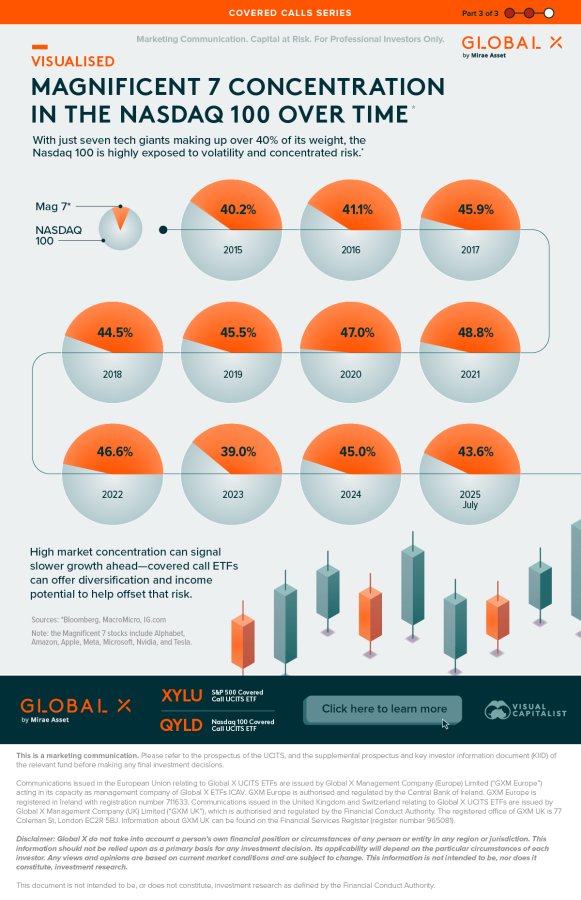
The Nasdaq 100, a key benchmark for U.S. technology companies, is remarkably concentrated. Just seven stocks make up nearly 40% of the entire index.
This visualisation—created in partnership with Global X and using data from Bloomberg—highlights the extent of this market capitalization concentration. This offers a clear look at how a handful of companies dominate the index.
What Is the Nasdaq 100?
The Nasdaq 100 is one of the most widely followed equity indices in the world. It tracks the performance of the 100 largest non-financial companies listed on the Nasdaq Stock Exchange. While it is best known for its heavy weighting in technology firms, the index also includes some leaders in other sectors.
Unlike the broader Nasdaq Composite, the Nasdaq 100 focuses exclusively on the largest and most influential companies. Because of this, it has become a key benchmark for investors looking to gain exposure to high-growth, large-cap businesses.
What Is Concentration Risk?
The Nasdaq 100’s heavy tilt toward a handful of mega-cap tech stocks creates concentration risk. This means the index’s performance relies too heavily on just a few companies.
These seven giants—Alphabet, Amazon, Apple, Meta, Microsoft, Nvidia, and Tesla, often called the “Magnificent 7”—have dominated the index for years. Their combined weight has hovered around 40% over the past decade, reaching 43.6% as of July.
| Year | Mag 7 Market Concentration in Nasdaq 100 (%) |
|---|---|
| 2015 | 40.2 |
| 2016 | 41.1 |
| 2017 | 45.9 |
| 2018 | 44.5 |
| 2019 | 45.5 |
| 2020 | 47.0 |
| 2021 | 48.8 |
| 2022 | 46.6 |
| 2023 | 39.0 |
| 2024 | 45.0 |
| July 2025 | 43.6 |
Such concentration can also weigh on long-term growth. When market gains are driven by only a few players, it limits broader participation. This makes future returns less sustainable and more uncertain.
Covered Call Options
A Nasdaq 100 covered call ETF offers investors a way to stay exposed to the index while softening the impact of concentration risk. By writing call options on the underlying holdings, these funds generate additional income that can help offset potential losses if a few dominant stocks experience volatility.