Which Countries Are Winning the Resilience Race?
Key Takeaways
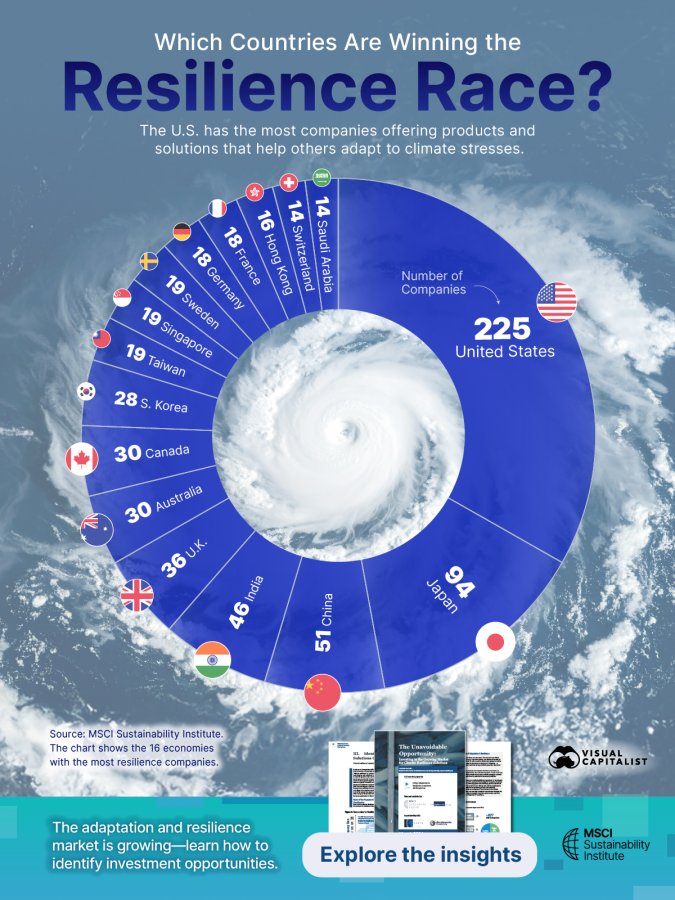
- The U.S. has the most companies offering products and solutions that help others adapt to climate stresses.
- Two-thirds of resilience companies are located in developed markets.
Extreme weather and climate change keep rewriting the playbook for governments and businesses. As risks mount, society is racing to build resilience.
This graphic, in partnership with MSCI, shows which countries have the most companies offering solutions that help others protect themselves against physical climate risks.
What Are Resilience Companies?
In most cases, a company will not self-identify as a climate resilience or adaptation company. Investors can identify these companies if they have a significant business line in a technology, product, or service that prevents or reduces the impact before, during, or after climate stresses.
Here are some examples of climate solutions:
- Early monitoring systems for floods or wildfires
- Vaccines for new diseases
- Water storage technologies
It’s important to note that adaptation and resilience companies are businesses that offer these solutions to third parties. If a company is taking steps to make their own operations more resilient, experts consider this a normal element of risk management.
Resilience Companies by Country
Using this framework, MSCI has identified more than 800 publicly-traded companies that help others adapt and be resilient to climate stresses. This represents about 11% of the public global equity market, as measured by the MSCI ACWI IMI Index.
The U.S. has the largest share of resilience companies.
| Country/Economy | Number of Companies |
|---|---|
| United States | 225 |
| Japan | 94 |
| China | 51 |
| India | 46 |
| United Kingdom | 36 |
| Australia | 30 |
| Canada | 30 |
| South Korea | 28 |
| Taiwan | 19 |
| Singapore | 19 |
| Sweden | 19 |
| Germany | 18 |
| France | 18 |
| Hong Kong | 16 |
| Switzerland | 14 |
| Saudi Arabia | 14 |
Source: MSCI Sustainability Institute. The chart shows the 16 economies with the most resilience companies.
Overall, two-thirds of these companies are located in developed markets. China and India have the largest representation among developing markets. Why should investors pay attention to these companies?
A Compelling Investment Opportunity
The effects of climate change are widespread and worsening. For instance, billion-dollar weather disasters in America have become more frequent and costly with each passing decade. According to insurers, climate change is the top emerging risk, tied with war.
On top of this, BlackRock has noticed rising demand for resilience solutions. Companies that offer these solutions are poised to benefit from the rising demand, but few easily investable products are available to investors.