
See more visuals like this on the Voronoi app.
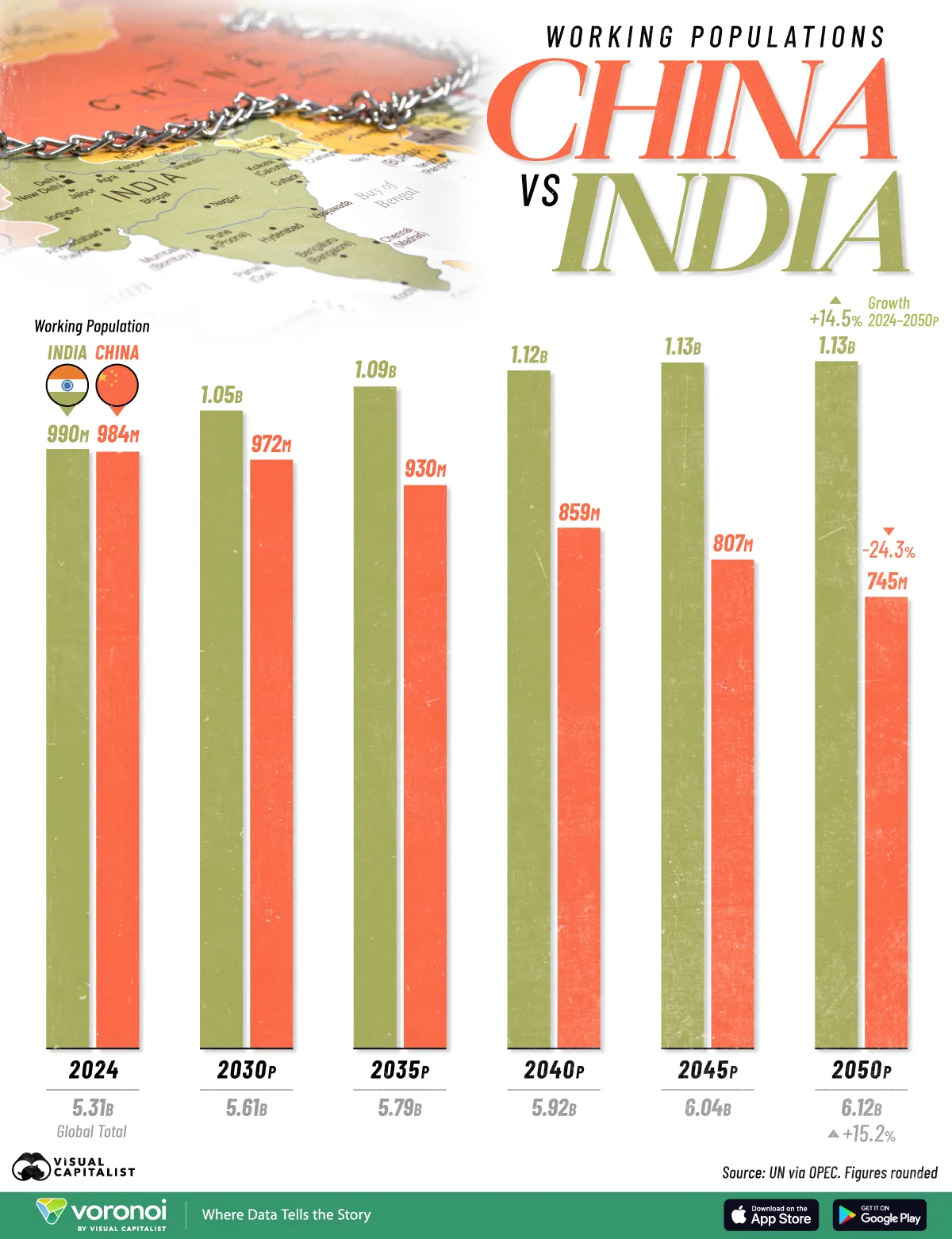
Charted: India vs. China Working Age Populations, 2024–2050
See visuals like this from many other data creators on our Voronoi app. Download it for free on iOS or Android and discover incredible data-driven charts from a variety of trusted sources.
Key Takeaways
- India’s working-age population is projected to grow by 14.5% through 2050, adding 144 million people.
- China’s working-age population is expected to shrink by 24%, losing 239 million workers over the same period.
India and China are home to the world’s two largest labor forces, and their demographic paths are diverging rapidly. New projections highlight a critical economic shift: India is still expanding its pool of working-age adults, while China is entering a long period of contraction.
This infographic visualizes how each country’s labor force will evolve from 2024 to 2050 and the scale of change relative to the global workforce.
These demographic trajectories have major implications for manufacturing, economic growth, and the balance of global influence. As China ages, India is positioned to become the world’s largest source of labor, reshaping global supply chains and investment flows.
Data & Discussion
The data for this visualization comes from the UN, as compiled by OPEC’s World Oil Outlook 2025. It tracks projected working-age populations (15–64) through 2050 for India, China, and the world.
India’s Expanding Labor Force
India’s working-age population grows from 990 million in 2024 to 1.13 billion by 2050. This adds 144 million potential workers—more than the current working-age population of Japan and Germany combined. The increase reflects India’s younger demographic structure and higher fertility rates.
| Country | 2024 (in millions) | 2030P | 2035P | 2040P | 2045P | 2050P | Growth 2024–2050 (in millions) | Growth % |
|---|---|---|---|---|---|---|---|---|
| India | 990 | 1,053 | 1,092 | 1,118 | 1,133 | 1,134 | 144 | 14.5% |
| China | 984 | 972 | 930 | 859 | 807 | 745 | -239 | -24.3% |
| World | 5,312 | 5,605 | 5,791 | 5,916 | 6,036 | 6,117 | 805 | 15.2% |
China’s Sharp Demographic Decline
China’s working-age population is already shrinking and is projected to fall from 984 million in 2024 to 745 million in 2050. That is a loss of 239 million workers—nearly one-quarter of its labor force.
The decline stems from decades of low fertility and an aging population. As the workforce contracts, China faces rising labor costs, slower growth potential, and greater pressure on social welfare systems.
A Shifting Global Center of Labor
While global working-age numbers increase modestly by 15.2% through 2050, India is responsible for a significant share of that growth.
By contrast, China’s decline acts as a drag on the global total. This shift could influence capital allocation, supply-chain strategy, and geopolitical power. For companies, India’s expanding workforce may become increasingly attractive for manufacturing, services, and technology hubs.
Learn More on the Voronoi App
If you enjoyed today’s post, check out Aging of the Population Accelerates in India on Voronoi, the new app from Visual Capitalist.