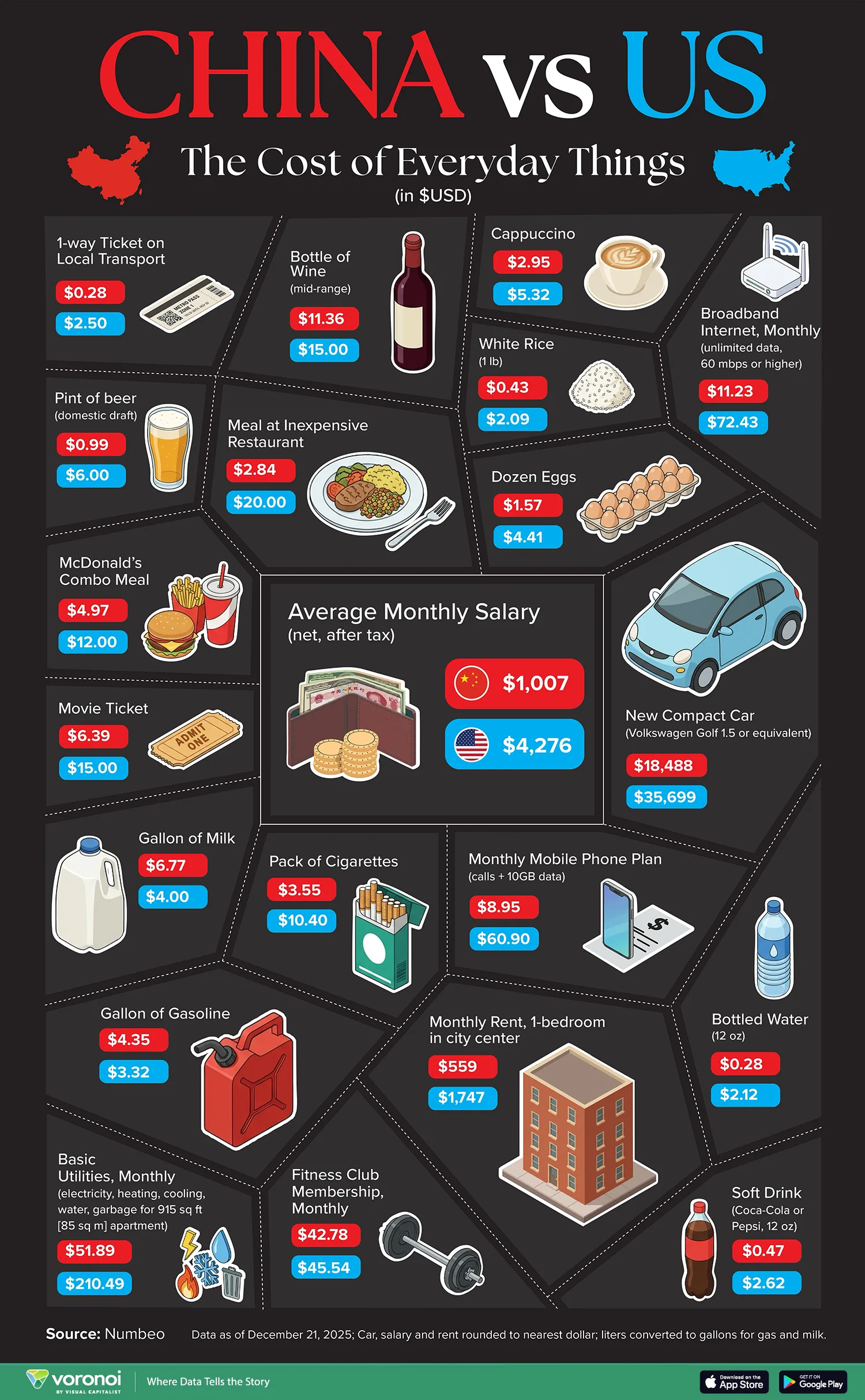
Visualized: The Cost of Everyday Things in China vs. the U.S.
This was originally posted on our Voronoi app. Download the app for free on iOS or Android and discover incredible data-driven charts from a variety of trusted sources.
Key Takeaways
- As a developing economy, China has drastically lower prices for most daily goods and services, but also a much lower average monthly salary.
- Basic utilities, internet, and rent are more than 3x cheaper in China compared to the U.S., easing overall cost of living.
- Surprisingly, items like milk, gasoline, and wine are more expensive in China despite its overall lower cost structure.
From broadband to Big Macs, the price of everyday essentials can vary dramatically depending on where you live.
This visual, by Julie Peasley, compares the cost of 20+ common items in China and the United States using data from Numbeo, the world’s largest crowdsourced cost-of-living database.
The chart offers a direct side-by-side view of consumer prices in U.S. dollars, giving insight into which country is more affordable across key spending categories. While the U.S. boasts higher average salaries, China’s everyday living expenses are very low.
Here’s a detailed look at the dataset used in the visualization:
| Item | China Cost ($USD) | US Cost ($USD) |
|---|---|---|
| Average Monthly Salary (Net, after Tax) | 1,007 | 4,276 |
| New Compact Car | 18,448 | 35,699 |
| Monthly Rent, 1-bedroom in city center | 559 | 1,747 |
| Monthly Basic Utilities | 51.89 | 210.49 |
| Monthly Mobile Phone Plan | 8.95 | 60.90 |
| Monthly Fitness Club Membership | 42.78 | 45.54 |
| Meal at an Inexpensive Restaurant | 2.84 | 20.00 |
| Bottle of Wine (Mid-Range) | 11.36 | 15.00 |
| Movie Ticket | 6.39 | 15.00 |
| Combo Meal McDonald’s | 4.97 | 12.00 |
| Pack of Cigarettes | 3.55 | 10.40 |
| Pint of Beer (Domestic Draft) | 0.99 | 6.00 |
| Cappuccino | 2.95 | 5.32 |
| Dozen Eggs | 1.57 | 4.41 |
| Milk (1 gallon) | 6.77 | 4.00 |
| Gasoline (1 gallon) | 4.35 | 3.32 |
| White Rice (1 lb) | 0.43 | 2.09 |
| Local Transport 1-Way Ticket | 0.28 | 2.50 |
| Soft Drink (Coca-Cola or Pepsi, 12 oz) | 0.47 | 2.62 |
| Bottled Water (12 oz) | 0.28 | 2.12 |
| Monthly Broadband Internet | 11.23 | 72.43 |
The biggest shock? Broadband internet in the U.S. costs over $72/month, compared to just $11 in China. Yet for some essentials, the tables turn: milk and gasoline are both more expensive in China, despite its typical cost structure.
Housing, Utilities, and Connectivity: Cheap in China
When it comes to fixed monthly costs, China is significantly cheaper. Renting a one-bedroom apartment in a city center costs $559 in China versus $1,747 in the U.S., a nearly 70% discount.
Likewise, basic utilities like electricity, heating, and garbage removal for an 85 m² apartment are just $52 per month in China, while Americans shell out over $210 on average. This massive difference is partly due to government subsidies and lower energy costs in China’s urban centers.
Food and Dining: Affordable Meals, but Not Always Cheaper Groceries
In China, an inexpensive restaurant meal costs just $2.84, versus $20 in the U.S., while a McDonald’s combo meal is less than half the price.
However, grocery items tell a more nuanced story. A gallon of milk in China costs $6.77, which is well above the U.S. average of $4. Meanwhile, a dozen eggs are $1.57 in China compared to $4.41 in the United States. Pricing discrepancies like this often stem from differing production models and import dependencies.
Salaries vs. Spending Power
The U.S. may be more expensive, but it also pays more: the average monthly salary after tax in the U.S. is $4,276, compared to just $1,007 in China. While this gap is significant, lower prices in China offset much of the income disparity, offering residents stronger local purchasing power for basic needs.
Still, U.S. consumers benefit from better affordability in certain categories like cigarettes, gasoline, and even gym memberships, which suggests the cost balance isn’t universally tilted.
For a wider global context, see our earlier piece: Mapped: The Global Cost of Living Index (2025).
Learn More on the Voronoi App 
Explore even more global cost-of-living data in this post: Ranked: U.S. Cities With the Highest Cost of Living.