
Use This Visualization
With a population smaller than a mid-sized American suburb and an economy heavily dependent on Danish subsidies, Greenland would seem an unlikely candidate for the center of a geopolitical firestorm. Yet this autonomous Danish territory—home to just 57,000 people and a GDP of roughly $3.3 billion—has become one of the most talked-about places on Earth.
On conventional maps, where bigger countries stand out, Greenland certainly looks important. The island visually rivals Africa in size, appearing as an imposing landmass stretching across the top of the globe. But that impression is a 500-year-old cartographic illusion.
The Mercator Distortion
In 1569, Flemish cartographer Gerardus Mercator created a map projection that would become the default for classrooms, atlases, and eventually Google Maps. The Mercator projection preserves angles and shapes that are essential for navigation, but at a significant cost: it dramatically inflates landmasses as they approach the poles.
The result? Greenland appears roughly the same size as Africa. In reality, Africa is 14 times larger.
The Numbers Behind the Distortion
According to data from climate scientist Neil Kaye and the interactive mapping tool at Engaging Data, Greenland is the single most exaggerated territory on Earth by percentage. It is actually 73.9% smaller than is shown on a Mercator map.
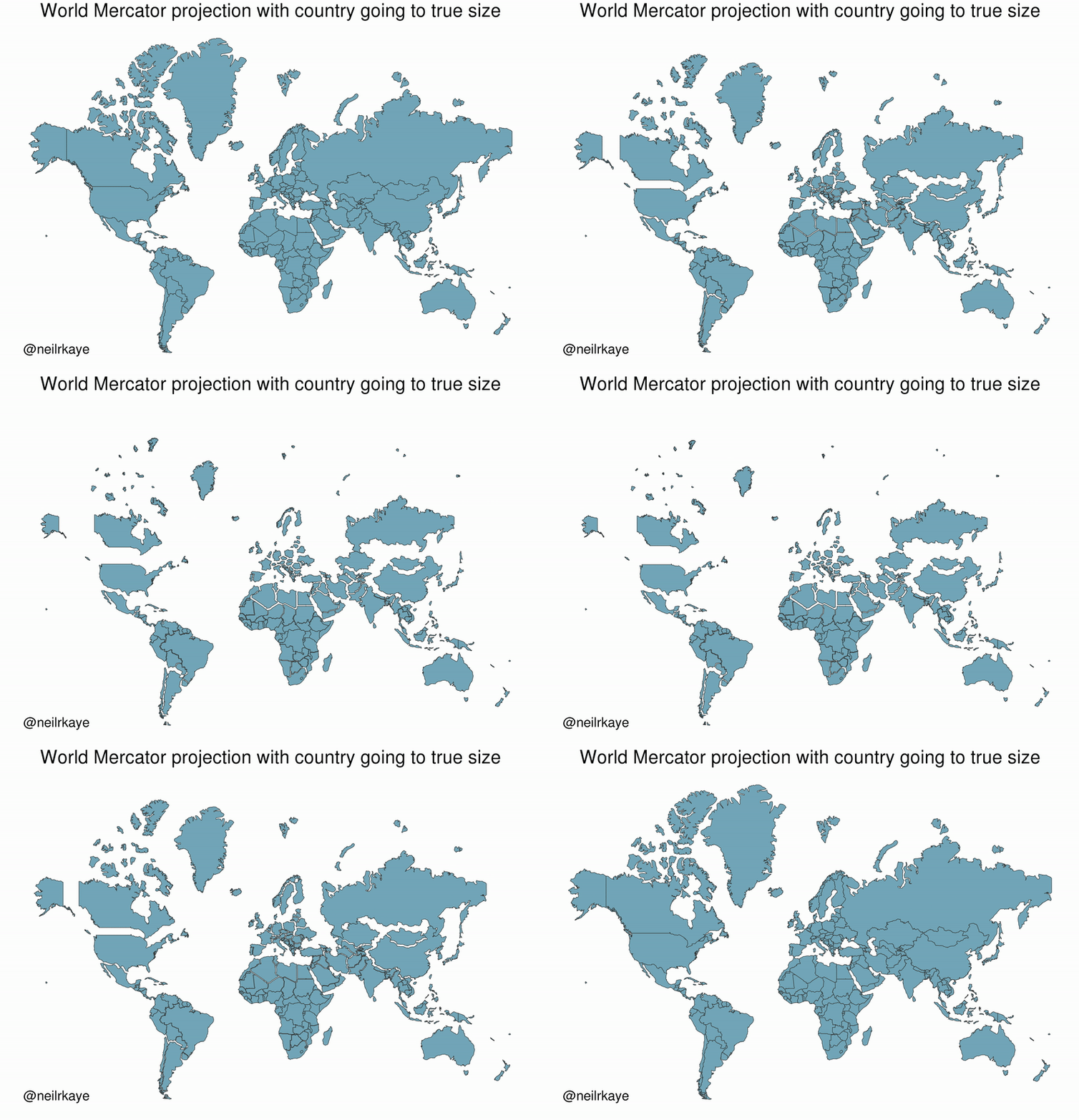
In absolute terms:
- Greenland’s true area: 836,000 mi² (2.17 million km²)
- Africa’s area: 11.7 million mi² (30.4 million km²)
A 2020 study published in ISPRS International Journal of Geo-Information surveyed over 130,000 people worldwide and found that this distortion meaningfully shapes how we perceive geography.
Participants consistently overestimated the size of high-latitude countries like Greenland, Canada, and Russia while underestimating equatorial nations. In other words, they had a cognitive bias baked in by decades of exposure to Mercator maps.
Big Enough to Matter
Despite the cartographic exaggeration, Greenland is no small place. At 2.17 million square kilometers, it ranks as the 12th largest country or territory in the world, larger than Saudi Arabia, Mexico, and Indonesia. It’s the world’s largest island, more than three times the size of Texas, and about 26% bigger than Alaska.
Its location adds to the intrigue. Thule Air Base in northwest Greenland sits almost exactly halfway between Washington, D.C. and Moscow along the polar route, a geography that has made the island strategically valuable since the Cold War. In an era of hypersonic missiles and renewed Arctic competition, that position remains critical.
From Nuuk, Greenland’s capital, the straight-line distance to Washington is nearly the same as to Copenhagen.
Greenland: The Island That Looks Like a Continent
So yes, your mental map has been distorted. The reality of Greenland does not match the gargantuan size portrayed on the world’s most popular maps.
But it’s still the world’s largest island—rich in rare earths, positioned at the crossroads of a geopolitical power struggle, and increasingly ice-free due to climate change. The Mercator projection may exaggerate Greenland’s size, but its strategic importance is no illusion.