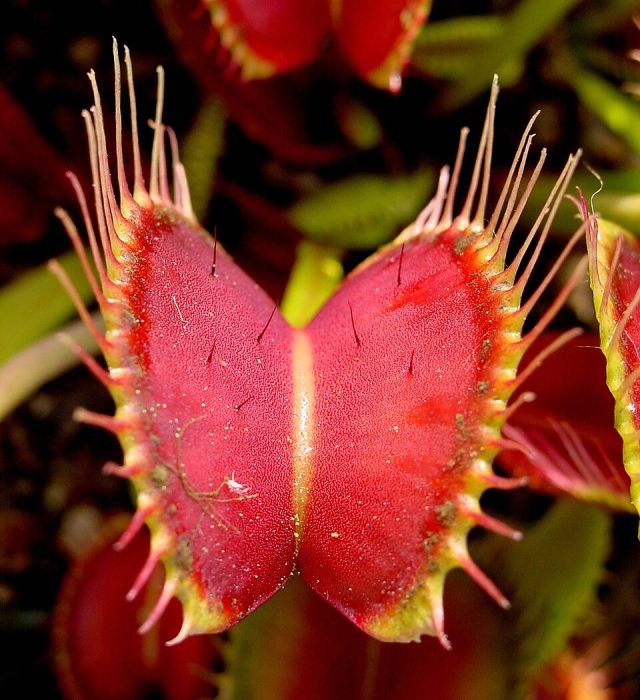
The open lobes of a Venus flytrap. The trigger hairs in the centre must be touched twice within about 20 seconds to fire the trap. Image: Noah Elhardt, CC BY-SA 2.5.
Carnivory in plants is a response to poverty, not to appetite. Bogs, seeps and wet rock are poor in nitrogen and phosphorus, and a plant that can catch and digest an animal gets those elements without waiting for soil to supply them. The traps below are the five most instructive: two snap, one sucks, one is a pit and one is a pitcher. All of them move water, and none of them has a muscle.
-
Bladderwort — the fastest trap on Earth. Utricularia is the largest genus of carnivorous plants, and its traps are bladders a few millimetres across. The plant pumps water out of the bladder, storing elastic energy in its walls; when a passing crustacean touches a trigger hair, the trapdoor buckles and opens in less than half a millisecond, and the prey is sucked in with the water at up to 1.5 m/s and an acceleration of some 600 g. The whole capture takes a few milliseconds — about as fast as a chameleon's tongue, and far faster than the Venus flytrap.
-
Venus flytrap — the snap trap. Dionaea muscipula grows wild only in a small area of boggy coastal North and South Carolina. Each lobe carries three trigger hairs; two touches within about 20 seconds, or one touch twice, fires the trap, which closes in about a tenth of a second. The closure is a snap-buckling instability: the lobes move past a mechanical threshold and the stored curvature does the rest, which is why the trap is faster than a purely hydraulic movement could be. It then seals and digests for several days before reopening.
-
Sundew — glue plus a catapult. Most Drosera species catch insects on tentacles tipped with sticky mucilage, and the leaf curls slowly around the prey. One Australian species does something else: Drosera glanduligera has snap tentacles that fling an insect onto the sticky part of the leaf in about 75 ms, a catapult rather than a glue trap. The two mechanisms together — a fast throw and a slow, sticky hold — make it one of the few plants that uses both.
-
Nepenthes rajah — the biggest pitcher. A montane pitcher plant of Mount Kinabalu in Borneo, and the owner of the largest traps in the genus: up to 41 cm tall, 20 cm wide, holding 3.5 litres of water and more than 2.5 litres of digestive fluid. The rim is slippery when wet and the inside is waxy, so insects that come for the nectar slide in and drown; the fluid digests them. The pitchers are big enough that small vertebrates occasionally fall in as well, though insects are the bulk of the diet.
-
Sarracenia — the trumpet. The North American pitcher plants grow tall, hollow leaves in boggy ground along the Gulf and Atlantic coasts. The mouth is ringed with nectar glands, the rim is slippery, and downward-pointing hairs inside stop an insect from climbing back out. The pitcher is a passive trap: it does not move, and it does not need to. The flowers, which open on tall stalks above the pitchers, are shaped so that the plant's own pollinators arrive at the flower rather than falling into the trap below.
Carnivory costs energy: a trap is expensive tissue, and a plant that relies on it usually has less root and less leaf for ordinary photosynthesis. That is why carnivorous plants are confined to sunny, wet, nutrient-poor places where the trade pays. It is also why they are so easy to kill with kindness: most of them want distilled water, poor soil and full sun, and a rich potting compost or a hard-water tap is more dangerous to them than a missed meal.