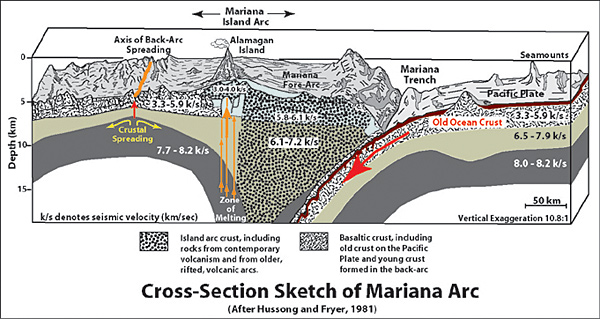
Cross-section of the Mariana arc, after Hussong and Fryer (1981), from NOAA Ocean Explorer. The trench is the notch on the right, where the Pacific Plate turns down into the mantle; the vertical scale is exaggerated 10.8 times. Image: NOAA.
Ocean trenches are the deepest scars on the planet, cut where one tectonic plate slides beneath another. The five below are the deepest places ever surveyed. The figures come from multibeam sonar and from pressure-recorded submersible dives, and two surveys of the same trench can differ by tens of metres; below 6,000 m the water is called the hadal zone, after Hades.
-
Mariana Trench — Challenger Deep, 10,935 m. The deepest point on Earth. A series of submersible dives in 2020, analysed by NOAA and published in 2021, put the floor at 10,935 m ± 6 m below sea level. The pressure at that depth is about 1,086 bar, close to a tonne on every square centimetre. More people have now been to the bottom than have walked on the Moon — twelve walked there, while more than twenty-five have reached Challenger Deep, most of them since 2019: Don Walsh and Jacques Piccard in the bathyscaphe Trieste in 1960, James Cameron solo in 2012, and Victor Vescovo's fifteen descents from 2019.
-
Tonga Trench — Horizon Deep, 10,816 m. The second-deepest point in the ocean and the deepest in the Southern Hemisphere. The Five Deeps Expedition mapped it with multibeam sonar in 2019 at 10,816 m ± 16 m and then confirmed the depth with a submersible dive at 10,817 m ± 6 m. It sits on the same subduction system as the Kermadec Trench, split from it by the subducted Osborn Seamount.
-
Philippine Trench — Emden Deep, 10,540 m. East of Mindanao, in the Philippine Sea. The Emden, a German survey ship, sounded the trench in 1927 and gave the deep its name; the commonly published depth is 10,540 m (Britannica gives 10,539 m). The Five Deeps Expedition mapped the trench in detail in 2019, and Victor Vescovo's Ring of Fire expedition found the wreck of the Samuel B. Roberts on its floor in 2022.
-
Kermadec Trench — 10,047 m. North of New Zealand, and one of the coldest hadal environments on Earth: the water at the bottom stays close to 1 °C. Its deepest point, in the Scholl Deep, is about 10,047 m. The trench has been sampled by baited landers and by the Japanese research submersible Shinkai 6500, which is limited to 6,500 m and therefore works the upper hadal zone only.
-
Izu–Ogasawara Trench — 9,780 m. South of Japan, on the same long subduction system as the Japan and Mariana trenches. Its deepest point is about 9,780 m. The trench is the reason the Izu–Bonin–Mariana arc exists at all: the Pacific Plate descends here, and the water released from the sinking slab melts the mantle above it, feeding the volcanoes of the arc.
The five lie within about 1,150 m of one another, and all are deeper than Everest is tall: the ocean's deepest points cluster along subduction zones rather than being scattered across the seafloor. Most of the hadal zone has never been visited, and only about a quarter of the seafloor has been mapped with modern multibeam sonar.