
See more visuals like this on the Voronoi app.
Use This Visualization
U.S. Population by Generation
See visuals like this from many other data creators on our Voronoi app. Download it for free on iOS or Android and discover incredible data-driven charts from a variety of trusted sources.
Key Takeaways
- Millennials are the largest generation in the U.S., accounting for more than one in five Americans.
- Boomers and Gen X together still make up nearly 40% of the population, reflecting the country’s aging demographic profile.
The age structure of the U.S. population is undergoing a major transition, as younger generations are becoming more prominent.
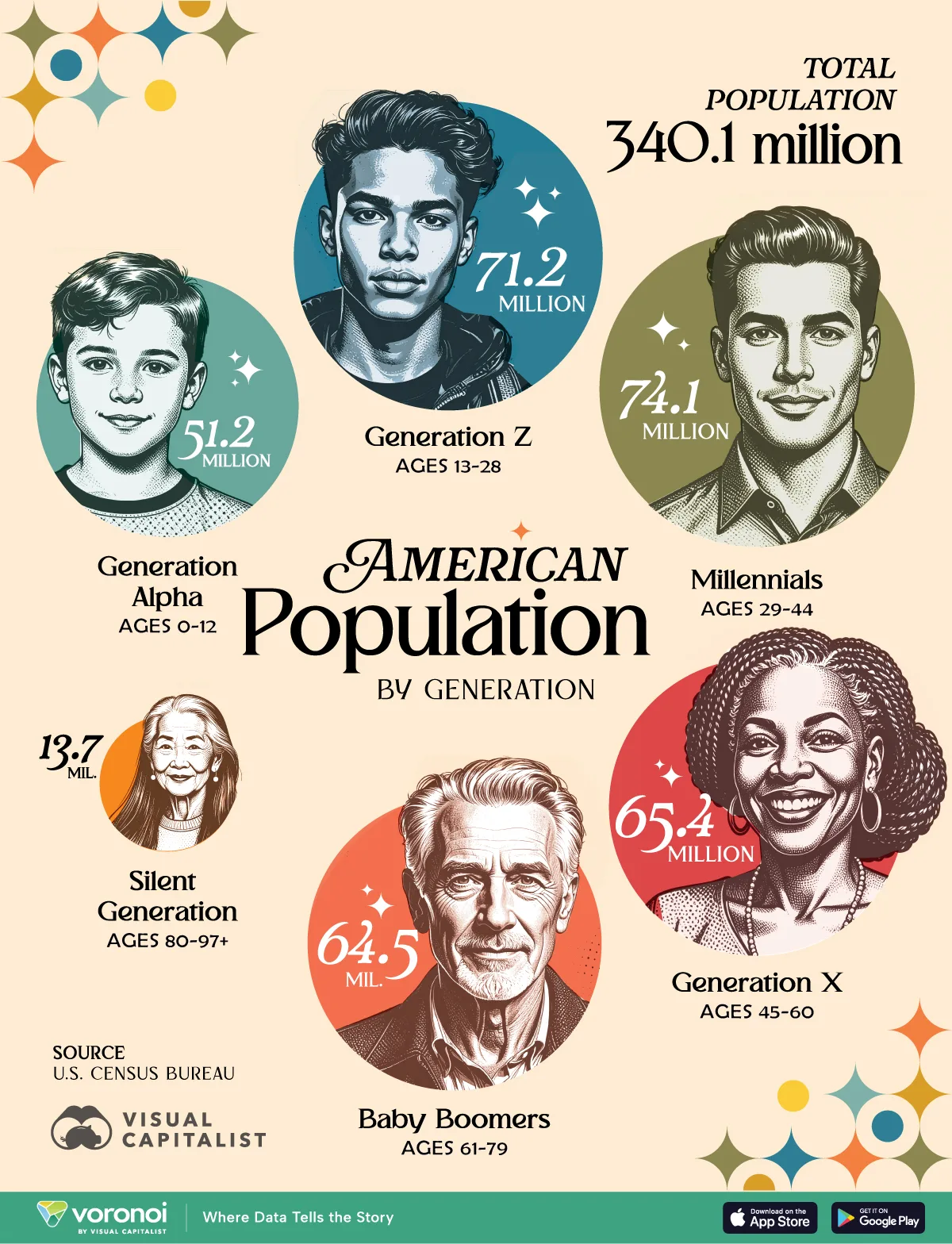
This visualization breaks down the U.S. population by generation in 2025, using data from the U.S. Census Bureau, as of 2025.
Millennials and Gen Z Are the Two Largest
Millennials, born between 1981 and 1996, are the largest generation in the U.S., with roughly 74 million people. They account for 22% of the total population and are now firmly in their prime working and family-forming years. Close behind is Generation Z, with over 71 million people, representing 21% of Americans.
| Generation | Birth Years | Age Range (2025) | Population | Share of population |
|---|---|---|---|---|
| Silent Generation | 1928–1945 | 80–97 | 13,741,630 | 4% |
| Baby Boomers | 1946–1964 | 61–79 | 64,448,248 | 19% |
| Generation X | 1965–1980 | 45–60 | 65,432,121 | 19% |
| Millennials | 1981–1996 | 29–44 | 74,104,186 | 22% |
| Generation Z | 1997–2012 | 13–28 | 71,146,116 | 21% |
| Generation Alpha | 2013–2025 | 0–12 | 51,238,687 | 15% |
| Total Population | - | - | 340,110,988 | 100% |
Boomers and Gen X are a Major Demographical Force
Baby Boomers remain a major demographic force, totaling about 64 million people, or 19% of the population. Now aged 61 to 79, this group continues to impact healthcare demand, retirement systems, and wealth distribution. Generation X is nearly the same size, with 65 million people and an equal 19% share.
Meanwhile, generation Alpha, born from 2013 onward, already numbers more than 51 million people. Although they represent 15% of the population, their impact is still emerging. This cohort will shape future education systems, technology adoption, and long-term workforce trends.
At the opposite end of the spectrum, the Silent Generation now makes up just 4% of Americans.
Learn More on the Voronoi App
If you enjoyed today’s post, check out Why U.S. Homes Feel Pricier: House Prices vs. Income (1985–2025) on Voronoi, the new app from Visual Capitalist.