
See more visuals like this on the Voronoi app.
Use This Visualization
Mapped: U.S. States With the Most Data Centers in 2025
See visuals like this from many other data creators on our Voronoi app. Download it for free on iOS or Android and discover incredible data-driven charts from a variety of trusted sources.
Key Takeaways
- Virginia dominates U.S. data center infrastructure with more than 600 facilities.
- Network effects, cheap power, and cloud hyperscaler clusters make Northern Virginia the world’s most critical internet hub.
As AI and other technologies accelerate, data centers have become increasingly important to today’s digital economy.
In the U.S., the distribution of these facilities is far from even, with a few key states emerging as global powerhouses of digital infrastructure.
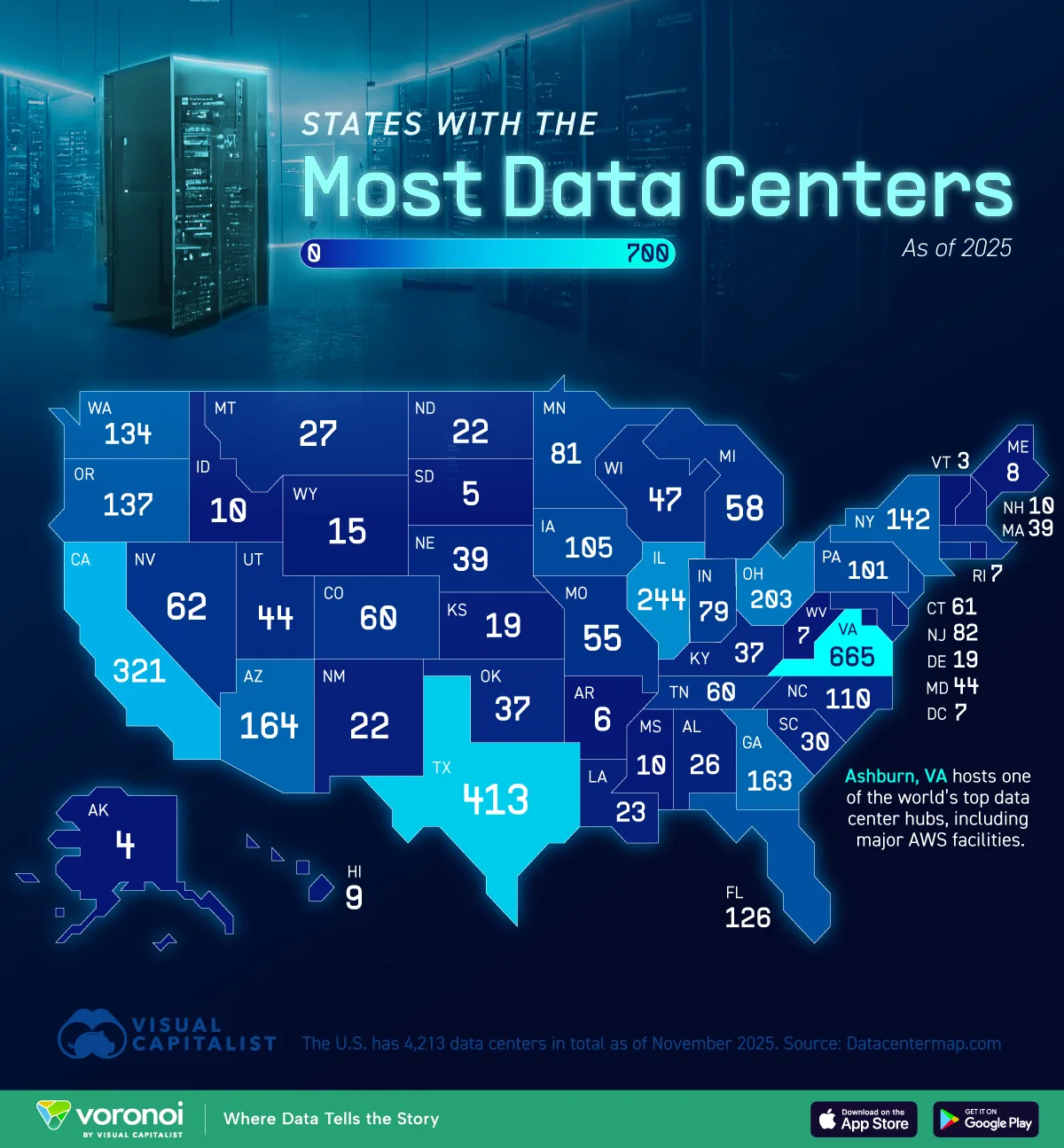
This map highlights where these clusters have formed and why certain states—especially Virginia and Texas—have become magnets for hyperscale growth. The data for this visualization comes from Datacentermap.com.
Virginia: The World’s Digital Capital
With 665 data centers, Virginia hosts the largest concentration of digital infrastructure on the planet.
Northern Virginia hosts massive deployments from all major hyperscalers, including AWS, Microsoft Azure, Google Cloud, Meta, Oracle Cloud. Today, dense fiber networks, reliable power, and fast permitting make Virginia nearly impossible to replicate as a data center region.
| Rank | State | Data Centers |
|---|---|---|
| 1 | Virginia | 665 |
| 2 | Texas | 413 |
| 3 | California | 321 |
| 4 | Illinois | 244 |
| 5 | Ohio | 203 |
| 6 | Arizona | 164 |
| 7 | Georgia | 163 |
| 8 | New York | 142 |
| 9 | Oregon | 137 |
| 10 | Washington | 134 |
| 11 | Florida | 126 |
| 12 | North Carolina | 110 |
| 13 | Iowa | 105 |
| 14 | Pennsylvania | 101 |
| 15 | New Jersey | 82 |
| 16 | Minnesota | 81 |
| 17 | Indiana | 79 |
| 18 | Nevada | 62 |
| 19 | Connecticut | 61 |
| 20 | Colorado | 60 |
| 20 | Tennessee | 60 |
| 22 | Michigan | 58 |
| 23 | Missouri | 55 |
| 24 | Massachusetts | 49 |
| 25 | Wisconsin | 47 |
| 26 | Maryland | 44 |
| 26 | Utah | 44 |
| 28 | Nebraska | 39 |
| 29 | Kentucky | 37 |
| 29 | Oklahoma | 37 |
| 31 | South Carolina | 30 |
| 32 | Montana | 27 |
| 33 | Alabama | 26 |
| 34 | Louisiana | 23 |
| 35 | New Mexico | 22 |
| 35 | North Dakota | 22 |
| 37 | Delaware | 19 |
| 37 | Kansas | 19 |
| 39 | Wyoming | 15 |
| 40 | Idaho | 10 |
| 40 | Mississippi | 10 |
| 40 | New Hampshire | 10 |
| 43 | Hawaii | 9 |
| 44 | Maine | 8 |
| 45 | District of Columbia | 7 |
| 45 | Rhode Island | 7 |
| 45 | West Virginia | 7 |
| 48 | Arkansas | 6 |
| 49 | South Dakota | 5 |
| 50 | Alaska | 4 |
| 51 | Vermont | 3 |
Texas and California Anchor Regional Growth
Texas ranks second with 413 data centers, driven by abundant land, competitive electricity costs, and major cloud deployments in Dallas, Austin, and San Antonio. Its flexible grid and fast construction timelines continue to attract hyperscale expansions.
California follows with 321 facilities, supported by long-standing tech ecosystems in Silicon Valley and strong enterprise demand. While power constraints limit new mega-projects, the state remains a key node for mission-critical data infrastructure.
Midwestern and Western States Build Strategic Clusters
States like Illinois, Ohio, Oregon, and Washington have become important secondary hubs.
Illinois benefits from Chicago’s role as a central U.S. interconnection point, while Ohio has emerged as a major cloud region thanks to available land and stable power. Oregon and Washington contribute strong renewable energy potential and cooler climates that help reduce cooling costs.
Learn More on the Voronoi App
If you enjoyed today’s post, check out The Soaring Revenues of AI Companies (2023–2025) on Voronoi, the new app from Visual Capitalist.