
See more visuals like this on the Voronoi app.
Use This Visualization
America’s Religion Map, Visualized as 100 People
See visuals like this from many other data creators on our Voronoi app. Download it for free on iOS or Android and discover incredible data-driven charts from a variety of trusted sources.
Key Takeaways
- Roughly 162 million U.S. adults identify as Christian, making Christianity the largest religious bloc in the country.
- About 76 million U.S. adults say they have no religious affiliation.
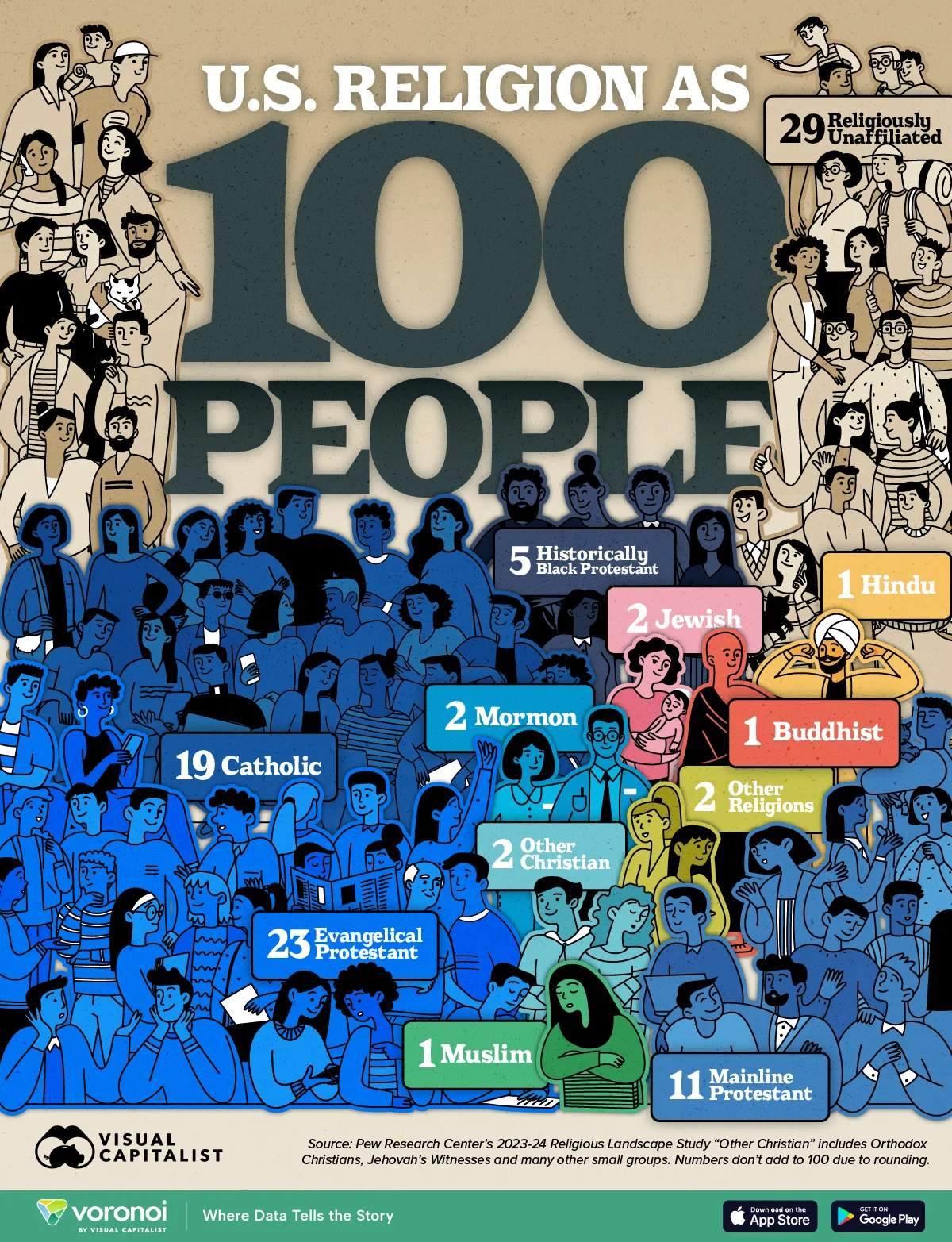
The visualization reimagines the U.S. religious landscape as a group of 100 people.
Each person represents roughly 1% of U.S. adults. Totals may not sum to exactly 100 due to rounding in survey responses. The data for this visualization comes from Pew Research Center’s 2023–24 Religious Landscape Study.
Christianity Remains the Largest Bloc, but It’s Diverse
Christians make up about six in ten U.S. adults in this snapshot, yet the bloc spans multiple traditions with distinct histories, geographies, and growth patterns.
Evangelical Protestants are the single largest subgroup at nearly one quarter of the “100 people,” while Catholics account for just under one-fifth. Mainline and Historically Black Protestant traditions together represent 16 people, underscoring Protestantism’s internal variety.
The two “Other Christian” people reflect communities often missed in headline figures, from Eastern Orthodoxy to millenarian groups.
| Category | Subgroup | People (out of 100) |
|---|---|---|
| Christian (62) | Evangelical Protestant | 23 |
| Mainline Protestant | 11 | |
| Black Protestant | 5 | |
| Catholic | 19 | |
| LDS (Mormon) | 2 | |
| Other Christian | 2 | |
| Non-Christian (7) | Jewish | 2 |
| Muslim | 1 | |
| Hindu | 1 | |
| Buddhist | 1 | |
| Other religions | 2 | |
| Unaffiliated (29) | — | 29 |
The Rise of the Religiously Unaffiliated
Nearly three in ten people in the group report no religious affiliation. This segment includes atheists, agnostics, and those who describe their religion as “nothing in particular.”
In absolute terms, that’s about 76 million U.S. adults that have no religious affiliation.
America’s Religious Pluralism Beyond Christianity
Seven of the 100 people belong to non-Christian religions: roughly two Jewish, and about one each Muslim, Hindu, and Buddhist, plus two in other faiths.
While small in share, these communities are often concentrated in specific regions and metro areas, shaping local culture and institutions. Immigration patterns, birth rates, and conversion dynamics help explain their distribution and growth trends.
Learn More on the Voronoi App
If you enjoyed today’s post, check out America’s Most Religious States on Voronoi, the new app from Visual Capitalist.