
See this visualization first on the Voronoi app.
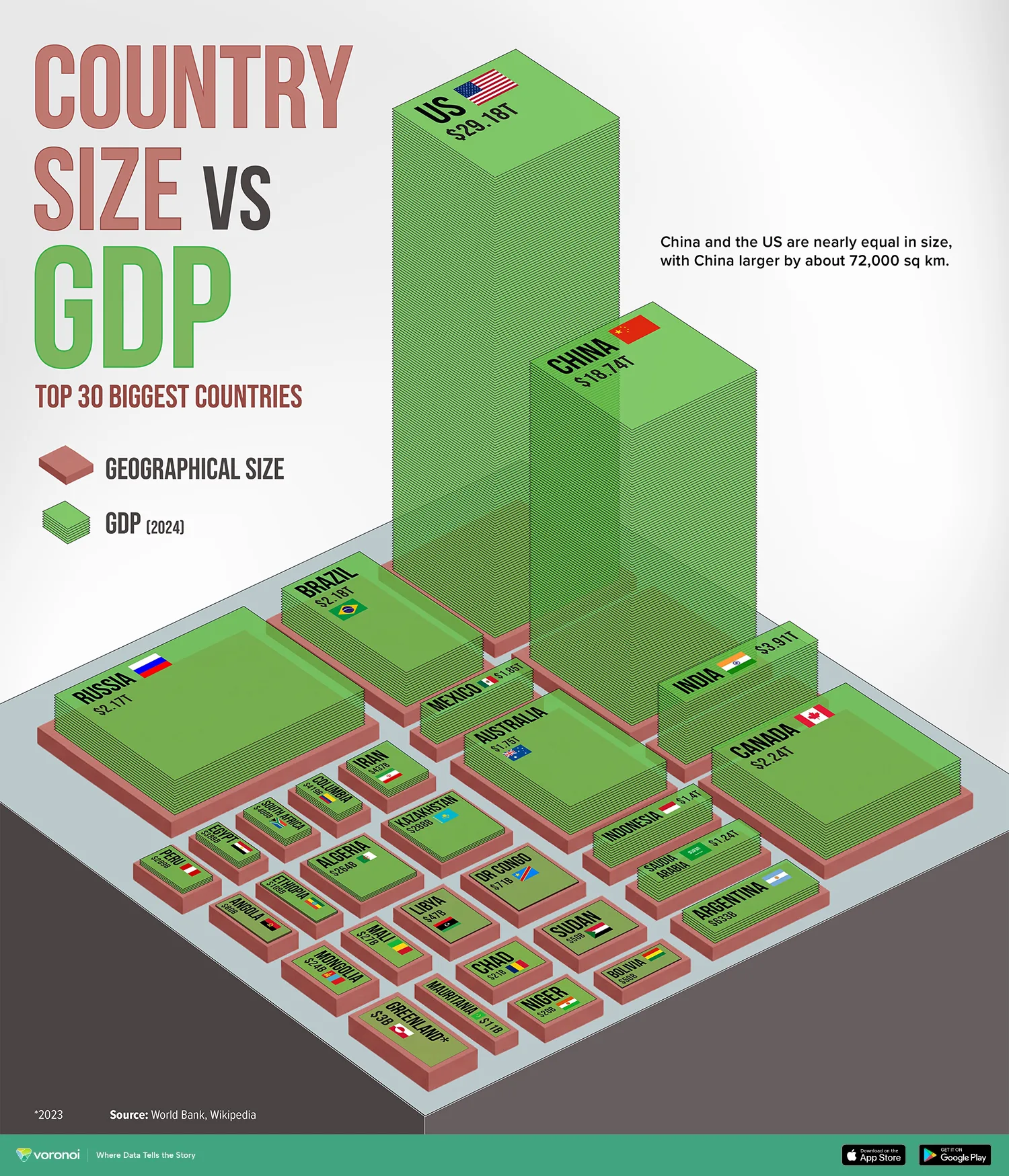
Visualizing the Relationship Between Country Size and GDP
This was originally posted on our Voronoi app. Download the app for free on iOS or Android and discover incredible data-driven charts from a variety of trusted sources.
Key Takeaways
- The U.S. has the world’s largest GDP at over $29 trillion, despite being only the third-largest country by land area.
- Russia and Canada are among the largest countries geographically but rank much lower in GDP.
- There is no clear correlation between land area and economic output. Smaller countries can punch well above their weight.
When comparing countries, two common metrics are land area and GDP. But how closely are they actually related?
This visualization, created by Julie Peasley, juxtaposes the land area and economic output of the 30 largest countries in the world. It draws from World Bank GDP data and Wikipedia’s country size estimates, offering a unique look at just how different these measures can be.
Here’s the full data used in the visualization:
| 30 Largest Countries | GDP ($USD) | Area (square km) | Area (square miles) |
|---|---|---|---|
| United States | 29,184,890,000,000 | 9,525,067 | 3,677,649 |
| China | 18,743,803,170,827 | 9,596,960 | 3,705,407 |
| India | 3,912,686,168,582 | 3,287,263 | 1,269,219 |
| Canada | 2,241,253,230,970 | 9,984,670 | 3,855,103 |
| Brazil | 2,179,412,080,829 | 8,510,346 | 3,285,863 |
| Russia | 2,173,835,806,672 | 17,098,246 | 6,601,670 |
| Mexico | 1,852,722,885,258 | 1,964,375 | 758,449 |
| Australia | 1,752,193,307,380 | 7,741,220 | 2,988,902 |
| Indonesia | 1,396,300,098,191 | 1,904,569 | 7,35,358 |
| Saudi Arabia | 1,237,529,866,667 | 2,149,690 | 830,000 |
| Argentina | 633,266,692,534 | 2,780,400 | 1,073,518 |
| Iran | 436,906,331,672 | 1,648,195 | 636,372 |
| Colombia | 418,542,042,920 | 1,138,910 | 439,736 |
| South Africa | 400,260,724,226 | 1,219,090 | 470,693 |
| Egypt | 389,059,911,004 | 1,001,450 | 386,662 |
| Peru | 289,221,969,060 | 1,285,216 | 496,225 |
| Kazakhstan | 288,406,138,231 | 2,724,910 | 1,052,094 |
| Algeria | 263,619,794,507 | 2,381,741 | 919,595 |
| Ethiopia | 109,490,000,000 | 1,104,300 | 426,373 |
| Angola | 80,396,942,242 | 1,246,700 | 481,354 |
| DRC | 70,749,355,652 | 2,344,858 | 905,355 |
| Sudan | 49,909,807,030 | 1,861,484 | 718,723 |
| Bolivia | 49,668,296,744 | 1,098,581 | 424,164 |
| Libya | 46,636,278,902 | 1,759,540 | 679,362 |
| Mali | 26,588,067,731 | 1,240,192 | 478,841 |
| Mongolia | 23,586,055,802 | 1,564,116 | 603,909 |
| Chad | 20,625,711,665 | 1,284,000 | 495,755 |
| Niger | 19,537,639,288 | 1,267,000 | 489,191 |
| Mauritania | 10,766,731,874 | 1,030,700 | 397,955 |
| Greenland | 3,326,544,174 | 2,166,086 | 836,330 |
While China is slightly larger in land area than the U.S. (by about 72,000 sq. km), America’s GDP is over $10 trillion higher. Meanwhile, Russia and Canada—two of the largest countries—fall behind in economic output, illustrating the lack of a strong link between size and GDP.
Does Geographic Size Influence GDP?
Looking at this data, there’s no strong correlation between landmass and economic output. According to a 2023 research paper, GDP is more strongly influenced by population and infrastructure than sheer physical size.
For instance, India, with only a third of the U.S. or China’s landmass, ranks third in GDP due to its massive population and growing industrial base. On the flip side, Australia and Canada boast vast territories but smaller populations, limiting their economic scale.
Outliers That Punch Above Their Weight
Several countries in the visualization illustrate this dynamic vividly:
- Japan and Germany: Relatively small in landmass but economic powerhouses, ranking high in global GDP.
- Indonesia: The fourth most populous country, yet its GDP lags behind similarly sized countries due to development disparities.
- Brazil: A mix of large area and moderate economic power, it sits in the middle of the pack.
As this chart shows, while landmass can support economic activity (through agriculture, resource extraction, etc.), it does not guarantee high GDP. In fact, many of the most prosperous countries are relatively small but highly industrialized and urbanized.
Learn More on the Voronoi App
Looking to explore more comparisons like this? Check out Comparing the Land Area of the 15 Largest Countries in the World on the Voronoi app.