
See more visuals like this on the Voronoi app.
Use This Visualization
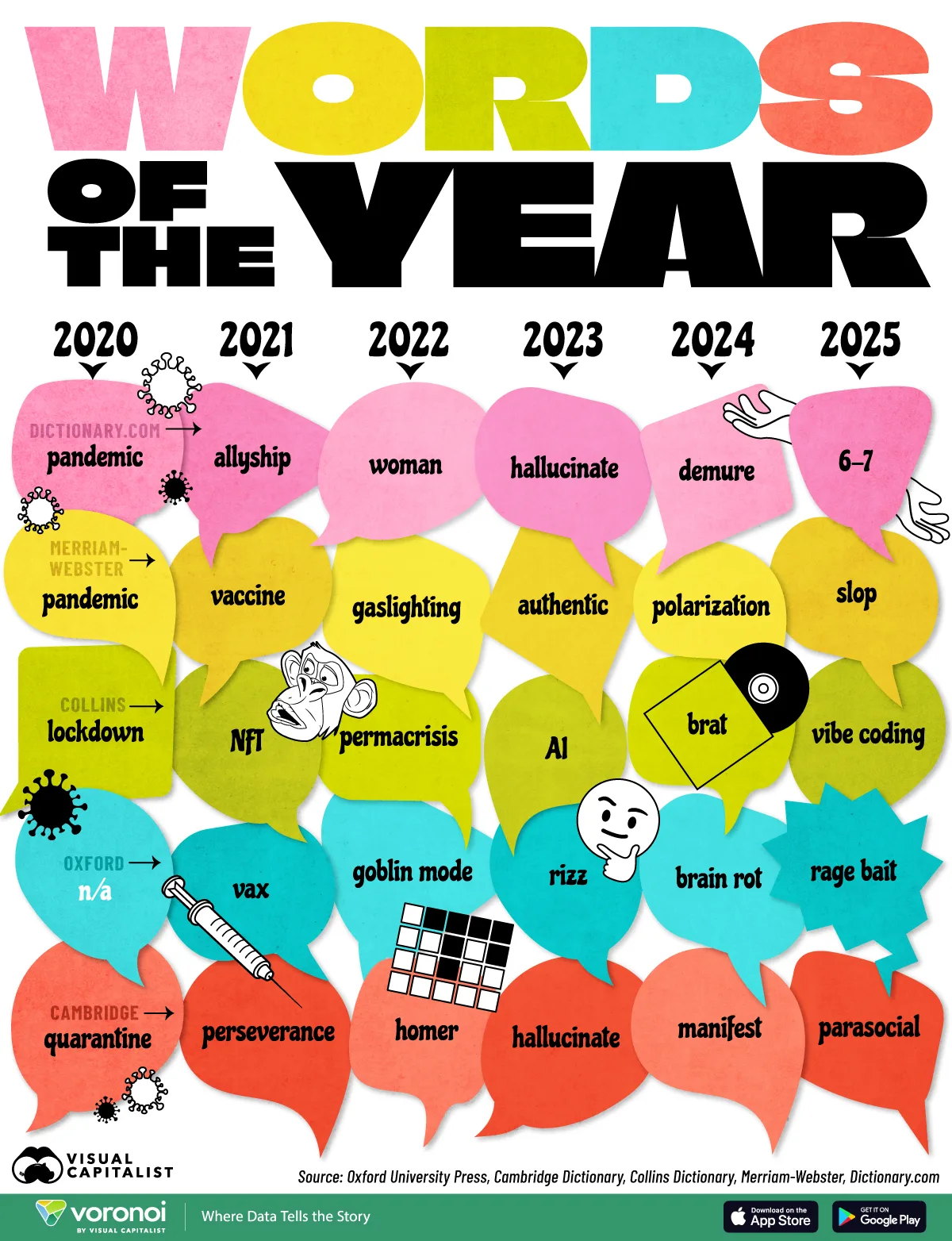
Every ‘Word of the Year’ According to Dictionaries (2020-2025)
See visuals like this from many other data creators on our Voronoi app. Download it for free on iOS or Android and discover incredible data-driven charts from a variety of trusted sources.
It’s impossible to describe an entire year with just a single word, but the various major dictionaries try each year.
While it can’t capture all of the complexity a year had in store, the right word can be emblematic of a year’s social phenomena, newly established terminology, and shared cultural experiences over those 365 days.
This graphic visualizes the words of the year of five major dictionaries from 2020 to 2025, with the dictionaries’ sites (Dictionary.com, Merriam-Webster, Collins, Oxford, and Cambridge) being the source of the data.
How Dictionaries Choose Their Word of the Year
Dictionary.com, Collins, Merriam-Webster, Oxford, and Cambridge all treat their ‘Word of the Year’ as an editorial choice that is guided heavily by evidence of real-world usage and public interest.
Dictionary.com weighs cultural impact alongside signals like news and social trends, while Collins draws on its Collins Corpus of spoken and written English to spot words that rose to prominence.
Merriam-Webster and Cambridge lean strongly on lookup and search spikes on their sites, then apply editorial judgment (Cambridge also filters for zeitgeist and what’s linguistically notable).
Oxford combines corpus-based language research with editor curation and, in some years, public voting, before its team makes the final call.
In short: editors make the final pick, primarily using data from searches, written and spoken language, along with cultural trends.
Words That Defined Each Year From 2020 to 2025
With the words of the year of various dictionaries laid out clearly, it’s fascinating to see the trends that were felt most each year.
The table below shows the word of the year of major dictionaries from 2020 to 2025:
| 2020 | 2021 | 2022 | 2023 | 2024 | 2025 | |
|---|---|---|---|---|---|---|
| Dictionary.com | pandemic | allyship | woman | hallucinate | demure | 6-7 |
| Merriam-Webster | pandemic | vaccine | gaslighting | authentic | polarization | slop |
| Collins | lockdown | NFT | permacrisis | AI | Brat | vibe coding |
| Oxford | no word chosen | vax | goblin mode | rizz | brain rot | rage bait |
| Cambridge | quarantine | perseverance | homer | hallucinate | manifest | parasocial |
We can see how 2020 was defined by the pandemic, with pandemic, quarantine, and lockdown all chosen that year (while Oxford University Press didn’t choose a word that year).
While 2021’s words feature vaccine, vax, and perseverance, non-pandemic words and trends like NFT and allyship were part of the mix.
2023 brought AI-related words like hallucinate and AI into the mix, as it was ChatGPT’s first full year after launching in November of 2022.
In 2025, we’ve seen evolutions of more specific AI-related jargon like slop (sloppy or low-quality AI-made digital content) and vibe coding, which defines AI-driven software development through prompts rather than writing out the code oneself.
2025’s other words of the year like parasocial and rage bait define growing cultural trends and behaviors of an increasingly online world, while 6-7 remains a largely incomprehensible meme—ubiquitous among younger generations despite having no clear or widely agreed-upon meaning.
Learn More on the Voronoi App
If you liked this visualization, check out this graphic on Voronoi that breaks down the world’s most-spoken languages.