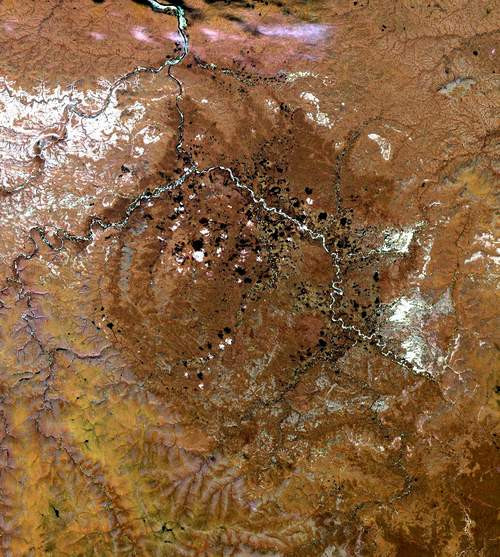
Popigai in northern Siberia: the ring is the eroded rim of a structure about 100 km across, cut through by the Popigai river. The target rock held graphite, and the shock turned it into diamond. Image: NASA Landsat.
An impact does not only make a hole. It melts rock, throws debris across continents, shatters minerals into forms that exist nowhere else, and sometimes concentrates ore. These five are notable for what they left behind.
-
Popigai, Russia — diamonds. The crater sits on graphite-bearing rock, and the shock turned graphite into diamond directly, without the slow burial that makes kimberlite diamonds. The result is a layer of impact diamonds in tagamite, the melt rock of the crater. The deposit is real, but the figures quoted for its size are press estimates rather than published reserve calculations.
-
Sudbury, Canada — nickel and copper. The impact melted a sheet of crust that became the Sudbury Igneous Complex, and the ores that settled in and around it have been mined since the 1880s. The basin is one of the largest metal-producing districts in the world, and the mines were worked for a century before anyone accepted that the structure was an impact.
-
Nördlinger Ries, Germany — suevite and moldavite. A 24 km crater about 15 million years old, filled with suevite, a breccia of melted and shattered rock thrown out by the impact. The same event produced moldavites, green tektite glass found in Bohemia hundreds of kilometres away, which is how the crater and the glass were tied together.
-
Chicxulub, Mexico — a global layer. The impact threw ejecta around the world, and the result is a thin clay layer at the Cretaceous–Paleogene boundary on every continent, enriched in iridium and shocked quartz. The iridium anomaly, measured in 1980, was the first evidence that an impact ended the Cretaceous; the crater itself was found a decade later.
-
Bosumtwi, Ghana — tektites in Ivory Coast. Glassy tektites found in Ivory Coast match the Bosumtwi crater in age and chemistry, which identifies the lake as their source. They are the only physical trace of the impact outside the crater, since the crater itself is filled by water and forest.
What a crater leaves depends on what it hit: graphite becomes diamond, crust melts into ore-bearing rock, and sediment vaporises into glass that falls hundreds of kilometres away. That is why an impact structure can be valuable long after its outline has gone, and why the search for old craters often starts with an odd mineral or an odd layer in a cliff rather than with a circle on a map.