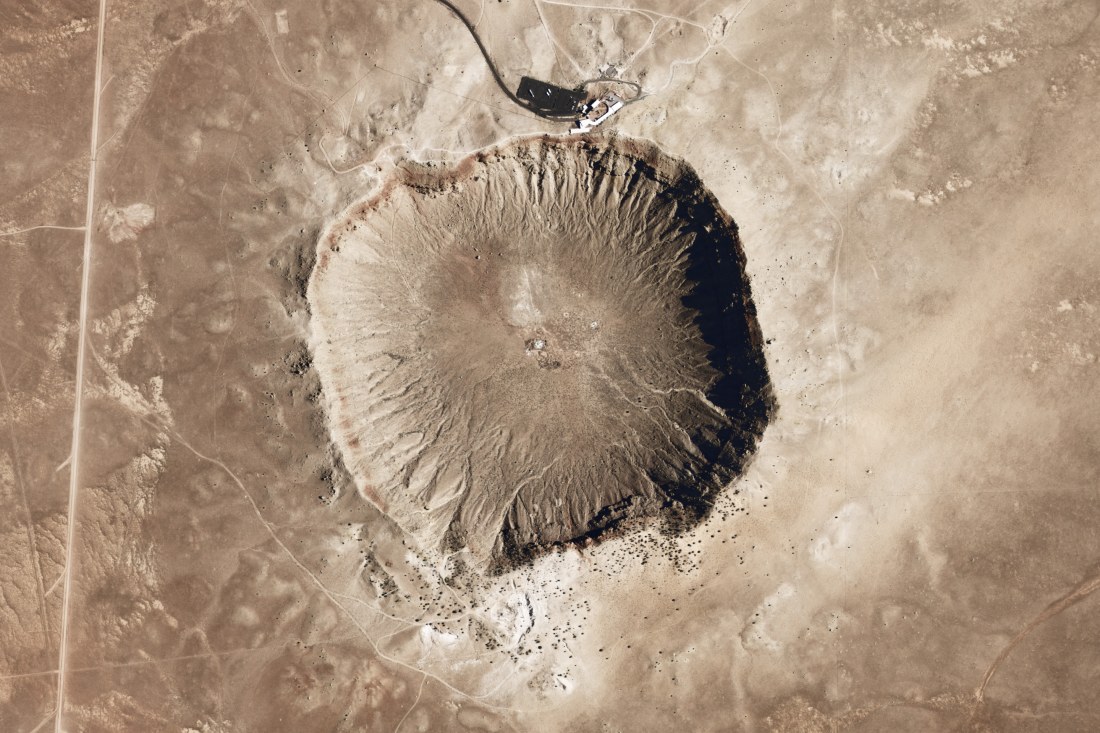
Meteor Crater, Arizona, from the International Space Station: a 1.18 km bowl whose rim still stands above the plain 49,000 years after the impact. Image: NASA.
Impact craters are destroyed by the same processes that build landscapes: erosion, burial, plate movement. A crater stays recognisable only if it is young, or dry, or cut into hard rock, and ideally all three. These five still look like what they are.
-
Barringer Crater (Meteor Crater), Arizona — 1.18 km, 49,000 years. The reference crater: a bowl about 170 m deep, with a rim standing some 45 m above the plain in dry Colorado Plateau rock. It was the first crater on Earth proven to be an impact, though the proof took decades — coesite, a form of silica that only forms under shock, was found there in 1960. Meteorite fragments are still collected around the rim.
-
Lonar, India — 1.83 km, 37,000 to 570,000 years. A fresh bowl in the Deccan basalt, with a rim that still closes completely and a lake at the bottom. Because the target rock was lava, the crater preserves a different set of shock features from craters in sandstone or limestone. Its age has been measured several ways and the answers span a factor of fifteen — 37,500 years from cosmogenic exposure, 52,000 from thermoluminescence, 570,000 from argon-argon — and the bowl is fresh under any of them, which is why it belongs on this list.
-
Pingualuit, Quebec — 3.44 km, 1.4 million years. Old for this list, but in a tundra landscape that erodes slowly, and with a lake that has kept the bowl clear. The rim stands well above the surrounding plateau and the circle is unbroken, which is why the crater was identified from the air before geologists reached it.
-
Tenoumer, Mauritania — 1.9 km. A circle in the Sahara with a rim about 100 m high and a floor of impact melt. Its age is the weakest part of its file: fission tracks in the melt gave 21,400 ± 9,700 years, argon-argon in 2016 gave 1.57 ± 0.14 million, and earlier potassium-argon work gave 2.5 ± 0.5 million. The disagreement is itself informative — the crater is young enough that its shape survives, but its melt is too altered for the dating methods used on fresh craters to agree.
-
Wolfe Creek, Western Australia — 880 m. A near-circular bowl in the Kimberley, with a rim of tilted sandstone and a floor of sand. It is one of the few craters on Earth from which meteorite fragments have been recovered, and the dry interior is the reason the classic crater profile — rim, slumped wall, flat floor — is intact.
Preservation depends on climate as much as on geology: three of the five sit in desert or tundra, where annual rainfall is too low to move much rock, and the others are young enough that erosion has not yet removed them. None is large by the standards of the largest impact structures on Earth, which is expected: the bigger the structure, the longer erosion has had to work on it.