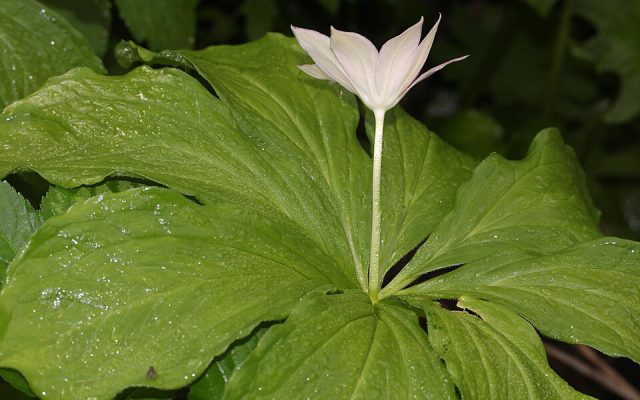
Paris japonica, the flowering plant with the largest genome: 148.89 billion base pairs, about 46 times the human one. Image: Alpsdake, CC BY-SA 4.0.
A genome is measured in base pairs, and the total has almost nothing to do with how complex the plant is. The largest plant genomes are 50 times the human one and belong to a fern and a woodland herb; most of that DNA is repetitive sequence rather than genes. The figures below are 1C values — the DNA in one unreplicated nucleus — measured by flow cytometry against a known standard, which is the method that lets these numbers be compared at all.
-
Tmesipteris oblanceolata — 160.45 billion base pairs. A fork fern from New Caledonia and Vanuatu, described in iScience in 2024 by Fernández, Pellicer and colleagues. It is the largest genome recorded in any eukaryote: about 50 times the human genome, and if the DNA in a single cell were unwound it would run more than 100 m. The plant itself is small and easy to overlook, which is part of why the record was only measured in 2024.
-
Paris japonica — 148.89 billion base pairs. A Japanese woodland herb with a single white flower, and the record holder from 2010 until the fork fern: it is still the largest genome among flowering plants. It is an octoploid, with eight sets of chromosomes (2n = 40), and its DNA weighs about 152 picograms per nucleus. It grows slowly and is uncommon in the wild; whether the enormous genome is a cost, a cause or simply tolerated is still argued.
-
Tmesipteris obliqua — 147.29 billion base pairs. A close relative of the record holder, measured in 2017 and at the time the second-largest plant genome known. That two species in the same small genus sit at the top of the table is the interesting part: genomic gigantism is a recurring feature of this group rather than a one-off accident in a single species.
-
Fritillaria assyriaca — about 127 picograms, roughly 125 billion base pairs. A bulbous plant from Turkey to Iran, and for years the largest genome known in any organism. It is a tetraploid, and its genome is so large that the chromosomes are difficult to sort by conventional staining. The Fritillaria genus keeps turning up in these tables: several of its species pass 100 billion base pairs.
-
Viscum album — 95.1 billion base pairs. European mistletoe, a parasitic shrub that grows on the branches of trees across Europe and western Asia. Its genome is nearly 30 times the human one, which is notable for a plant that makes its living by tapping a host rather than by competing for light. Mistletoe is a hemiparasite: it photosynthesises for itself but takes water and minerals from the tree it grows on.
For scale, the smallest plant genome known is that of Genlisea tuberosa, a Brazilian carnivorous plant, at about 61 million base pairs — roughly a 2,600-fold range within flowering plants alone. Genome size is not gene count: the giant genomes are mostly transposable elements and other repeats, and how a plant tolerates so much extra DNA without paying an impossible cost is still an open question. What is clear is that sequencing these genomes is hard: assembling 160 billion base pairs of repetitive sequence is a much bigger job than assembling the human genome, and only a handful of labs attempt it.