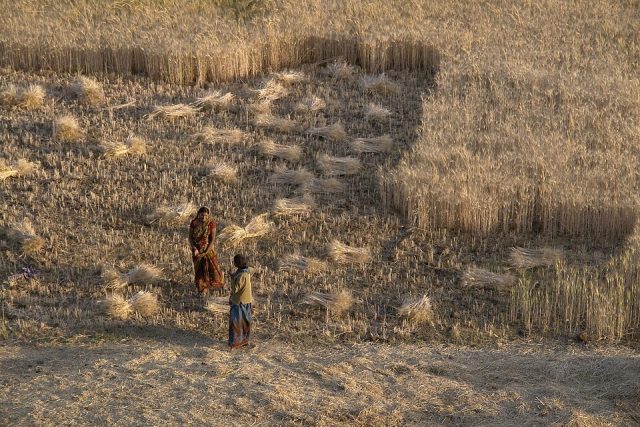
Wheat harvest in Raisen district, Madhya Pradesh. Wheat and rice are level at about 800 million tonnes a year. Image: Yann, CC BY-SA 4.0.
These are the five crops that supply most of the world's dietary energy, ranked by the tonnage harvested. The figures are the Food and Agriculture Organization's: cereals for 2024, from its December 2025 statistical brief, and roots and tubers for 2023, the latest year that brief covers. Sugar cane is larger than any of them at about 2 billion tonnes, but it is a sugar crop rather than a staple, so it is left out; the note at the end explains why tonnage is a crude measure anyway.
-
Maize — 1.22 billion tonnes (2024). The largest cereal crop on Earth and the fastest-growing of the major ones, up 46 per cent since 2010. Only part of it is eaten as maize: a large share goes to animal feed and to ethanol, which is why its tonnage is so far ahead of the other cereals. The United States, China and Brazil are the biggest producers.
-
Rice — 820 million tonnes (2024). The staple for roughly half the world's population, grown mostly in Asia and mostly on small farms. It is usually reported as paddy, the weight of the unhusked grain, so its food value per tonne is lower than the number suggests. Rice production rose only about 15 per cent between 2010 and 2024, against 25 per cent for wheat, because the land and water it needs are close to fully used in the main growing regions.
-
Wheat — 798 million tonnes (2024). Essentially level with rice, and grown across a much wider range of climates, from the Canadian prairies to the Indian subcontinent. It is the main bread grain of Europe, North Africa and the Near East, and the crop most exposed to the war-driven disruption of Black Sea exports since 2022.
-
Potatoes — 383 million tonnes (2023). The largest root or tuber crop and the one that yields the most food per hectare in cool climates. About four-fifths of the tuber is water, so the tonnage overstates its food value relative to grain; on a dry-weight basis potatoes are roughly a fifth of their harvest weight. China and India are the largest producers, and much of the crop is eaten fresh rather than processed.
-
Cassava — 334 million tonnes (2023). A woody shrub's starchy root, grown across the tropics and the most important staple in much of sub-Saharan Africa. It tolerates poor soil and drought, which is why it is a food-security crop rather than an export one, and it must be processed before eating: the raw root contains cyanogenic compounds that soaking, fermenting or cooking removes. Production rose 32 per cent between 2010 and 2023, faster than any other root or tuber.
Tonnes are a poor proxy for nutrition. Potatoes and cassava carry a lot of water, and maize loses much of its harvest to feed and fuel, so the ranking by calories looks different: rice, wheat and maize together still supply about half of the calories humanity eats, but the order shifts and the roots matter more than their tonnage suggests. What the list does show is concentration — five crops, four plant families, and most of the world's food energy resting on them.