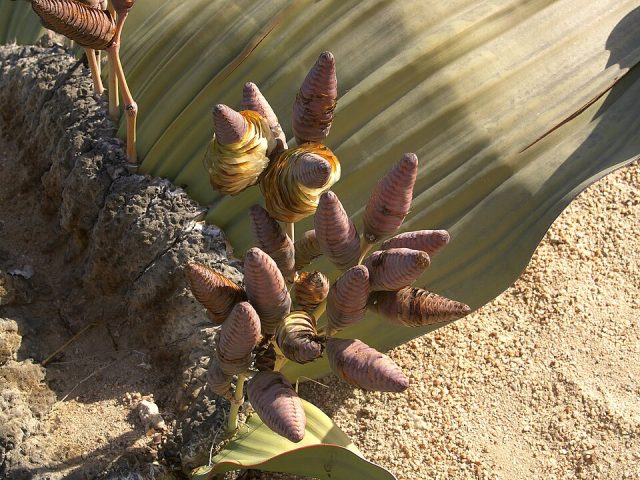
A female welwitschia (Welwitschia mirabilis) with its cones. The plant has only two leaves, which grow at the base and are split into ribbons by the wind. Image: Hans Hillewaert, CC BY-SA 4.0.
Deserts are not empty, they are selective. The plants below live where rain arrives in a few storms a year and the air can take more water out of a leaf in an afternoon than the soil put into it in a month. None of them beats the drought; each one gives up something — speed, size, leaves — to keep a little water moving through the tissue until the next rain.
-
Welwitschia — drinks the fog. Welwitschia mirabilis grows in the Namib, one of the driest places on Earth, and it has only two leaves. They emerge from a short woody trunk, never stop growing at the base, and are shredded by wind and sand into a tangle of ribbons that can spread several metres across the ground. The plant takes water from fog directly through its stomata, which is why it survives where rain may not fall for years, and it is dioecious: male and female cones sit on separate plants. Radiocarbon dating has put individuals at several hundred years old and some estimates are older still. It is Namibia's national plant, and it is the only species left in its order.
-
Saguaro — stores water in a pleated trunk. Carnegiea gigantea is the tall cactus of the Sonoran Desert, up to about 12 m and 150 to 200 years old. The trunk is ribbed, and the ribs let it expand as it fills after a storm and contract as it dries. It runs CAM photosynthesis: the stomata open at night, when the air is cooler and wetter, and the carbon dioxide is stored as an acid until daylight, when the pores shut and the sugar is made. A wide, shallow root net catches rain before it soaks away, and the same trunk that holds water holds a nest cavity for woodpeckers, which other birds then reuse.
-
Baobab — a cistern with bark. Adansonia digitata grows across dry Africa and stores water in the fibrous wood of a trunk that can be many metres across. In the dry season it drops its leaves and sits leafless; in the wet season it leafs out, flowers and sets fruit, and the trunk swells. Thick bark insulates the living tissue from grass fires and from the day's heat. The flowers open at dusk and are pollinated by bats, and the fruit — the source of the "superfruit" powders — hangs on the tree through the dry months.
-
Prickly pear — pads that are stems. In Opuntia the flat green pads are not leaves but flattened stem segments, and they are where the water is stored; the spines are the leaves, reduced to needles that protect the tissue and shade it. The plant also uses CAM, so its pores are closed through the hot day, and it roots shallowly and widely so that a brief shower is captured before it drains. It is edible, it hosts the cochineal insect that gives carmine dye, and it is invasive in Australia and the Mediterranean for exactly the reasons it survives at home.
-
Date palm — roots down to the water. Phoenix dactylifera is the tree of the oasis: it tolerates heat well above 40 °C, soil saltier than most crops can bear, and air dry enough to crack mud. Its roots reach deep toward groundwater while the crown keeps its leaves small and waxy, and it fruits in the hottest, driest weeks of the year. A date palm can live a century or more and still crop; the sugar in the fruit is the plant's way of packaging a season's water and sunlight into something that keeps.
Three strategies repeat across the list: close the pores when the sun is up, store water in tissue that can swell, and grow slowly. A saguaro adds a few centimetres a year and a welwitschia grows its leaves at a rate measured in millimetres, and both are still there when faster plants have come and gone. The desert is not a place where plants beat the odds; it is a place where they stop trying to.