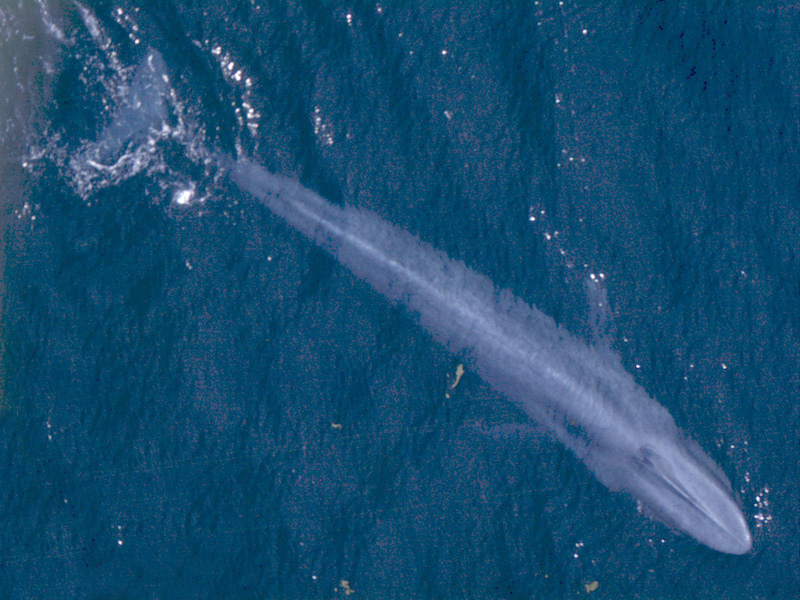
A blue whale photographed from the air by NOAA Fisheries. The largest animal that has ever lived is also the largest entry in the list above, at up to about 30 m. Image: NOAA Fisheries.
Whales are the largest animals that have ever lived, and the five below are the largest of the whales, ranked by the maximum length reliably recorded for the species. The figures come from whaling records, strandings and aerial surveys, and they are maxima: a typical adult of each species is considerably smaller. Females are larger than males in most of these species, which is unusual among mammals.
-
Blue whale — up to about 30 m. The largest animal known to have existed. NOAA gives a maximum of 31 m and a usual weight of about 150 tonnes, with one measured specimen at 190; the heart alone weighs as much as a small car, and the call is louder than a jet engine at take-off. Whaling in the twentieth century killed perhaps 380,000 of them, and the species is still endangered.
-
Fin whale — up to about 26 m. The second-largest animal on Earth and the fastest of the large whales, sometimes called the greyhound of the sea. It is the only whale with an asymmetric head: the lower jaw is white on the right side and dark on the left, a difference thought to help it feed by turning on its side near the surface. Its low-frequency calls travel for hundreds of kilometres.
-
Bowhead whale — up to about 20 m. A stocky Arctic whale with no dorsal fin and a skull a third of its body length, used to break through ice. It is also the longest-lived mammal: some individuals carry stone harpoon points from nineteenth-century hunts and are estimated at more than 200 years old. Its blubber can be half a metre thick.
-
Sei whale — up to about 19.5 m. A fast, slender rorqual of the open ocean, named after the Norwegian word for pollack because it appeared where the fish were. Females reach about 19.5 m. It is one of the least studied large whales, and its population was hit hard by whaling after the larger species had been depleted; it is listed as endangered.
-
Sperm whale — up to about 18 m. The largest toothed whale and the deepest-diving of the great whales, hunting squid in dives that routinely pass 1,000 m. Its head holds the spermaceti organ, a case of oil and wax whose function is still debated; its clicks are the loudest sounds produced by any animal. The species was hunted for that oil for two centuries.
The order is not quite the whole story. Bowheads, sei and sperm whales overlap in the 18–20 m range, and which is longest depends on the population and on which record is used. The gap at the top is not in doubt: the blue whale is about 15 per cent longer than the fin whale and roughly twice its weight.