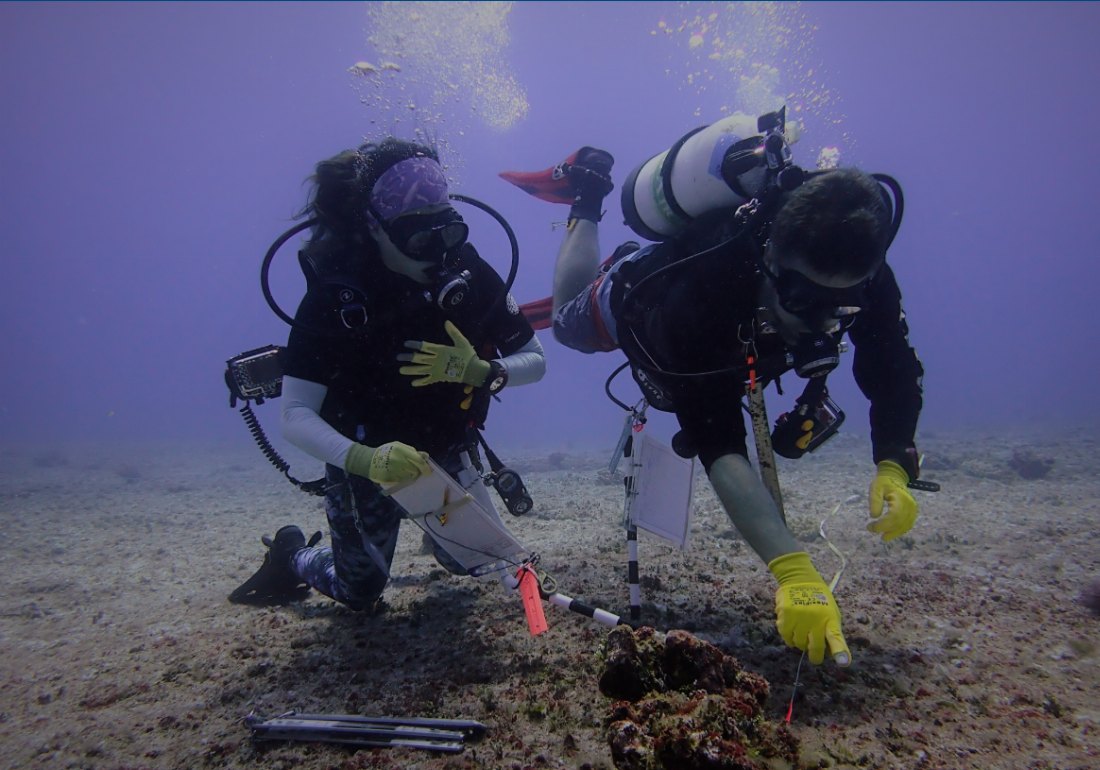
NOAA divers survey a reef off Pagan in the Northern Mariana Islands in 2022, laying a transect to measure coral cover. Reef systems this size are assessed by sampling, not by counting. Image: NOAA.
Coral reefs cover less than one per cent of the sea floor and shelter about a quarter of all marine species. The five below are the largest reef systems on Earth, ranked by extent. Two measures are in play and they do not always agree: the area a system covers under water, and the length of the reef front itself. Where the published figure is one and not the other, the text says so.
-
Great Barrier Reef — 344,400 km², about 2,300 km long. The largest coral reef system in the world, and the only one visible from orbit. It holds some 3,000 individual reefs, 300 coral cays and 600 continental islands, and 450 species of hard coral. The Great Barrier Reef Marine Park Authority gives the park area as 344,400 km²; the Queensland government quotes 348,000 km², a difference of boundaries rather than biology. It is also the largest structure made by living organisms on the planet.
-
New Caledonia — 1,600 km of reef, 44,000 km² of lagoon. The second most extensive reef system in the world, according to the UNESCO/UNEP-World Conservation Monitoring Centre assessment of the lagoons, which cover 4.4 million hectares. Its double barrier is the longest continuous barrier structure after the Great Barrier Reef, and its diversity equals or exceeds the Australian reef in places: 510 coral species are recorded, against 450 on the Great Barrier Reef.
-
Mesoamerican Barrier Reef — about 1,000 km. The largest reef system in the Americas, running from the tip of the Yucatán Peninsula past Belize and Guatemala to the Bay Islands of Honduras. It is a mosaic of barrier reef, fringing reef, atolls and patch reefs, and it supports more than 60 species of reef-building coral — the full Caribbean complement. The WWF assessment puts the system at nearly 1,000 km.
-
Florida Reef Tract — about 580 km, 251 km². The only living barrier reef in the continental United States, running from Martin County past the Keys to the Dry Tortugas. A 2022 survey of the tract gives its area as 251 km² and its live coral cover as about 7.8 per cent, down from 12–32 per cent in the late 1980s — the steepest decline of any system on this list, driven by bleaching, disease and runoff.
-
Belize Barrier Reef — 290 km. The best-preserved section of the Mesoamerican system and, by the Great Barrier Reef Marine Park Authority's count, the second-longest barrier reef in the world. The number depends on what is counted: 290 km is the continuous barrier off Belize, while the 1,000 km figure above includes the fringing and patch reefs of three other countries. It has been a World Heritage Site since 1996 and is one of the few large reefs that still has its full complement of grazing fish.
The ranking is stable at the top and arguable below it, because "largest" can mean area, length or volume of limestone. The Florida tract is the clearest case of decline: its live coral cover fell from 12–32 per cent in the late 1980s to about 7.8 per cent in 2022. A system this large is not one habitat but thousands, and the same bleaching event can kill one lagoon and leave its neighbour intact.