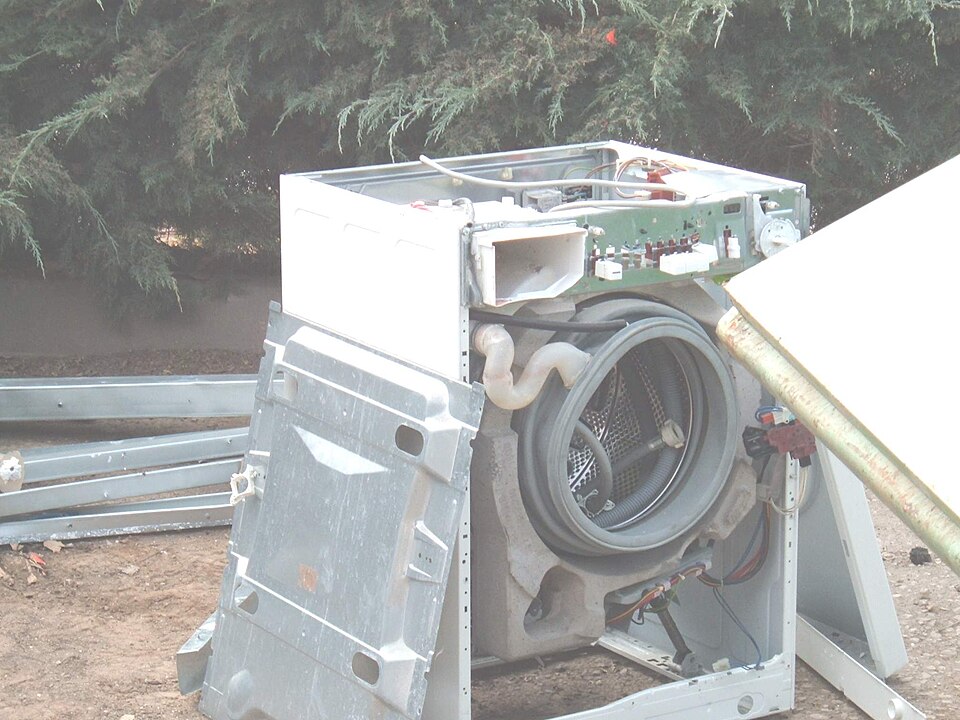
A washing machine with its front off. The drum bearing, the door seal and the drain pump are the parts the reliability surveys find failing. Image: Poo, public domain, via Wikimedia Commons.
The most reliable appliance in an American home is the clothes dryer; the least reliable is the dishwasher. That is the finding of the J.D. Power 2026 U.S. Appliance Reliability & Service Study, which surveys owners of appliances bought in the previous one to three years and counts problems per 100 appliances (PP100). The lower the number, the fewer the failures. Ranked worst first, five categories account for most of the trouble.
-
Dishwashers — 92 PP100. Up from the second-highest rate in 2025 to the highest in 2026. A dishwasher combines a pump, a heater, a fill valve, a drain and a control board in a wet box, and it is the appliance most exposed to hard water and food debris. KitchenAid led the category with 72 PP100 for the second year running.
-
Front-load washers — 91 PP100. One point behind, and the highest of any washer type: top-loaders average 64. The drum bearing, the door seal and the drain pump are the parts that fail, and the 14 per cent of owners who report mould around the seal are reporting a design consequence, not a defect: water sits in the gasket unless the door is left open.
-
French-door refrigerators — 76 PP100. The premium layout is also the least reliable one. Top-mount freezer refrigerators average 59, and the difference is almost entirely the through-the-door ice and water hardware that a French-door model includes by default.
-
Side-by-side refrigerators — 72 PP100. Better than a French-door model and still twice the problem rate of a top-mount. Narrow compartments make the shelving fragile and put the ice maker in the door, where the wiring flexes every time it opens.
-
Cooking appliances — 66 PP100. Wall ovens, ranges and cooktops together. The study singles out control panels and touchpads: 8 problems per 100 among cooking-appliance owners are button or touchpad failures, most often after a spill has dried on the membrane. A mechanical knob cannot fail that way.
Two lessons sit under the table. The first is that connectivity costs reliability: in both the 2025 and 2026 studies, appliances with Wi-Fi and Bluetooth averaged 87 PP100 against 63 for those without, and among owners who actually use the connected features the rate reached 92. The second is that service is a separate problem. Overall satisfaction with appliance service was 743 out of 1,000 in 2026, down 13 points; 88 per cent of customers had a technician arrive on time, and 94 per cent said the visit fixed the fault, which means the machines are repairable even when the experience is poor.