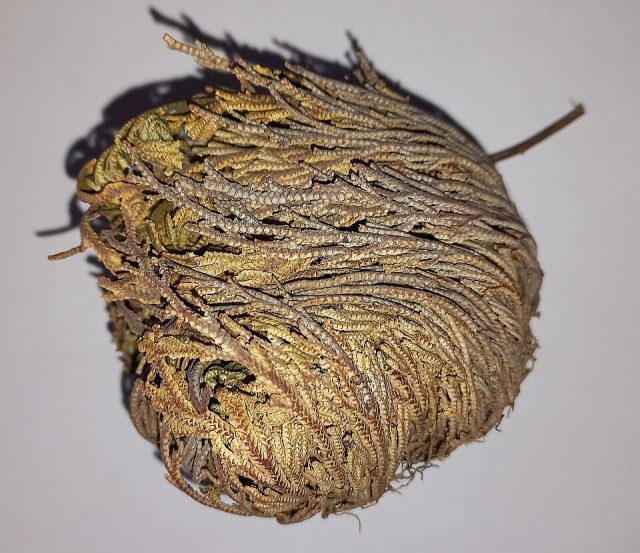
Selaginella lepidophylla, dry and curled. Wetted, the ball unfurls and turns green within hours. Image: Asurnipal, CC BY-SA 4.0.
Seeds survive drying; leaves almost never do. A small group of plants — around 240 to 300 species of flowering plants, plus a few ferns and clubmosses — can dry their leaves to about 10 per cent of their water content, sit in that state for months, and then resume normal growth within hours of rain. They are called resurrection plants, and the list below is the best-studied of them.
-
Selaginella lepidophylla — the false rose of Jericho. A clubmoss from the Chihuahuan Desert, not a flowering plant, and not the true rose of Jericho (Anastatica hierochuntica), which is a mustard relative that rolls but does not revive. Dry, S. lepidophylla curls its fronds into a tight brown ball that can be blown around for years; wetted, it unfurls within hours and turns green. The ball also protects the growing tip from sun and from being eaten. A 2012 metabolomic study found it keeps unusually high levels of sucrose, sugar alcohols and betaine while dry, which is how it keeps its cell membranes from crystallising.
-
Myrothamnus flabellifolius — the only woody one. A small shrub of rocky outcrops in southern Africa, 0.2 to 1.2 m tall, and the only woody resurrection plant known. Its leaves fold fan-like against the stem as it dries, which shades the tissue and limits damage from light while the photosynthetic apparatus is idle. Wet it and the bush turns green within minutes, which is how it got its Afrikaans name, opstandingsplant. It is also used in traditional medicine across the region, and its resin has been studied for the same drought-protective compounds.
-
Xerophyta — the one that throws its chlorophyll away. The Xerophyta species of southern Africa are poikilochlorophyllous: as they dry they dismantle their chlorophyll and thylakoid membranes completely, so the leaves go from green to yellow to brown, and on rewatering they rebuild the whole photosynthetic system from scratch. That costs days rather than hours, but it avoids the oxidative damage that chlorophyll causes when there is no water to use it. X. viscosa and X. humilis are the standard laboratory species.
-
Haberlea rhodopensis — the Balkan survivor. A rosette plant of shady limestone rocks in Bulgaria and northern Greece, and a relic of the flora that covered the Balkans before the last glaciations. It is one of the few resurrection plants that keeps its chlorophyll while dry, so it greens up within hours, and it has been reported to survive up to two years without water — longer than most of its relatives. It also tolerates months of darkness and hard frost, which is unusual even among resurrection plants, and it is the subject of most of the molecular work on the group.
-
Ramonda serbica — the resurrection flower. Another Balkan endemic, in the same family as Haberlea (Gesneriaceae), and the plant that gave the group its common name in Europe: dry in summer, it looks dead on the rock, and after rain the rosettes flatten out and turn green again. Ramonda nathaliae is a close relative from the same limestone gorges. Both are protected, and both are grown by alpine gardeners who value them for exactly the trait that makes them hard to keep: they want to dry out completely between waterings.
The mechanism is a set of protections rather than one trick: proteins that keep other proteins from unfolding as water leaves, sugars that replace the water shell around membranes, antioxidants that mop up the damage light does to a leaf that cannot photosynthesise, and cell walls that fold instead of tearing. The trait is ancestral in seeds and has been re-evolved in leaves at least a dozen times. It is also the reason these plants are studied: a crop that could pause like this would survive a drought that would otherwise kill it, and the genes involved are being moved into tobacco and rice in the laboratory, though not yet into a farmer's field.