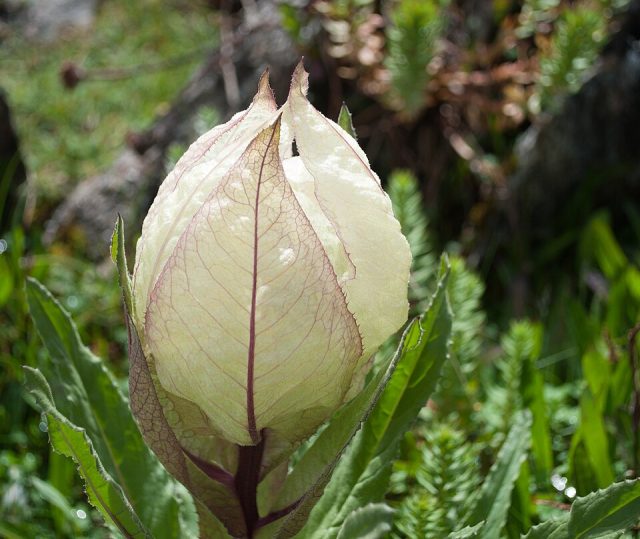
Brahma Kamal (Saussurea obvallata), a Himalayan relative of Saussurea gnaphalodes, one of the five species that share the altitude record at about 6,400 m. Image: Sujay25, CC BY-SA 4.0.
The highest plants on Earth are known from pressed specimens, not from a photograph of a summit meadow. During the 1935 and 1952 Everest expeditions, climbers collected vascular plants at about 6,400 m on both the north and south sides of the mountain. One was identified immediately; the other four sat in herbaria for decades, and a 2018 review by Cédric Dentant in Alpine Botany worked out what they were. Five species now share the record, and this is the list.
-
Saussurea gnaphalodes — the one they knew. A woolly rosette in the daisy family, collected on Everest in 1935 and named at the time. The wool is not decoration: dense hairs trap a layer of still air around the leaf, which cuts the heat loss to the wind and shields the tissue from the very strong ultraviolet light at that altitude. The genus is the highest-reaching group of seed plants on record, with an upper limit of about 6,300 m in the Himalaya.
-
Lepidostemon everestianus — described in 2000. A small crucifer, in the same family as cabbage and wallflowers. It was collected on the 1935 expedition and only recognised as a species new to science in 2000, from a specimen that had been filed away unidentified for 65 years. The delay is the point: at this altitude the plants are a few centimetres across, and telling one from another takes a specialist and a microscope.
-
Arenaria bryophylla — a sandwort. A cushion-forming plant in the carnation family, identified by Dentant from a 1952 specimen. Its name means "moss-leaved", and the comparison is fair: it grows as a tight dome of tiny leaves a couple of centimetres high, which is the warmest shape a plant can make in cold, windy air. A cushion keeps its own growing points a few degrees above the surrounding air.
-
Saxifraga lychnitis var. everestianus — a saxifrage variety. Saxifrages are the classic rock plants of the high Himalaya and the Alps, and this is a variety described from the 1952 collections. The name "saxifrage" means stone-breaker, from the old belief that the plants split rocks; what they actually do is root in the grit that collects in crevices, where the soil is thin, dark and warms quickly in the sun.
-
Androsace khumbuensis — the newest name. A rock jasmine, in the primrose family, also described from a 1952 specimen. It is a tiny rosette that grows in the shelter of boulders on the Khumbu side of the mountain. Like the others on this list, it is a perennial: at 6,400 m there is no time to flower, set seed and die in one season, so the plant survives the winter under snow and grows for a few weeks each summer.
What stops plants at this height is not simply cold. Tissue temperature, the thin air's low carbon dioxide, and the short window between snowmelt and the next snowfall all matter, and above roughly 6,400 m on Everest there is nowhere left for a vascular plant to complete a season. A plant at that limit may be decades old and the size of a coin: growth rings, where they can be counted at all, run at fractions of a millimetre a year. The record is a reminder that the limit of plant life is set by the cost of building tissue, not by the drama of the place.