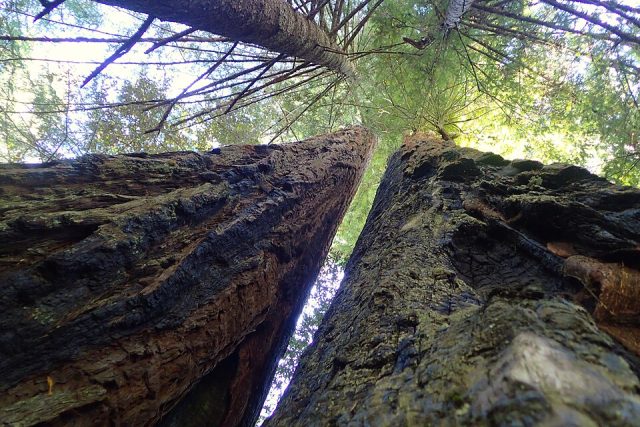
The fibrous, fire-scarred bark of coast redwoods. The species holds the height record; the tallest individuals stand in a handful of groves in northern California. Image: Krzysztof Ziarnek, Kenraiz, CC BY-SA 4.0.
One tree per species, because a list of the five tallest individual trees would be five coast redwoods standing in the same two parks. Heights here are the tallest reliably measured specimen of each kind, measured by tape drop from a climber or by laser from the ground, and averaged between the high and low sides of the ground where the tree grows on a slope. That convention matters: the same Bornean tree reads 100.8 m on one side and 96.26 m on the other.
-
Coast redwood, Hyperion — 116.22 m. The tallest living tree, in Redwood National Park, California, found on 25 August 2006 by Chris Atkins and Michael Taylor. It measured 115.55 m by tape drop that year and 116.07 m in 2019; the 2026 remeasurement stands at 116.22 m. Its trunk is 4.94 m across and its crown begins 90.9 m above the ground, the deepest crown ever recorded. Its exact location is kept secret because foot traffic compacts the soil around the shallow roots. The tree is estimated at 600 to 800 years old — young for its species.
-
South Tibetan cypress — 102.3 m. A Cupressus austrotibetica in the Yarlung Zangbo National Nature Reserve, Tibet, announced in May 2023 by a Peking University-led team that found it with drone and backpack LiDAR and then confirmed the height on the ground. It is the tallest tree in Asia and the only non-redwood reliably measured above 100 m outside a handful of Pacific Northwest conifers.
-
Sitka spruce — 100.2 m. One of four Sitka spruces between 97.7 and 100.2 m surveyed by Steve Sillett and colleagues in 2021, all inside the California redwood parks. The species grows along the Pacific coast from Alaska to California and is the tallest tree in the world outside the redwood belt.
-
Coast Douglas-fir, the Doerner Fir — 99.8 m. In Coos County, Oregon, on land managed by the Bureau of Land Management, with a trunk 3.5 m across. It was found in 1989 and named after a local public servant; it is the tallest Douglas-fir known and the tallest tree in the United States that is not a redwood.
-
Yellow meranti, Menara — 97.58 m. A Richetia faguetiana (formerly Shorea faguetiana) in the Danum Valley Conservation Area, Sabah, Malaysian Borneo, climbed and tape-dropped by Unding Jami on 6 January 2019. The famous 100.8 m figure is the distance to the lowest point of its buttresses; the standard average is 97.58 m. It weighs an estimated 81.5 tonnes above ground, 95 per cent of it trunk, and it is the tallest flowering plant — angiosperm — known.
Records move in both directions. The Australian mountain ash Centurion was measured at 100.5 m in 2018 and had lost about four metres to the 2019 Tasmanian fires by 2025. Older claims of 130 m and 150 m trees are now treated as measurement error, and the tallest redwoods stand close to the height at which water can no longer be pulled to the top: about 130 m is the physical ceiling for a tree of this kind. The five above are the ones that got closest.