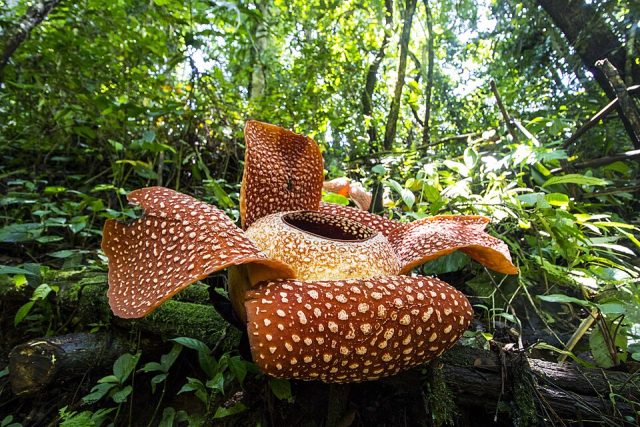
A Rafflesia arnoldii in Bengkulu, Sumatra. The bloom has no leaves or stem of its own: it emerges from the vine it parasitises, stays open about a week and smells of carrion. Image: SofianRafflesia, CC BY-SA 4.0.
"Biggest flower" has two honest answers. A flower is one bloom; an inflorescence is a cluster of many small flowers on one stem, and the two records belong to different plants. The list below gives the largest single blooms first, then the largest flowering structures, and says which is which. Every figure is a measured specimen, not a species average.
-
Rafflesia arnoldii — 111 cm across, up to 11 kg. The largest single flower on Earth, found in January 2020 in a forest in West Sumatra and measured at 111 cm (Guinness World Records). The five fleshy petals can be 1.9 cm thick. The plant has no leaves, stem or roots: it lives as threads inside a Tetrastigma vine and absorbs its host's water and nutrients, then pushes a cabbage-like bud through the bark. The bloom lasts about a week, smells of rotting meat and is pollinated by carrion flies. The common figure of "about a metre" is a rounded average; specimens vary by 20 cm or more.
-
Rafflesia kerrii — 112 cm, the largest bloom actually measured. A flower of this species in Kelantan, Malaysia, was recorded at 112 cm across in August 2007, which is a centimetre wider than the R. arnoldii record. R. arnoldii is still called the largest because its blooms are bigger on average and much heavier; the point of putting both here is that "largest" depends on whether you rank the species or the single widest specimen.
-
Titan arum — an inflorescence 3.2 m tall. Amorphophallus titanum from Sumatra does not have one giant flower; it has thousands of small ones packed onto a spike wrapped in a petal-like spathe. That structure is the largest unbranched inflorescence in the world: 3.225 m at Meise Botanic Garden in Belgium on 13 August 2024, and about 3 m in the wild. It opens for 24 to 48 hours, heats itself to spread the smell of carrion, and grows from a corm that has weighed up to 153.9 kg in cultivation. The plant flowers every few years across a life of roughly 40 years.
-
Talipot palm — an inflorescence 6 to 8 m tall, about 24 million flowers. Corypha umbraculifera, native to India and Sri Lanka, produces the largest branched inflorescence of any plant: a candelabra up to 8 m high and up to 12 m wide above a trunk 20 m tall, carrying an estimated 24 million tiny flowers. Laid end to end, its flowering branches would run about 9 km. The palm grows for 30 to 80 years, flowers once, sets fruit over the following year and dies — a monocarpic plant spending its whole life on one reproductive event.
-
Pelican flower — 10 to 30 cm across, with a tail up to 60 cm. Aristolochia grandiflora is one of the largest flowers in the New World, a vine from southern Mexico to Panama with a heart-shaped bloom that opens at dawn and closes at dusk. The mouth is 10 to 20 cm wide and the point extends into a ribbon-like tail up to 60 cm long. It smells of rotting meat, and downward-facing hairs trap flies inside overnight; the next day the flower sheds pollen on them and lets them go. Each bloom lasts two days.
The single-flower record belongs to a parasite with no leaves, which says something about how the size is paid for: it is built from another plant's sugar. The inflorescence records are a different strategy — many small flowers packed into one advertisement, with the titan arum heating itself and the talipot palm spending decades of stored growth on a single display. Both are measured in metres rather than centimetres, and neither is a single bloom.