Visualized: Increasing Carbon Removal Costs
Carbon removal costs are set to surge as corporate demand rises and new rules tighten supply. Therefore, companies with net-zero goals should act before prices re-rate.
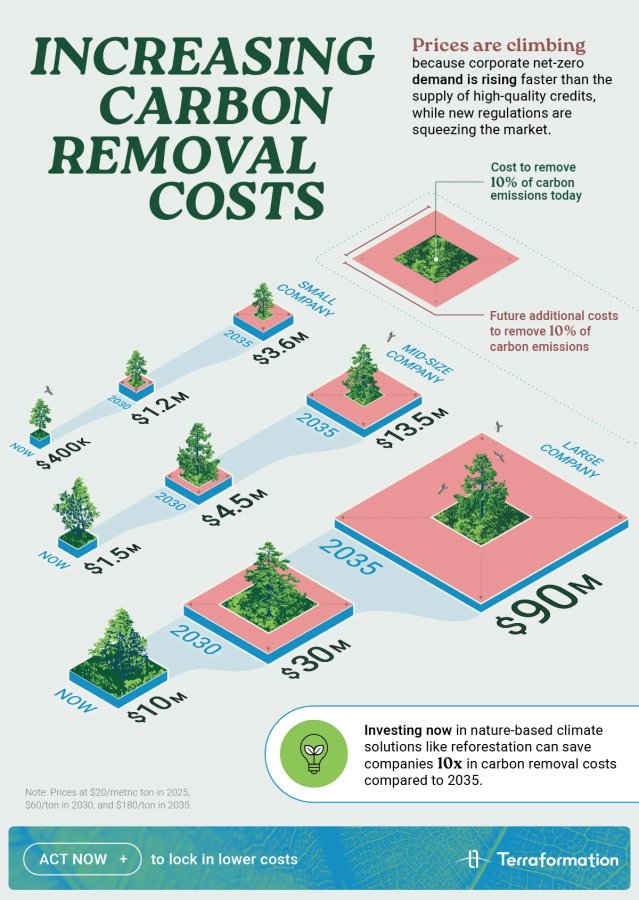
This graphic, in partnership with Terraformation, shows how offset budgets can multiply across company sizes under a plausible price path, using data from BloombergNEF and VanderStyn.
The Carbon Removal Cost Curve Is Steep
At $20 per metric ton today, offsetting 10% of emissions costs roughly $400,000 for a small emitter (200,000 tCO₂e), $1.5 million for a mid-size firm (750,000 tCO₂e), and $10 million for a large one (5,000,000 tCO₂e).
However, at $60 per metric ton in 2030 and $180 per metric ton in 2035, those same allocations rise depending on company size:
| Size of Company | Cost to Offset 10% of Emissions Today | Cost to Offset 10% of Emissions in 2030 | Cost to Offset 10% of Emissions in 2035 |
|---|---|---|---|
| Small Company | $400,000 | $1,200,000 | $3,600,000 |
| Mid-Size Company | $1,500,000 | $4,500,000 | $13,500,000 |
| Large Company | $10,000,000 | $30,000,000 | $90,000,000 |
Prices modeled at $20/ton (2025), $60/ton (2030), and $180/ton (2035).
As a result, delaying purchases multiplies exposure even without changing volumes. Moreover, the modeled price path—$20 in 2025, $60 in 2030, and $180 in 2035—shows why locking supply early matters.
How Companies Can Prepare
Nature-based solutions like reforestation are currently most available, and early procurement can reduce spend by up to 10x versus 2035 scenarios as high-integrity supply tightens.
Therefore, secure multi-year or forward agreements, budget now, and build governance to align with net-zero milestones.
Furthermore, monitor evolving standards so purchased credits remain acceptable across voluntary and potential compliance markets.