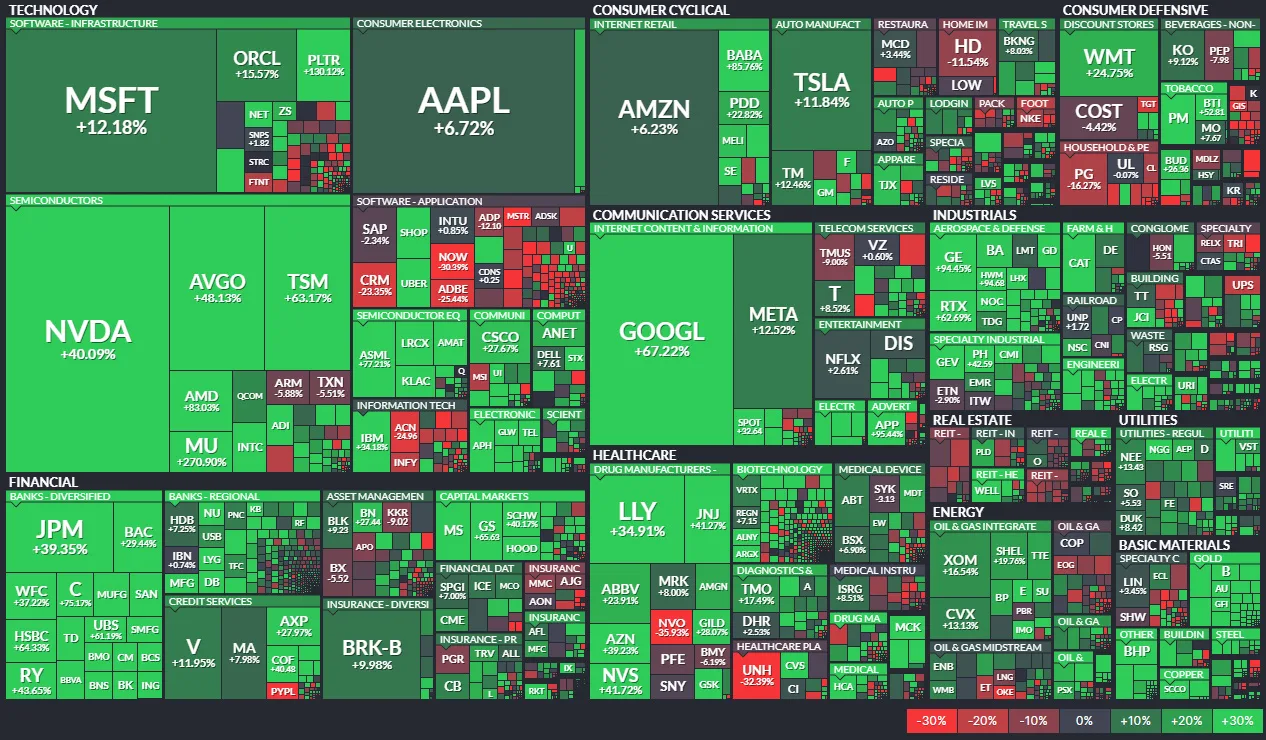
Winners and Losers in U.S. Stocks Over the Last Year
See visuals like this from many other data creators on our Voronoi app. Download it for free on iOS or Android and discover incredible data-driven charts from a variety of trusted sources.
Key Takeaways
- Google was one of the big winners of 2025, beating out the rest of the Magnificent Seven.
- Losers included several prominent sectors, from real estate (REITs) to non-AI software companies.
The above visualization shows a heatmap of U.S. stock performance over the trailing 12 months, inclusive of January 5th, 2026 data.
The heatmap and data come from Finviz.com, a platform we highly recommend for any of your stock market data visualization needs.
U.S. Stock Market: Winners in 2025
Overall, the S&P 500 posted its third straight year with 15% or higher gains. These gains were largely driven by specific sectors that boomed: specifically those tied to AI and the hyperscaling of data centers.
1. Google
In 2025, Google (Alphabet) was the biggest individual winner, completing its redemption arc in the world of big tech. It beat out other Magnificent Seven companies handily with a 60%+ return.
In short: Google surged in 2025 after proving that AI strengthened rather than disrupted its core search and advertising business, with AI-powered results boosting user engagement, ad pricing, and margins. The release of Gemini 3 also helped flip the AI narrative, showing that Google was a leader in the field.
2. Banks
Big diversified banks had a great year, with each bank in the following segment posting double-digit (or higher) gains:
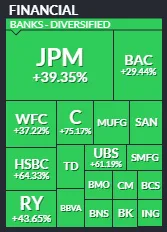
Higher interest rates, a rebound in capital markets, and strong consumer and wealth businesses were all firing at once for banks, creating multiple sources of profit. Their scale and diversification helped offset weaker areas like commercial real estate and outperform more specialized lenders.
3. Semiconductors
As the world races to build out AI infrastructure, chipmakers like Nvidia (+40%), AMD (+83%), TSMC (+63%), and Broadcom (+48%) saw big double-digit gains over the last year.
The biggest winner in this category was Micron (+271%), a leading memory chipmaker. Higher demand and prices for DRAM and high-bandwidth memory drove rapid profit growth and a major re-rating of the stock.
4. Aerospace & Defense
Aerospace and defense stocks rose in 2025 as elevated global tensions, rising defense budgets, and sustained military aid commitments drove strong order backlogs and long-term revenue visibility for major contractors. GE Aerospace (+94%) and RTX (+63%) were two top performers.
5. Gold & Mining
Gold and mining stocks gained in 2025 as central bank buying, geopolitical risk, and expectations of easier monetary policy pushed gold prices to record highs, boosting margins and cash flows for producers.
U.S. Stock Market: Losers in 2025
1. Real Estate (REITs)
REITs struggled throughout the last year as elevated interest rates kept borrowing costs high and pressured property valuations, especially in office and commercial real estate. Higher bond yields also made income-oriented real estate less attractive relative to safer fixed-income alternatives.
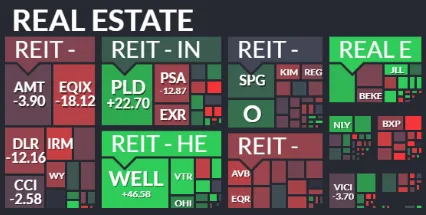
Healthcare facility REITs avoided some of the damage, with Welltower Inc. (+47%) posting some of the strongest gains.
2. Software Applications
Non-AI software stocks lagged in 2025 as investors rotated away from high-valuation growth names toward companies with immediate AI monetization and stronger cash flows.
Flagship examples of this effect can be seen in the stock performance of heavyweights like Salesforce (-23%), Adobe (-25%), ServiceNow (-30%), and SAP (-2%).
3. Oil and Gas (Upstream)
Upstream oil and gas stocks underperformed as energy prices stabilized and production growth limited upside despite ongoing geopolitical risks. Investors also favored capital discipline and shareholder returns over aggressive exploration, muting growth narratives in the sector.
4. Consumer Staples
Considered a defensive sector, it was believed that consumer staples would have a stronger year amid the projected geopolitical and economic turmoil. However, with economic growth getting back on track and inflation easing, hopes were quickly dashed as consumers spent money on more discretionary purchases.
5. Fiserv
Fiserv shares have collapsed 67% over the last year, after earnings disappointed and margins came under pressure from rising costs and intensifying competition in payments and fintech. The company specializes in processing transactions for banks.
Learn More on the Voronoi App 
What do experts see happening in markets in 2026? Check out our annual Prediction Consensus to get the lowdown.