
See more visualizations like this on the Voronoi app.
Use This Visualization
Ranked: The 5 Largest Megacities in 2025, Based on Built-Up Area
See visuals like this from many other data creators on our Voronoi app. Download it for free on iOS or Android and discover incredible data-driven charts from a variety of trusted sources.
Key Takeaways
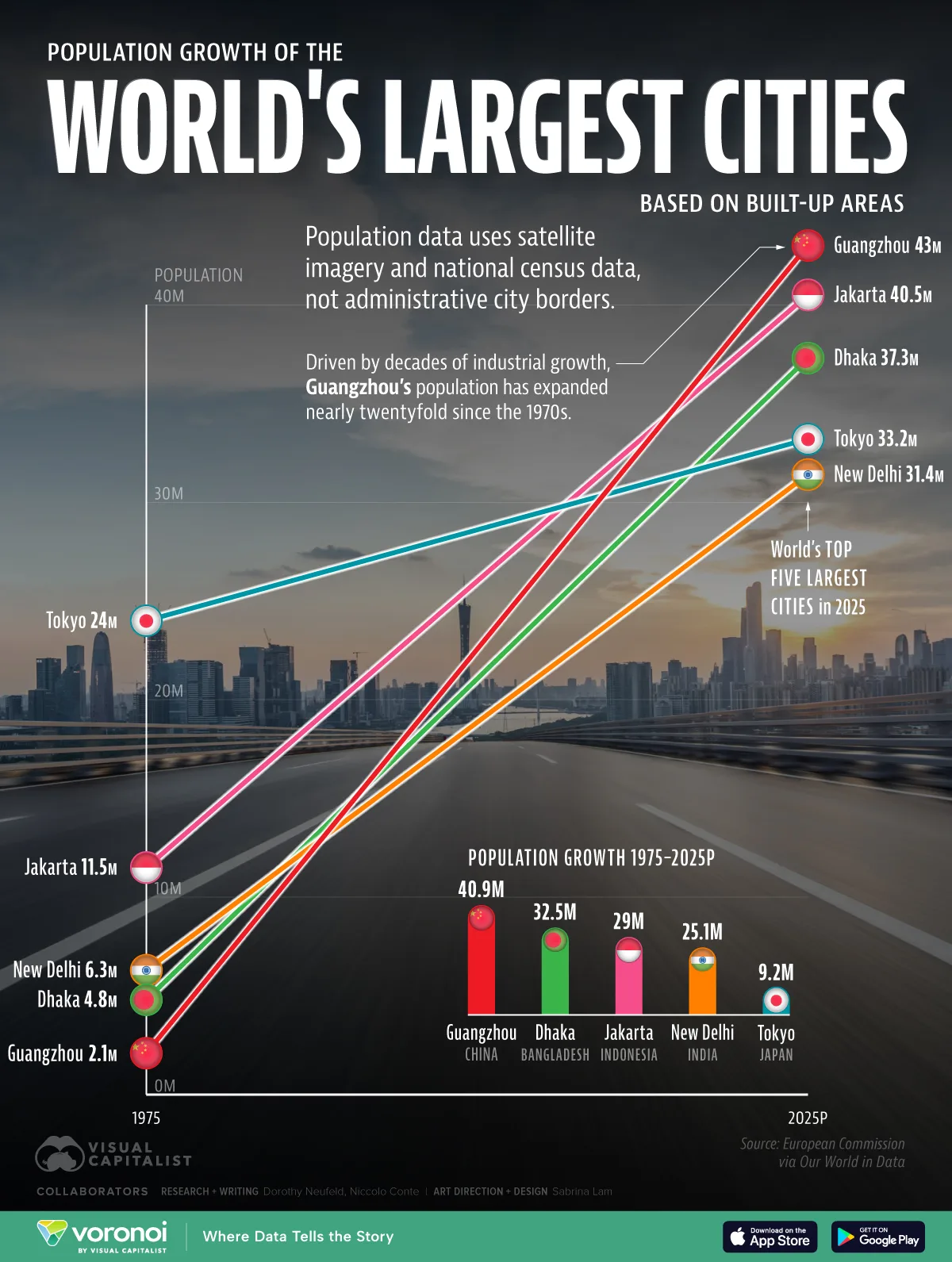
- Since 1975, Guangzhou, China’s population has grown by 1,948%, standing at a projected 43 million in 2025 based on satellite imagery and national census data.
- New Delhi, India has expanded by 398% over the same period, to reach a forecasted 31.4 million this year.
By 2050, 68% of the global population is projected to live in urban centers, up from 55% today.
The world’s largest megacity, when measured by the combination of satellite imagery and census data, is Guangzhou, China. Strikingly, the population has boomed by nearly 20-fold in just 50 years driven by China’s rapid economic rise.
This graphic shows the growth of the world’s megacities, based on data from the European Commission via Our World in Data.
The Rise of the World’s Megacities (1975-2025P)
Below, we show the rise of the top five largest cities worldwide—using satellite imagery and census data—not administrative borders:
| Year | Guangzhou, China Population | Jakarta, Indonesia | Dhaka, Bangladesh | Tokyo, Japan | New Delhi, India |
|---|---|---|---|---|---|
| 1975 | 2.1M | 11.5M | 4.8M | 24M | 6.3M |
| 1980 | 2.9M | 14M | 6.1M | 25.8M | 7.6M |
| 1985 | 3.8M | 16.6M | 7.9M | 27.3M | 9.3M |
| 1990 | 5.8M | 19.3M | 10.2M | 28.7M | 11.8M |
| 1995 | 12.8M | 21.9M | 12.9M | 29.2M | 14.7M |
| 2000 | 27.8M | 25M | 16.1M | 30.3M | 18.2M |
| 2005 | 33.1M | 28.2M | 19.8M | 31.4M | 20.9M |
| 2010 | 36.7M | 31.9M | 23.1M | 32.6M | 23.5M |
| 2015 | 38.9M | 35.2M | 27.7M | 33.2M | 26.3M |
| 2020 | 41.2M | 38.1M | 32.6M | 33.5M | 29.3M |
| 2025P | 43M | 40.5M | 37.3M | 33.2M | 31.4M |
| Growth 1975-2025P: | 1,948% | 252% | 677% | 38% | 398% |
Since 1975, the population of Guangzhou has expanded by 40.9 million. It has the equivalent population of the entire country of Canada.
During the 1990s, the city’s population growth accelerated, driven by trade and industrial activity. Located on the Pearl River Delta, north of Hong Kong, it stands as a key port and transportation hub.
Jakarta, Indonesia’s capital and the economic hub of Southeast Asia’s largest economy, has undergone massive expansion. Its population has surged by 29 million over the past five decades, reaching 38.1 million today.
Meanwhile, New Delhi, India has grown 398%, supported by rising incomes and urban migration. By 2030, the city is expected to gain nearly two million more residents, spanning a population of 33.3 million.
Learn More on the Voronoi App
To learn more about this topic, check out this graphic on the world’s fastest-growing economies.