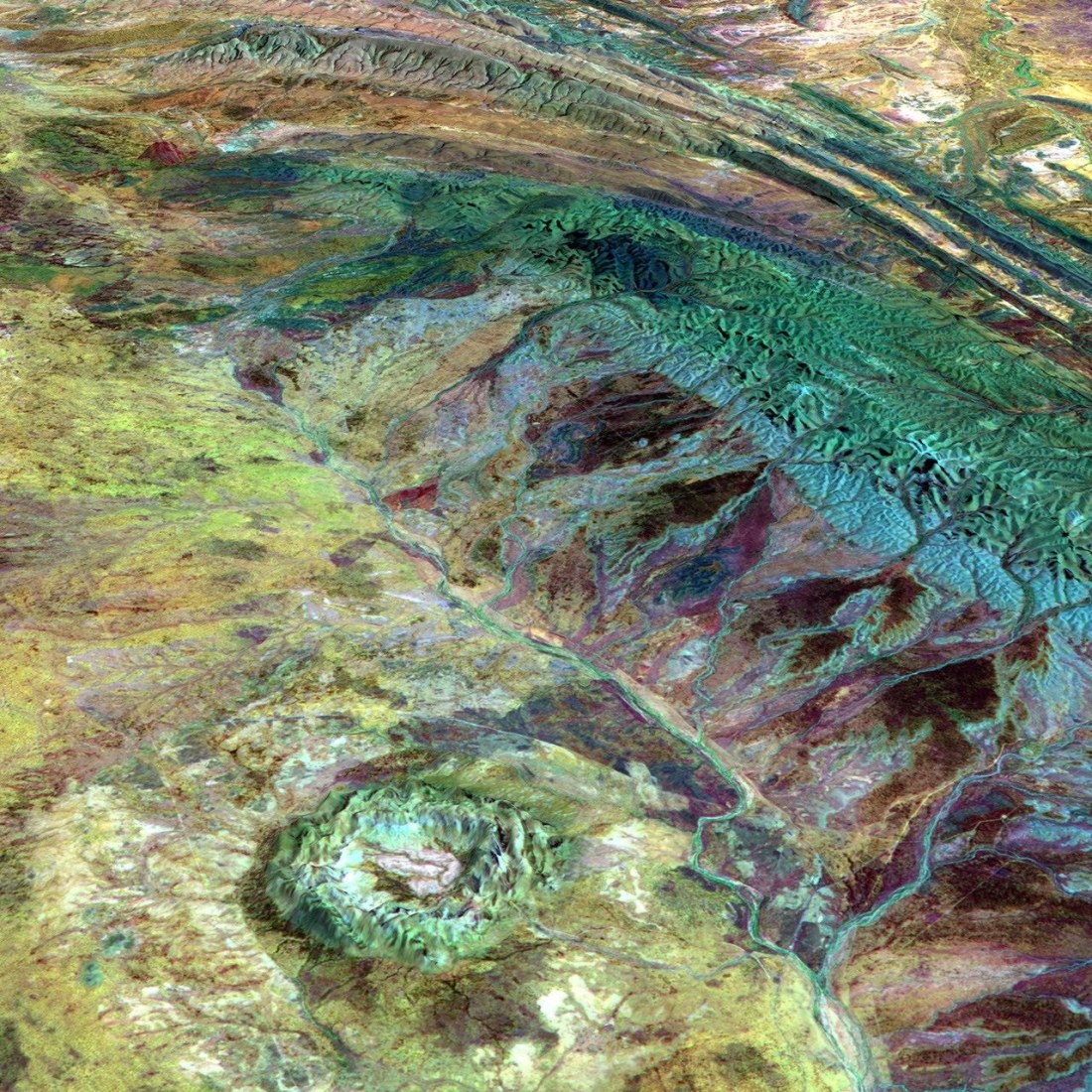
Gosses Bluff in the Northern Territory: the eroded central uplift of a crater formed 142 million years ago. Image: NASA/GSFC/METI/ERSDAC/JAROS and the U.S./Japan ASTER Science Team.
Impact structures are easiest to recognise from above, where a ring of hills, a circular drainage pattern or a colour change in the soil shows up at a glance. These five read most clearly in satellite and space-station imagery, and each has been photographed from orbit.
-
Gosses Bluff (Tnorala), Northern Territory — 22 km. A ring of hills about 200 km west of Alice Springs. The Earth Impact Database gives the structure 22 km and an age of 142.5 million years, though the argon ages behind that date only bracket the impact between about 165 and 383 million years, so the age is a best estimate rather than a measurement. NASA and the USGS describe an original crater about 24 km across and 5 km deep, of which erosion has left the central uplift as a circle of ridges. It is a sacred site to the Western Arrernte, who know it as Tnorala.
-
Aorounga, Chad — 12.6 km. A bullseye in the Sahara, with a rim of resistant sandstone standing above the sand. It is at least 345 million years old, dated from the rocks the impact deformed. Radar data from 1994 suggested that it is the middle of a chain of three craters formed by the same event, with the others buried under sand — a hypothesis only orbital radar could have raised.
-
Manicouagan, Quebec — 70 km ring. The most photographed crater on Earth, and the one most often used to show what an impact structure looks like from orbit. The ring is not the crater rim itself but the shoreline of the reservoir that fills the crater floor, which makes the original structure easier to follow than the eroded rim above it.
-
Ouarkziz, Algeria — 3.5 km. A small, sharply defined ring in the western Sahara, less than 70 million years old. It appears in astronaut photographs as a pale circle against dark rock, and its rim is still high enough to cast a shadow at low sun angles — which is how several craters of this size were first noticed.
-
Tenoumer, Mauritania — 1.9 km. A near-perfect circle in the western Sahara, with a rim about 100 m high and a floor of shocked rock. Its age is unsettled — fission tracks in the melt rock gave 21,400 ± 9,700 years, argon-argon work in 2016 gave 1.57 ± 0.14 million — but it is young either way, and that freshness is why the circle survives at all: older craters of that size in soft rock are usually gone. It was long taken for a volcanic crater until the shocked minerals settled the question.
A crater shows from orbit as a circular feature in terrain that is otherwise not circular. That is easy to see in desert, where sand and bare rock give the rim contrast, and hard in forest or on a continental shelf. A circle is not proof of an impact: every entry here was confirmed on the ground, by shocked minerals, shatter cones or meteorite fragments.