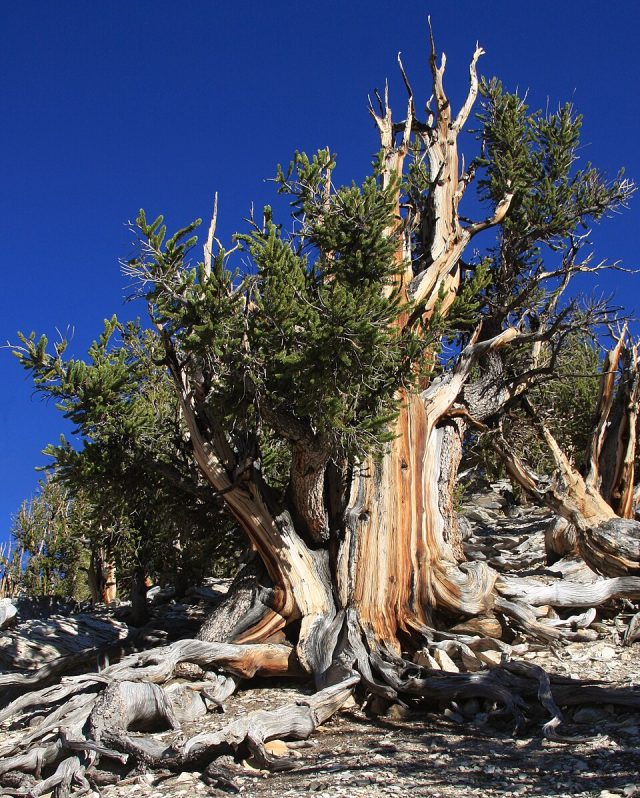
A Great Basin bristlecone pine. Its rings are the calendar against which every other claim of plant age is checked. Image: Dcrjsr, CC BY-SA 3.0.
Plant age is a claim about a method. A tree can be dated by counting rings, a dead stem by radiocarbon, a clone by modelling how fast it spreads — and the last of those produces the largest numbers and the widest error bars. The list below is ordered by the best current estimate for each plant, with the method named. Four of the five are clonal: what persists is a root system or a rhizome, not a trunk, and the visible stems are replaced every few centuries.
-
Posidonia oceanica seagrass, Mediterranean — up to about 100,000 years. A single meadow of the seagrass in the Balearic Islands was estimated at up to 100,000 years old by Arnaud-Haond and colleagues (PLOS ONE, 2012), using the extent of the clone and measured growth rates; some accounts round it up to 200,000. Seagrass is a flowering plant, not an alga, and it spreads by rhizomes under the sand. The figure is a model output, not a date from a sample, and its uncertainty grows with the assumed growth rate.
-
King's holly, Tasmania — at least 43,600 years. Lomatia tasmanica survives as a single population of several hundred genetically identical plants in south-west Tasmania. It is triploid, which makes it sterile: it has never been seen to set viable seed and spreads only by sending up new shoots from underground stems. Fossil leaves from the same site are dated at a minimum of 43,600 years, with the sediments around them no older than 130,000 — so the clone is at least that old, and possibly far older.
-
Pando, Utah — 16,000 to 81,000 years, best estimate 34,000. The quaking aspen colony in Fishlake National Forest is about 47,000 stems on 43 hectares, joined by one root system, with a total mass near 6,000 tonnes. A 2024 genetic study by Pineau and colleagues counted somatic mutations across the clone and estimated 34,000 years, with a range of 16,000 to 81,000 depending on how many mutations the method missed; the paper was posted as a preprint, and earlier estimates of 80,000 years had no such backing. Pollen from a nearby lake shows aspen growing in the area for at least 15,000 years, which fits the youngest end of the range.
-
Jurupa Oak, California — about 13,000 years. A clone of Palmer oak (Quercus palmeri) in the Jurupa Mountains, dated by May and colleagues in 2009 from its growth rate and the size of the grove. It survives by resprouting after fire, which is how a shrub species normally found in cooler, wetter country has held a hot, dry hillside since the last ice age. The visible stems are far younger than the root crown.
-
King Clone, Mojave Desert — about 11,700 years. A ring of creosote bushes (Larrea tridentata) near Lucerne Valley, California, dated by Frank Vasek in 1980 from the ring's diameter and the species' measured growth rate. Individual creosote bushes rarely pass 200 years; the ring is one plant cloning outward, with the oldest wood at its centre long dead. It is the same age, within error, as the start of the Holocene.
The oldest single, non-clonal plant is a different matter: a Great Basin bristlecone pine in California's White Mountains named Methuselah, dated by tree rings at 4,858 years, with another tree in the same range reported at 5,065 years in 2012. Those ages are counted, not modelled — but even they are disputed, because a core can miss the pith and the count then understates the age. Clones win on the numbers; ring counts win on the certainty.