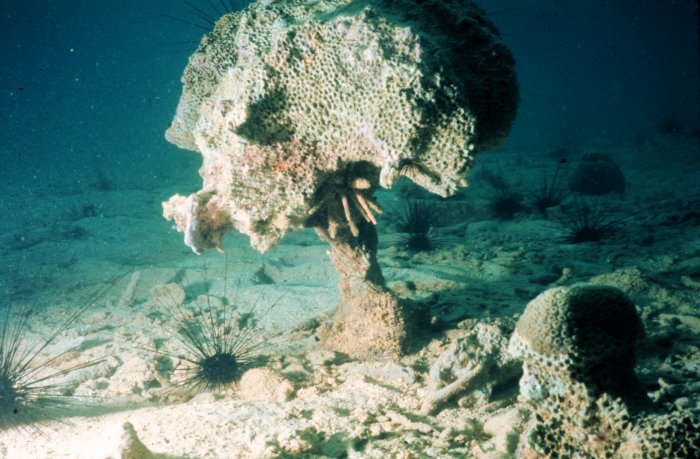
A coral head hollowed by bioerosion, with long-spined urchins below. Reef frameworks are eaten from the inside as well as built; at the deepest reef, light and time, not space, are the limits. Image: NOAA.
Reef-building corals need light, because most of them farm algae inside their own tissue. The depth at which the last of that light runs out sets the floor of the reef, and the corals that live near it are called mesophotic — the twilight zone, roughly 30 to 150 m down. The five below are the deepest records of light-dependent, reef-building corals, each confirmed by a submersible, a remotely operated vehicle or a technical dive.
-
Johnston Atoll — 165 m. The deepest recorded zooxanthellate scleractinian corals, found on the atoll's flanks in the central Pacific. Johnston Atoll sits in some of the clearest water in the ocean, and clarity is the whole explanation: the clearer the water, the deeper the usable light, and the deeper the reef can build. The depth figures below are the ones collected in Kahng and colleagues' 2010 review of mesophotic coral ecosystems, which remains the reference survey for this depth range.
-
Hawaii Island — 153 m. Leptoseris corals, a plating genus that specialises in deep, dim water, recorded at 153 m off the Big Island. Elsewhere in the archipelago the limit shallows with the water: 131 m off Maui, 115 m off Oahu, 111 m off Niihau. The pattern is a temperature effect as much as a light effect — the deep isotherms shoal as the islands run north-west, and the corals follow the light that the cooler water allows.
-
Great Barrier Reef and Coral Sea — 125 m. Leptoseris communities at Day Reef and Yonge Reef, and at Bougainville Reef in the Coral Sea, found by the Catlin Seaview Survey in 2012–2013 and published in 2014. The colonies at that depth are small, under 10 cm across, and attached flat to the substrate. The find mattered because the Great Barrier Reef lagoon averages only about 35 m deep, so its deepest corals sit on the outer reef walls, not in the lagoon.
-
Bahamas — 119 m. The deepest records for the western Atlantic before the Caribbean surveys of the 2010s, from the steep limestone slopes of the Bahamian platforms. The Bahamas are a bank system rather than a barrier reef: the reef grows on the edge of a drowned limestone platform, and the wall drops away fast, which is why the light-limited zone is compressed into a narrow band.
-
Curaçao — 91 m. The deepest zooxanthellate corals recorded in the southern Caribbean, Madracis pharensis colonies on the steep reef slope, found by submersible in a 2015 study. The Caribbean's water is less clear than the Pacific's, so its reefs stop shallower; 91 m is the regional floor, not a global one. The same study found that the deep corals host their own specialised symbionts, distinct from those in their shallow relatives.
Depth records depend on how much of the deep reef has been surveyed: submersibles and ROVs have examined only a few dozen walls worldwide, and the records cluster where those surveys took place. The corals are not rare — Leptoseris plates can cover whole slopes at 100 m — but at that depth the light is about one per cent of the surface, and growth is slow: about a centimetre a year.