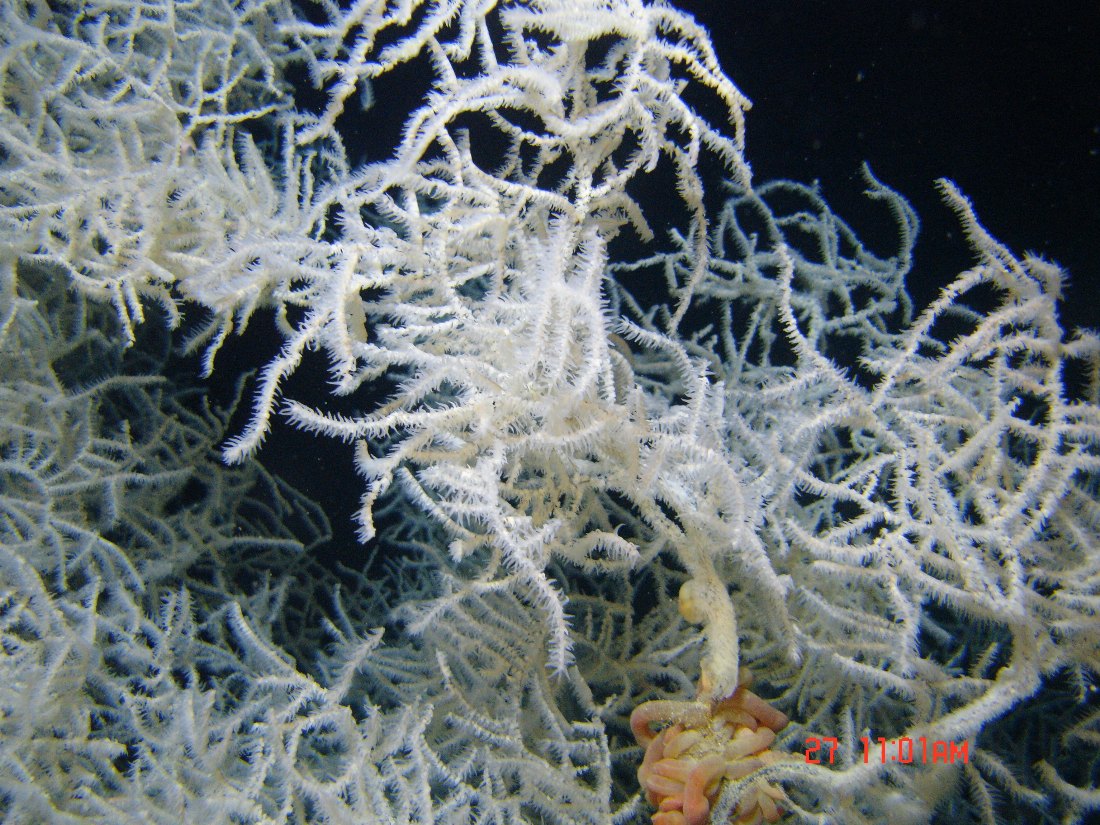
A deep-water coral photographed by a NOAA submersible. The living tissue is replaced continuously; the skeleton beneath it is what carries the radiocarbon date. Image: NOAA.
A coral colony is a skeleton with living tissue on the outside, and the polyps on that surface are replaced continuously. The animal can therefore be far older than any of its parts: radiocarbon dating of the skeleton, not the tissue, is what puts the ages below in the thousands of years. The dated colonies are deep-water species from Hawaii, published by Roark and colleagues in the Proceedings of the National Academy of Sciences in 2009. A later survey has estimated a much greater age for one colony from its size alone, and that estimate is marked as such rather than mixed in with the dates.
-
Leiopathes black coral, Hawaii — 4,265 ± 44 years. The oldest skeletal-accreting marine organism yet dated, a black coral collected live from about 400 m. Its skeleton grew at as little as 4 micrometres a year, which is why it could record four millennia in a trunk a few centimetres thick. The living polyps on its surface are only years old; the structure beneath them is older than the pyramids.
-
Gerardia gold coral, Hawaii — 2,742 years. The longest-lived dated specimen of its genus, and the figure most often quoted for gold coral. Gerardia is a zoanthid rather than a true coral and builds a protein skeleton, which is why it can be aged by bomb-carbon: the spike of radioactive carbon from atmospheric nuclear tests in the 1950s appears only in the outermost fraction of a millimetre, fixing the growth rate independently of any assumption about annual rings. Earlier counts of growth rings had suggested a few centuries, and the correction multiplied the estimate roughly tenfold.
-
Leiopathes black coral, Hawaii — 2,370 ± 35 years. A second colony of the same genus, from the same survey and the same water. That is the useful part of having two: the age is a property of the individual rather than of the species, and a bed of black coral can span several thousand years of recruitment.
-
Gerardia gold coral, Hawaii — 970 years on average. Across the dated specimens, Gerardia colonies average about 970 years and range from roughly 300 to 2,700. That range is what a slow-growing, long-lived species looks like when a handful of colonies are sampled: a few very old individuals, many younger ones, and no way to tell them apart from the surface.
-
Leiopathes, north-west Pacific — about 7,000 years, by estimate rather than by date. A colony 4.4 m wide and 3.1 m tall, found in 2020 at 525 m on a seamount south of Japan and described in Marine Biodiversity in 2024. Its age comes from applying the genus's measured growth rate, about 0.02 mm a year, to the thickness of its base; no radiocarbon date has been run on it, so the figure is an estimate of the colony's age and not a measurement. If it holds, this is the oldest animal colony known.
Age on this scale matters for management: a black coral bed that took four thousand years to grow can be destroyed by a single trawl or a single harvest for the jewellery trade, and it will not regrow on a human timescale. Several countries now manage the beds as habitat rather than as a resource. Shallow-water corals are shorter-lived, usually decades to a few centuries.