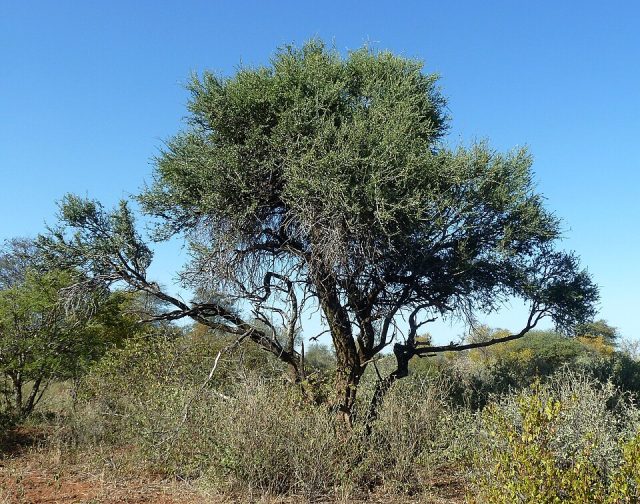
A shepherd's tree (Boscia albitrunca) in South African bushveld. The species keeps its leaves through the dry season on water drawn from as deep as 68 m. Image: JMK, CC BY-SA 3.0.
Roots are the least observable record in botany: you cannot see them from outside, and the only reliable ways to follow one down are a cave, a mine shaft, a road cut or a drill hole. Most of the figures below come from exactly those accidents, and the deepest single number on the list is a calculation rather than a measurement — which is why the text says which is which.
-
Wild fig at Echo Caves, South Africa — 120 m, calculated. A Ficus natalensis growing above the Echo Caves near Ohrigstad, Mpumalanga, is credited by Guinness World Records with roots reaching 120 m. The figure is calculated from the depth at which its roots appear inside the cave system and the distance to the tree, not from a root dug out and measured, so treat it as the largest claim rather than the firmest one. The cave's name is not decoration: the roots hang through the roof of a chamber.
-
Shepherd's tree, Kalahari — 68 m, measured. Boscia albitrunca roots were found at 68 m in deep Kalahari sand in Botswana during groundwater well drilling, reported by Jennings in 1974 and confirmed as the deepest direct observation in the global review by Canadell and colleagues (Oecologia, 1996). The tree above ground is often under 10 m tall. It keeps its leaves through the dry season because it is not depending on rainwater at all.
-
Camel thorn, Kalahari — 60 m, measured. Vachellia erioloba (formerly Acacia erioloba), the same survey and the same sand. The two Kalahari trees are the deepest-rooted pair ever recorded, and their depth is a property of the ground as much as the plants: deep, loose sand lets a root go down without hitting rock, and the water table is far below the surface.
-
Mesquite, Sonoran Desert — 53 m, excavated. Prosopis juliflora roots were followed to 53 m in a mine shaft in the Sonoran Desert by Phillips in 1963, still the deepest root excavated and measured in the Americas. Mesquite is not a desert specialist by constraint: given water near the surface it roots shallowly, and the same species will send a taproot dozens of metres down when the only water is deep.
-
Jarrah, Western Australia — 40 m. Eucalyptus marginata is the deepest-rooted tree in the 1996 global compilation, with roots recorded at 40 m in the laterite of the Darling Range. Jarrah forest survives a Mediterranean climate with a five-month drought by tapping groundwater far below the surface; the same depth is why bauxite mining there has to think about recharge as well as the ore.
The 1996 compilation counted 290 observations across 253 species: the average maximum rooting depth was 4.6 m, only 22 species reached 10 m, and the deepest biomes were savanna (15 m on average) and desert (9.5 m). Deep roots matter beyond the individual plant — they move water and carbon between layers that climate models often treat as separate — but they are also the hardest part of a plant to survey, which is why the record list is short and why one of its five entries is an estimate.