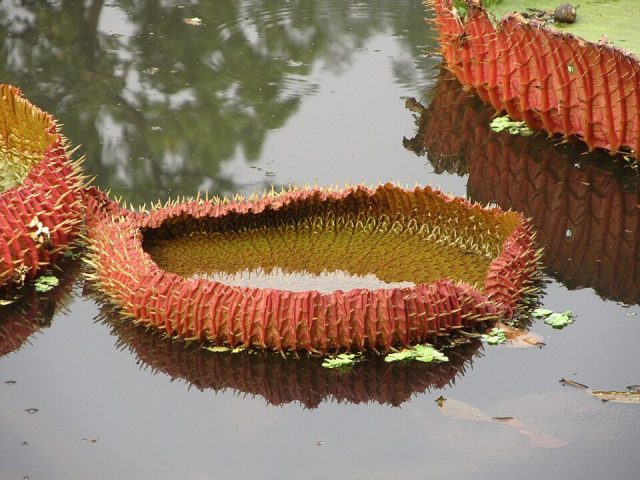
Giant waterlily pads in the Indian Botanic Garden, Howrah. The upturned rim and the ribbed underside are what let a leaf three metres across hold its shape and float. Image: Biswarup Ganguly, CC BY-SA 3.0.
A leaf can be big in three different ways: long from stalk to tip, wide across a single undivided blade, or large in area. The records do not line up, because a palm frond 25 m long is mostly leaflets on a stalk while a waterlily pad 3 m across is one sheet. This list ranks by the length of the whole leaf and gives the area where it is the more meaningful measure.
-
Raphia regalis — a frond 25.91 m long. The largest leaf ever measured, recorded by the botanist Francis Hallé in the Republic of the Congo in 1977: 16.47 m of blade on a 9.44 m stalk, with about 180 leaflets on each side of the rachis. The palm's trunk stays underground and rarely exceeds a metre, so the whole plant is a fountain of these fronds rising out of the forest floor. It is threatened by habitat loss across its west African range.
-
Manicaria saccifera — leaves up to 8 m. An Amazonian palm whose fronds are among the longest of any palm with a nearly undivided blade; the leaf is split only shallowly at the tip. It grows in swamp forest and along blackwater rivers, where the huge blade has to shed tropical rain without tearing, and the species is used locally for thatch and fibre.
-
Joey palm — an undivided leaf 4 m long. Johannesteijsmannia altifrons grows in Thailand, Malaysia and Sumatra and produces a leaf that is genuinely one piece, diamond-shaped, up to 4 m long, with no midrib division at all. It is the standard answer to "largest undivided leaf" and a popular conservatory plant for exactly that reason.
-
Titan arum — one leaf 4.7 m tall, about 3.2 m² of area. In the years between flowerings, Amorphophallus titanum grows a single compound leaf on a mottled stalk as thick as a person's thigh, branching into three sections at the top like a small tree. The leaf is the plant's whole photosynthetic surface for that year; it dies back and the corm stores what it made. The leaf and the inflorescence never exist at the same time.
-
Giant waterlily — a pad up to 3 m across, 4.6 m². Victoria amazonica floats circular leaves with upturned, spiny rims on a stalk up to 8 m long. A pad can add half a square metre a day, and the record at Kew in 1995 was 2.5 m across. The leaf's strength comes from a ribbed underside that traps air; with a board to spread the load, a pad has carried 226 kg. It is the largest leaf by area that most people will ever stand next to.
Size costs. A big leaf has to be supported, supplied with water and defended, which is why the largest ones grow where there is little wind, plenty of water and often deep shade — rainforest understorey palms, swamp forest, still water. The Raphia frond is the extreme case, and it is not a single blade but a leaf built like a feather: long, light and cheap to hold out sideways.