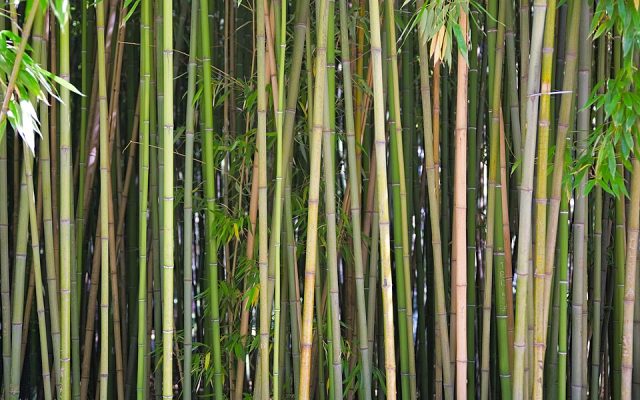
Bamboo culms in the Botanical Garden of the University of Vienna. A bamboo does not grow wider after it emerges; it extends from nodes already formed inside the shoot. Image: D-Kuru, CC BY-SA 4.0.
"Fastest" means three different things here: how much taller a stem gets in a day, how much mass a plant adds, and how quickly it covers open water. The entries below hold the records in those three senses, and the fifth is a brown alga rather than a plant — giant kelp is in every such list, and the text says so rather than quietly leaving it out.
-
Bamboo — up to 91 cm in a day. Guinness World Records gives the fastest-growing plant to certain species among the roughly 1,000 bamboos: 91 cm (35 in) a day, which is about 3.8 cm an hour around the clock. The trick is that a bamboo culm is not built the way a tree is. It emerges at close to full diameter with its segments already formed and then extends from each node, so a season's growth is one long unfurling rather than a century of rings. The tallest tropical bamboos reach about 40 m.
-
Kudzu — about 30 cm a day, 18 m a season. Pueraria montana is the vine that earned the nickname "mile-a-minute" in the southern United States. Extension services put it at roughly one foot (30 cm) a day in early summer and up to 60 feet (18 m) of vine in a single season, with mature vines up to 30 m long. It climbs by twining, roots at the nodes and stores enough starch in a taproot up to 12 feet deep to resprout after cutting. It was introduced from Japan as an ornamental in 1876 and planted for erosion control from the 1930s to the 1950s; the same vigour is why it now covers more than 3 million hectares there.
-
Water hyacinth — biomass doubling in about 8 to 34 days. Eichhornia crassipes, a floating South American plant, adds mass faster than almost any other freshwater plant when nutrients are plentiful. Field measurements at Mexican reservoirs by Gutiérrez and colleagues (2001) gave doubling times from 8.4 days in summer to 34.7 days in winter; a 2021 mesocosm study in Indonesia measured 9.6 to 10.8 days, and a single 160-gram clump covered a square metre in three weeks. That is why it blocks waterways across the tropics — and why it is studied as a biomass crop.
-
Duckweed — biomass doubling in 2 to 4 days. The duckweeds (Lemna, Wolffia and relatives) are the smallest flowering plants: a Wolffia plant is a green speck about a millimetre across. Under good light and nutrients the colony doubles its biomass every two to four days, covering a pond in a week or two. A 2025 review of the family calls them the fastest-growing angiosperms on Earth. They are also about 35 per cent protein by dry weight, which is why they are studied as feed and food.
-
Giant kelp — up to 60 cm a day, and not a plant. Macrocystis pyrifera can add two feet of stipe a day and reach 45 m in a single growing season, faster in length than any plant on this list. It is a brown alga, in the same broad group as diatoms, not a vascular plant; it has no roots, no flowers and no wood. It is included because the record is always compared with bamboo, and because the comparison is instructive: the kelp is growing a long, thin, cheap structure in moving water, while a tree is building something that has to hold itself up for centuries.
Growth rate falls as a plant gets big. Bamboo adds its 91 cm while the culm is still soft and short; the same plant adds almost nothing to its diameter afterwards. A mature giant sequoia, by contrast, puts on about a cubic metre of wood a year — a slow number that compounds for two thousand years. The records above are all about the burst, not the total.